The African House Snake - Natural History
Introduction and description
The African House Snake is small to medium-sized colubrid snake from Africa. Although it is commonly called the "African" House Snake in the herpetocultural community, there are at least ten other species in this genus found on the continent. (There is also an Arabian species and one endemic to the Seychelles).
I am no expert on House Snake taxonomy. A few authors still place this species in the genus Boaedon, but I will use the more widely accepted classification of all house snakes into the genus Lamprophis. The classification of the snakes within this genus has been a matter of some conjecture since their original description, and remains controversial today. For simplicity, I prefer to regard all the "Brown" House Snakes as one species. (If you have an informed opinion about this, please feel free to email me.)
These are the currently accepted taxa for this genus. I have added
English common names to those for which I could find one. Note that some
of these common names are difficult to apply in the perspective of the whole
genus (e.g - L. olivaceus is not the Olive House Snake).
Lamprophis arabicus
Lamprophis aurora - Aurora House Snake
Lamprophis erlangeri
Lamprophis fiskii - Fisk's House Snake
Lamprophis fuliginosus - Brown House Snake (aka African House
Snake)
Lamprophis fuscus - Yellow-bellied House Snake
Lamprophis geometricus - Seychelles House Snake
Lamprophis guttatus - Spotted House Snake
Lamprophis inornatus - Olive House Snake
Lamprophis lineatus
Lamprophis maculatus
Lamprophis olivaceus
Lamprophis swazicus - Swazi Rock Snake
Lamprophis virgatus
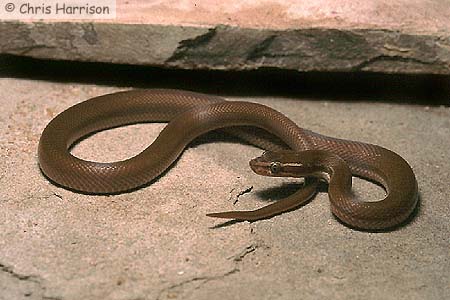
Lamprophis fuliginosus is a highly variable snake. It can be unicolored, spotted, or even striped. Many individuals are spotted as hatchlings and become unicolored as adults. Some adults retain this spotting on the anterior part of the body. As the common name suggests, they are often brown, ranging from tan to deep chocolate brown. However, they can also be olive-green, dark-green, orange, brick-red, or even black (in fact, the specific epithet fuliginosus comes from a latin word meaning "black" or "soot"). The ventral scales are pearly white and the whole snake has an iridescence that rivals even such snakes as the Rainbow Boa (Epicrates cenchria).
Most L. fuliginosus have a distinct light stripe on each side of the head from the rostrum to the back of the head. The presence or absence of this stripe has been used to taxonomically distinguish certain populations in the past, but is now simply regarded as part of the snakes geographic variation. Some individuals have very broad head stripes, which gives the head a very "boxy" appearance.
Range
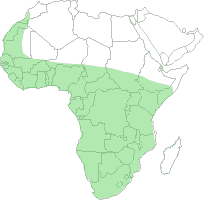
The African House Snake is one of the most common and widespread snakes in Africa. It is found on the whole continent south of the Sahara desert, from Ethiopia and Sudan in the east, west to Senegal, and north to Mauritania and Morocco. It is so common in some areas that its absence from an area is more noteworthy than its presence.
The map to the right shows the approximate range of the species in Africa.
Habitat
This snake gets its common name from the frequency with which it is found around human dwellings, where it feeds on the rodents that usually live there. However, this species is not restricted to areas around human habitation. Through its extensive range, the African House Snake is found in a variety of habitats ranging from scrubland, woodland, savannah and high grassland from sea level to almost 8000 ft. (2400 m.) elevation. It avoids true desert and heavily forested areas.
Adult size
African House Snakes are highly sexually dimorphic in size. Females attain larger adult size than males. Adult male L. fuliginosus rarely exceed 3 feet in length, while adult females can exceed 5 feet. On average, an adult male captive born and raised house snake is between 24 and 30 inches (60-75 cm) while females typically range from 3-4 feet (90-120 cm).
Although they can attain almost 5 feet in length, House Snakes are slender snakes. A large heavy bodied female would rarely exceed 500 grams whereas the smaller males rarely exceed 200 grams.
House Snakes can attain sexual maturity quickly and at surprisingly small sizes in captivity. See the reproduction page for more on growth and maturity.
© Chris Harrison
|