RSS
Featured Contributor
Featured Contributors to kingsnake.com
By kingsnake.com · December 21, 2025
THANK YOU
It’s been amazing welcoming you all back to the site. We’re exceptionally grateful you spend your time with us.
We’ve now made it easier for you to get assistance when you can’t use Kingsnake to the fullest.
Read full article
By Cindy Steinle · December 15, 2025
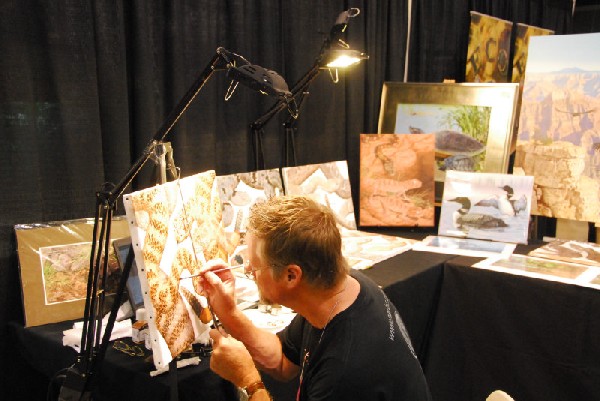
Tell Hicks, doing what he did best, painting reptiles at NARBC. Photo by Cindy Steinle
The reptile community lost one of our great leaders this Friday when artist Tell Hicks passed away. Tell was always a great friend to kingsnake.com and to me.
Read full article
By Cindy Steinle · December 5, 2025
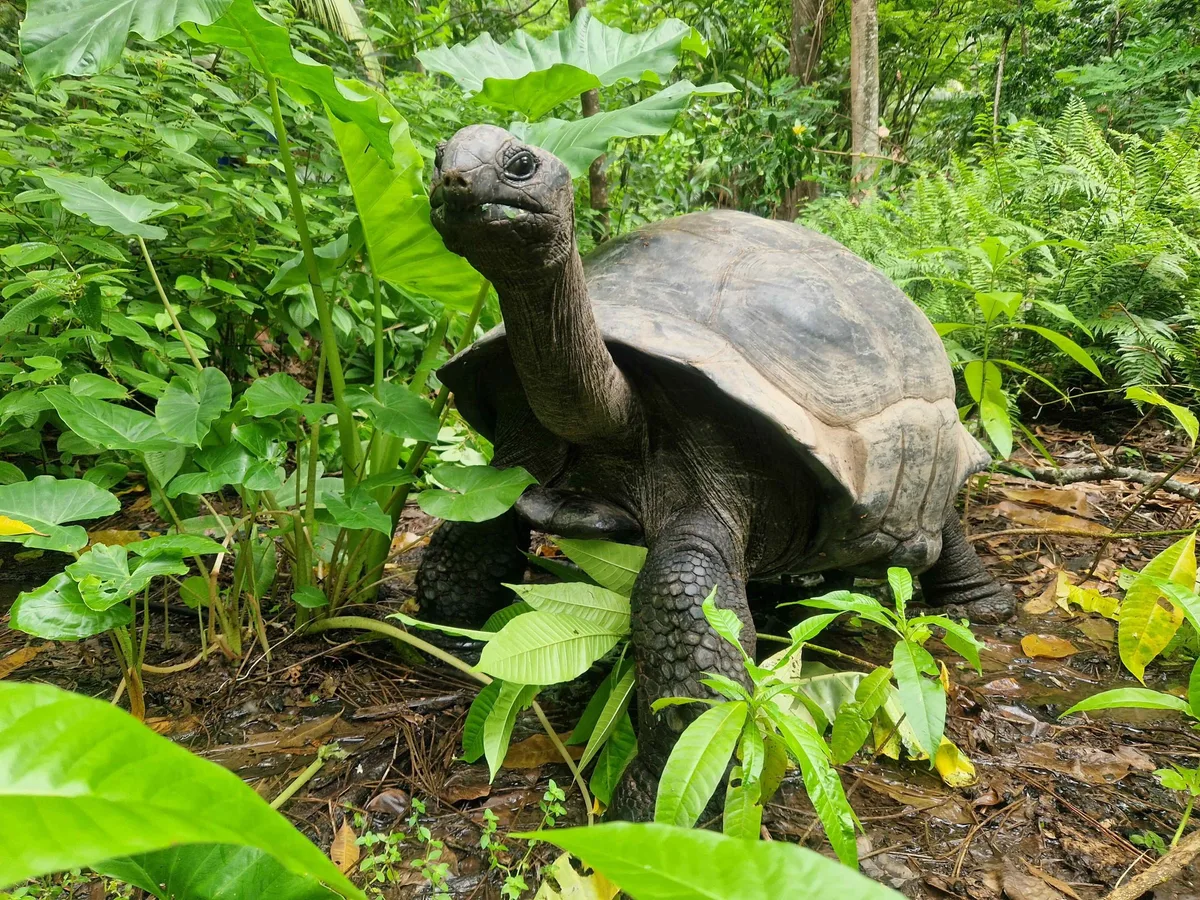
Aldabra giant tortoise foraging for food in a forest on North Island, which is part of Aldabra – the world's second-largest coral atoll. Credit: Rich Baxter/IOTA Seychelles
In 1997, North Island located in the Seychelles was purchased by private investors for ecotourism and rewilding. Today, that venture took 200 heavy steps forward as 50 Galapagos tortoises were released to the island to roam free again as they did once before. Many of the tortoises were actually pets surrendered for the joint project with Indian Ocean Tortoise Alliance (IOTA) and North Island Environment Department.
Before the tortoises left Mahé, they were microchipped for the national tortoise census and fed only native leaves to prevent the spread of invasive plant species via their droppings. They underwent two quarantines, one in Mahé and one on North Island, before taking their first steps into their new wild home.
Now, every day, they walk a little farther and explore a little more. “After months of planning, seeing them walk free was incredibly rewarding,” says IOTA assistant project officer Santosh Albert.
Read full article
By Jon Poff · December 3, 2025
Kingsnake has been under new ownership for just shy of 4 weeks and what a ride it’s been.
Read full article
By PHNajak · November 28, 2025
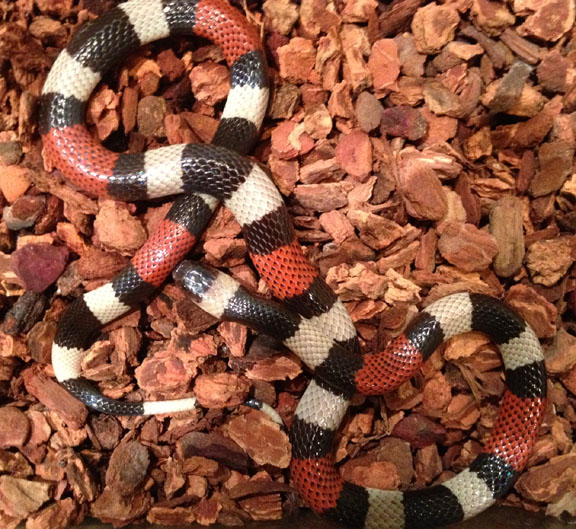
photo by kingsnake.com user MXHerper of a coral snake Micrurus laticollaris
We all know the rhyme, the one that has caused consternation to many an experienced herper but is just so catchy it sticks around. Red touch yellow, kill a fellow, red touch black, venom lack. Variations occur, but all of them are equally flawed. Plenty of highly venomous coral snakes across the western hemisphere fail to pay heed to that little saying, how rude.
Read full article
By Cindy Steinle · November 13, 2025
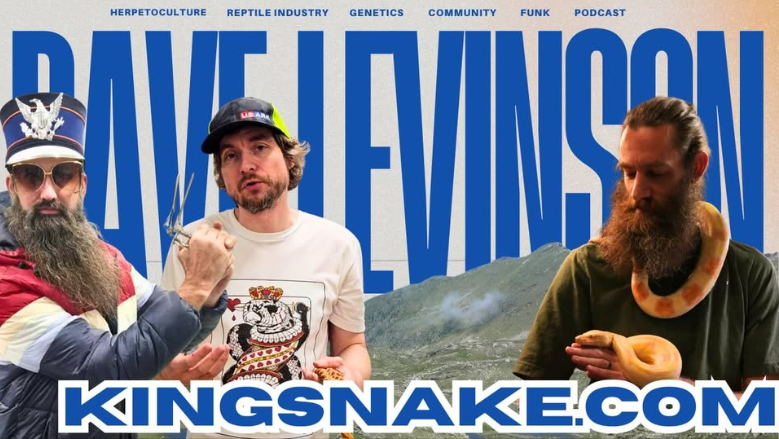
On Friday November 14 at 9 pm EST, our new owner, Jon Poff will be sitting down with David Levinson and Jeff Galewood of JMG Reptiles to talk about what is coming our way with the future of kingsnake.com on the Trap Talk Reptile Network!
This will be a live podcast with an open chat that you can ask questions in and steer the conversation. I will be joining along in chat and if possible I will help answer any questions too!
We hope you can join us live! Just click
here to do it! Remember 9 pm EST Friday!
By Jeff Barringer · October 21, 2025
In 1995 I, along with some other reptile enthusiasts (Joe Forks,Gerry Salmon, Troy Hibbitts, and others) created a web page for gray-banded kingsnake hobbyists called The Alterna Page. By 1997 one thing led to another and it had morphed into what today is kingsnake.com.
That marks 30 years building and maintaining web communities for reptile hobbyists around the world. That is almost half my life. But all good things eventually must come to an end and after discussing it with our sponsors and staff I have concluded it is time for me to retire to pursue other things in my life, and for kingsnake.com to retire as well.
I want to thank kingsnake.com's primary sponsors, LLLReptile.com and RodentPro.com, along with the staff, Cindy Steinle, Melody Golubski, Mark Kennedy, Gerry Freymann, Dick Bartlett, and Ted Hatfield who volunteered his time looking after our servers. Special thanks go to Christie Keith. It is because of their dedication that kingsnake.com has lasted so long. As well there are literally thousands of other advertisers and community members that made kingsnake.com the place to be for herpetologists and herpetoculturists during its great years, from 1999-2016, when some would say the reptile culture was at it's peak. I met many of these thousands of people at countless reptile expos and consider many of them my friends.
Along the way kingsnake.com pioneered many new things for the reptile community and industry, such as topic/species based message boards (forums), live chat symposiums, reptile blogs, podcasts, and video interviews. Many of the fights in the forums were epic.
Most remembered will be kingsnake.com's classifieds, for many years the Internets most popular reptile and amphibian sales tool. It helped turn a random group of like minded hobbyists into a real industry. At it's peak there were over 2200 active classified accounts.
Officially kingsnake.com will close down on October 31,2025. If you have your pictures on the site, or forum posts or other content that you want to save, please do so now, they will not be available on our systems after October 31. If you have a paid classified or other advertising account your account services will still be functional until October 31, or when your contract runs out if sooner.
If you would like to continue to post classified ads until the close date of October 31,2025 please feel free to register for a free classified account and post away. We will be disconnecting our advertising purchase system this week.
Though we are closing we are not filing bankruptcy. We go out clean, all our debts settled and all our bills paid. And if someone is interested in continuing kingsnake.com's legacy I will entertain offers until October 31
This has been a very hard decision, but it is the right one, and it is the right time. I will miss being an integral part of the reptile hobby and culture.
- Jeff Barringer
By Richard Bartlett · June 10, 2024
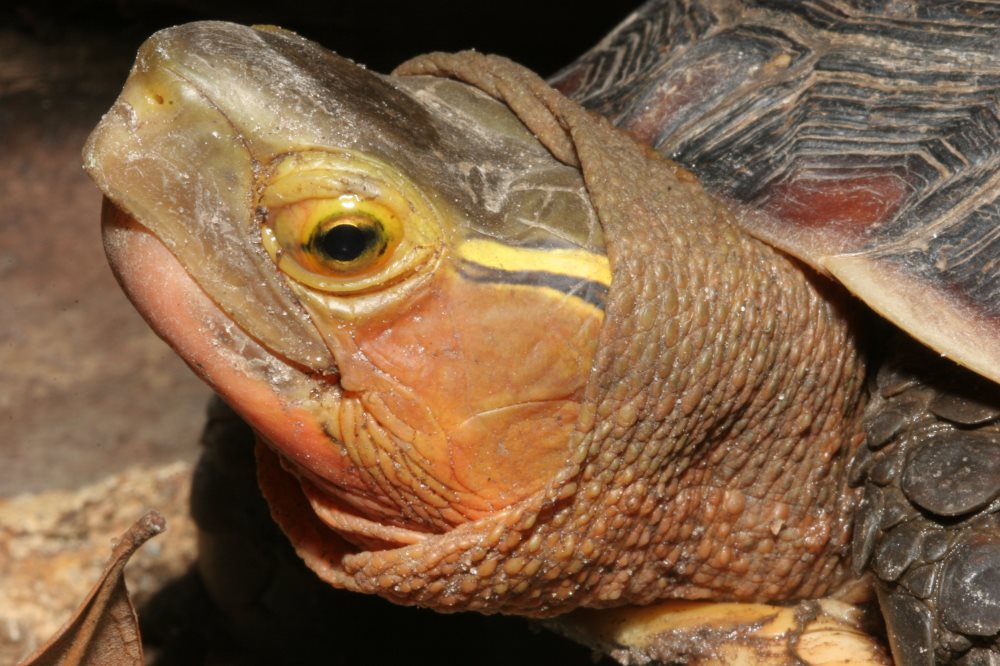
Note the yellow temporal line on this adult Chinese Box Turtle
At this point in time it has become difficult and quite expensive for hobbyists to acquire Asian herps, turtles included. Even prior to importation difficulties, hatchlings of several turtle species in the genera Cuora and Cistoclemmys were being priced by breeders in the many hundreds and even thousands of dollars each. Today (2024) the prices of many taxa are even higher.
Fortunately though, a few of the species that can still be imported and/or that are easily bred remain almost affordable. One of these, long a favorite of hobbyists (me included) is Cuora flavomarginata and is known to most as the Chinese Box Turtle. The 3 subspecies are divided between China mainland, Taiwan, and Japan. The subspecies, all remarkably similar in external appearances, are C.f. flavomarginata from Taiwan, C.f. sinensis from southern mainland China and C. f. evelynae from Japan.
Like the American Box Turtles its carapace is highly domed and the turtle has a very functional plastral hinge. The carapace may vary in color from dirty olive to black, with the latter being the more common. There is a yellowish vertebral stripe and the marginal scutes are a combination of dark and light pigment. The skin atop the head and on the limbs and tail is a dark charcoal, occasionally with pale olive overtones, The crown is separated from the pinkish cheeks by a prominent yellow bar on each side. All colors are at their brightest when the turtle is in breeding condition. Both males and females attain a straight measure of 5” (rarely to 6”).The external differences between male and female C. flavomarginata are slight. Males have a broader (but not much longer) tail than females. When extended the male’s tail is almost triangular in shape.
Like many terrestrial turtle species, the Chinese Box Turtle is omnivorous. Moistened tortoise diet, canned pet food, fresh succulent fruit, insects and worms are all accepted eagerly by most captives.
Summarizing, the common name given this turtle is quite descriptive, although not brightly colored they are pretty, personable, longlived, and proving that they are easily kept, some of mine have been captive for 40+ years.
Read full article
By Richard Bartlett · June 3, 2024
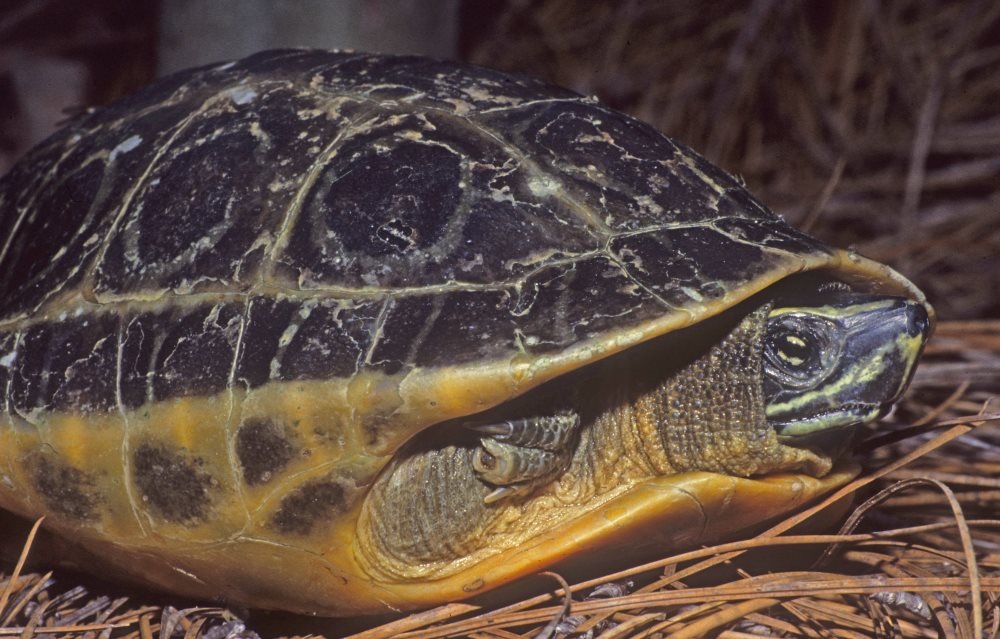
This is the seldom seen Indian Eyed Turtle. Note the dark smudges on the bridge plates.
Morenia petersi, the Indian Eyed Turtle, a Geoemydid species, was once available to American hobbyists, but this seems no longer the case.
Like its very closely related Burmese relative, M. ocellata, it is also known as the Swamp Turtle. It seems at home both in and out of the water. Adult size for females is about 8 inches. The smaller males are adult at 4 to 5 ½ inches.
Diet is said to consist of both plants and carrion.
This interesting but rather poorly known turtle has a black carapace with a light ocellus on each plate including the vertebrals, a yellow-orange plastron, and a black head with 3 yellow facial stripes on each cheek. The yellowish bridge plates bear darker smudges.
Wild females nest about half way through the dry season. Each clutch consists of 5 to 9 eggs. Incubation seems to be about 70 days..
M. petersi is found in northeastern India and in Bangladesh.
Read full article
By Richard Bartlett · May 27, 2024
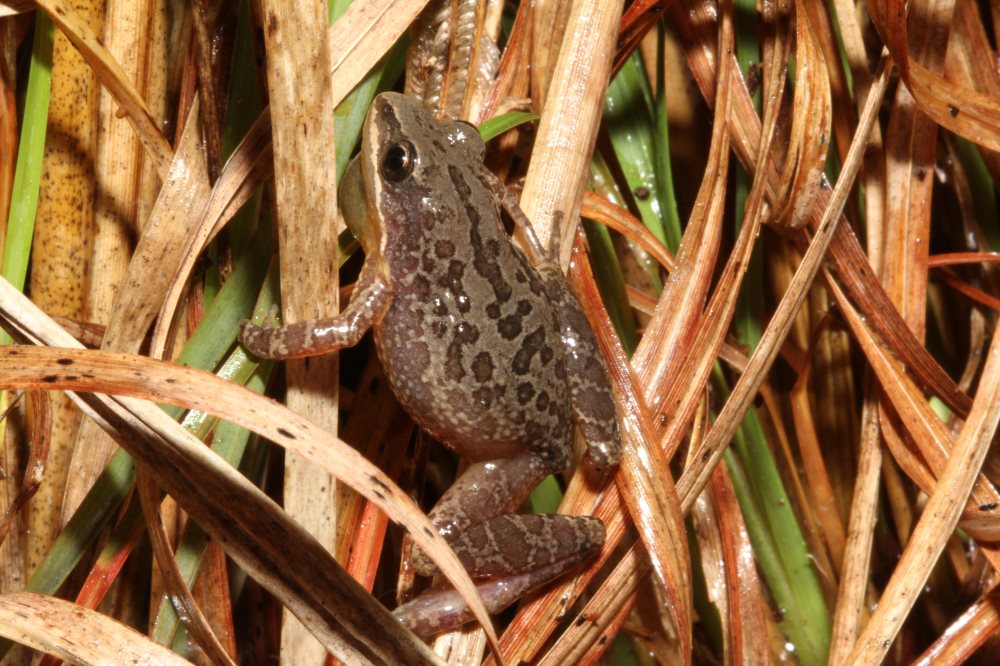
Southern Chorus Frog, once abundant but now seemingly less so.
Well, it was not really spring but 22 February 2024 was a fairly decent northcentral Florida day. The high had been about 73F and the low was forecast about 10 degrees cooler. Not bad. But then I remembered that the herping spot I was thinking about was about 100 mile further north, so I subtracted 3 or 4 degrees, thought for a minute or two, and decided, what the heck. I was tired of sitting home, so I washed the car’s windshield, and headed northward beneath a sky filled overhead with skudding clouds, and looking ahead into a horizon of gray. Ten miles up the road it clouded up a bit more, sprinkled for a couple of miles and then as I drove on the rains came. In a flash the car had me amidst a literal downpour. It rained and rained some more. But no herps, not even the rain-loving amphibians seemed to be moving..
After a pass or two on the tried and true (and now failing) roadway I decided to head towards home. A couple of miles south I ran out of the downpour. Here the rain was barely falling, and whoops—frogsong—Southern Chorus Frogs, Pseudacris nigrita, from the roadside. The car, or I, had been well trained. No cars behind, onto the grassy roadside, stop, grab flashlight and camera, and I was heading for frogsong from the newly freshened roadside ditch.
What had been an uneventful night soon became a joyful one for the chorus frogs were not the only species calling. Before midnight I had added spring peepers, Pseudacris crucifer, and even a few unexpected warmer weather (=springtime) species-, green and squirrel treefrogs, Hyla cinerea & H. squirella, a few southern toads, Bufo (Anaxyrus) terrestris and oak toads, B (A) quercicus, among them. And although they were not chorusing, Southern Leopard Frogs, Rana utricularia, were out and very active.
Ahhhhh, Florida and spring in Midwinter. Always good to experience.
Read full article
By Richard Bartlett · May 20, 2024
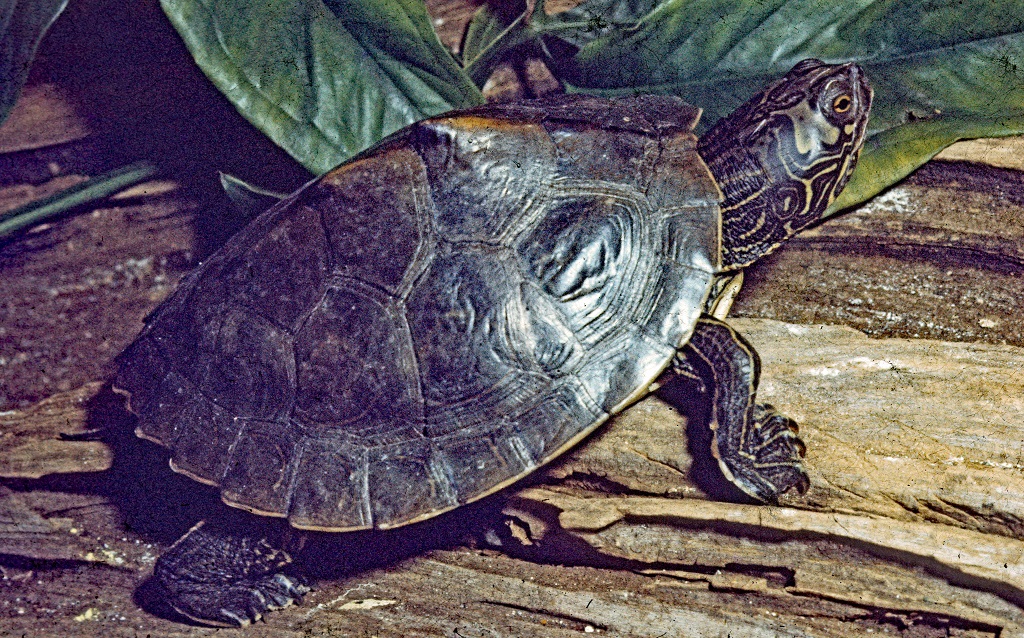
Young adult Barbour's Map Turtle
Back around 1960-something or the other, Patti and I used to take roadtrips much more frequently than we do today. As I think back, that was understandable because so much, including the various herps, was new to us. So we meandered from one end of the state to the other, and then westward to the 3rd end of the state, the Panhandle that reaches from Madison to Escambia counties. Somewhere along these craggy lines I began photographing again with the goal of depicting each and every amphibian and reptile that called Florida home. And and with that fixed firmly in mind, a beautiful dimorphic aquatic Panhandle turtle.caught my eye.
This was and is Barbour’s Map Turtle. It took only a few minutes research to learn that to do photographic justice to this persistently aquatic turtle would require pics being taken of 3 stages in its life, a hatchling, an adult male, diminutive though these may be, and a hulking adult female that, when fully grown is more than twice the size of the males. To apply a measurement to carapace sizes, hatchlings are about 1 ½ inches, adult males are about 4 ½ inches, and adult females are about 12 inches, impressively notable differences.
To shorten an unwieldy tale, hatchlings and males were easily photographed. It took only a couple of slow and enjoyable canoe rides, stopping here and there at submerged or protruding snags to take the “needed” pix. But the adult females were another several stories. Over the years Patti and I tried and failed. 4 decades rolled on by. 20 years ago Carl May and I tried. Again, failure. Now here we are in 2024 and I’m going to try again—this time with Jake..
And, because of unexpected flooding we almost failed again. But at the last stop Jake came through. He spotted a single female, way downriver, clambered down an 8 foot vertical drop, and took pix for both him and me-----and you. .Thanks, Jake.
Read full article
By Richard Bartlett · May 13, 2024
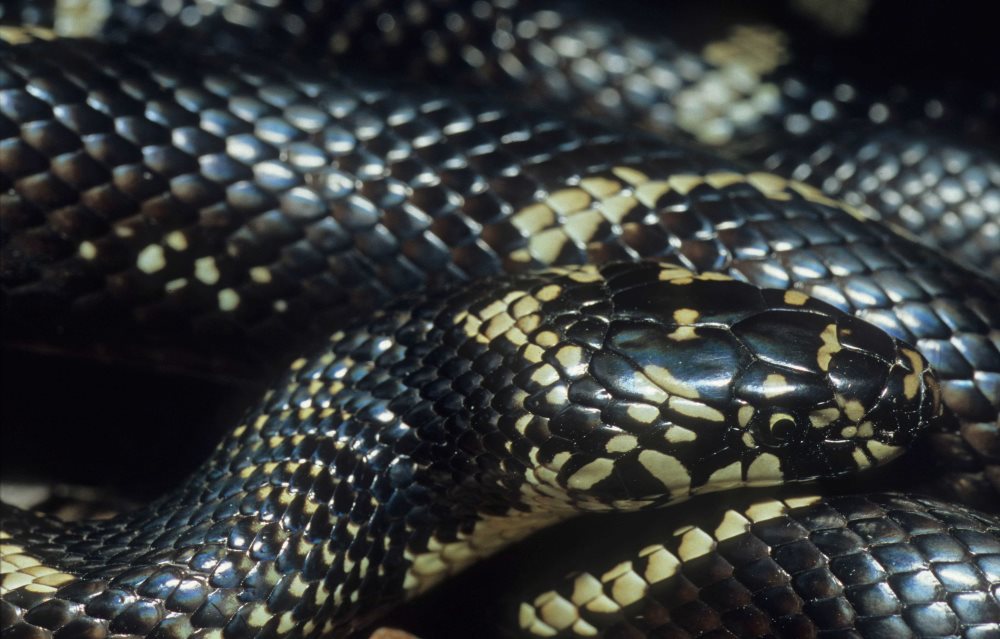
Typical eastern (chain) kingsnake from the FL-GA state line.
Well, firstly, if you are inclined to listen to the geneticists, the Florida Kingsnake, Lampropeltis getula floridana has become a nonentity, a snake having no special or interesting qualities. And that same disregard for subspecies would apply to the phases we have long known as “brooksi” and “goini.”. So for our purposes, herewith we’ll disregard the genetic findings and mention the various getula kingsnakes in FL as subspecies, as Linnaeus meant them to be.
In one subspecies or another the Kingsnake complex ranges throughout Florida
From the FL Keys in Monroe County, to the St Mary’s River in Nassau County, Fl and then westward to the Escambia River in Escambia County—In other words throughout all of FL---you will be treking through “Kingsnake Country”. These big, beautiful, secretive snakes are, or at least once were, found from border to border to border (and far beyond) in the sunshiney state of FL.
the USA.From the FL Keys to GA and AL a Kingsnake of some color could be encountered.Not only are these Found in one or another color beautiful snakes
When adult the various subspecies of the Eastern Kingsnake, including the nominate form, are big, occasionally attaining or even exceeding by a few inches, 6 feet in length. The base color may vary from yellow or black in northern FL to brown or yellow in southern FL.In northern FL the yellow occurs primarily in 2 discrete areas—Apalachicola Natl Forest and coastal neFL. A darker narrow vertebral stripe may or may not be present. They are rare in the former area and have not been seen for many years in the latter region.
Most individuals seen from north of the Ocala, FL area and except for Apalachicola area have been of rather typical eastern (Eastern Chain Kingsnake) pattern. The keywords in that sentence are “rather typical.” The differences usually most visible are in the variable amount of white—the thickness of the white bands both dorsally and laterally.Kingsnakes from the Panhandle , except fo the Apalachicola area, are white chain-patterned black snakes.
Florida Kingsnake pattern and colors are usually lighter overall than other subspecies, but some have a truly bungled light pattern over the black, or vice versa. Look for these from Ocala southward on the peninsula to Miami..
South Florida or Brook’s phase: Most King Snake enthusiast have searched eagerly for this Kingsnake having greenish ground color near Andytown—what? You don’t remember Andytown? No wonder. It was swallowed decades ago by the Interstate Highway System!—and more of a golden yellow down Everglades National Park way. Although variable both in ground color and the amount of dark patterning, all are well worth the search to find your choice.
Appalachicola or Goin’s phase may be virtually patternless ot have large often elongate oval darker dorsal pattern. Although variable they are often quite similar to Brook’s King variant from southwestern FL.
Ahhhhh. Florida! The land of the Kings.
Read full article
By Richard Bartlett · May 6, 2024
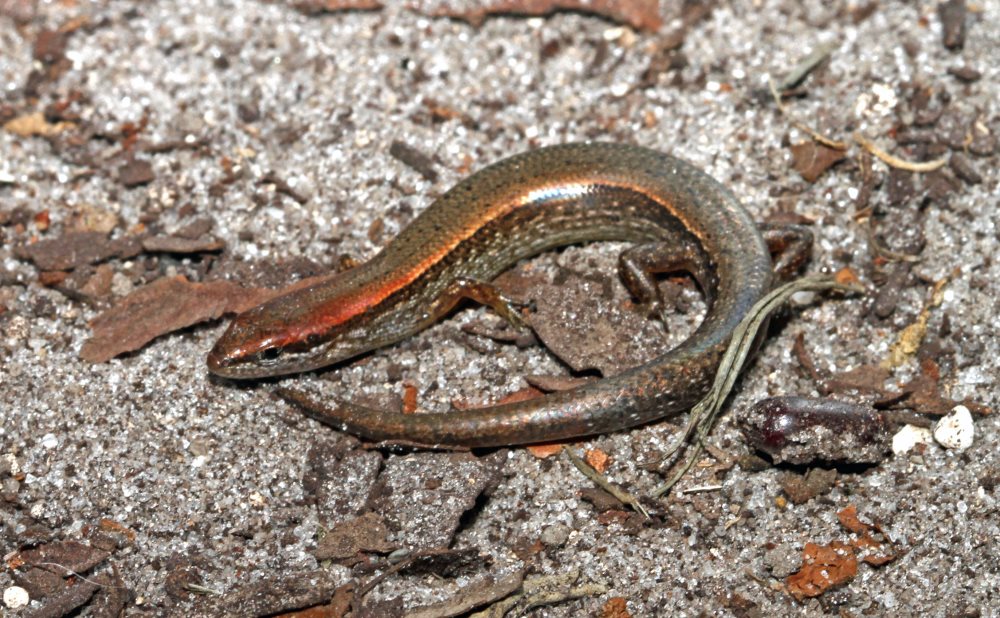
This is a typical, but rather dark Ground Skink, also known as Brown-backed Skink.
Ground Skink, Scincella lateralis. This tiny, slender (adult at 3 ½ inches including tail) and occasionally to as much as 5 inches) ranges southward from central eastern NJ to the southernmost of the FL Keys and westward to western TX. It was common in yards, open woodlands, grassy lake and pond edges, where in the latter it does not hesitate to take shelter if frightened. Likewise, it can climb agilely but seldom chooses to do so.
At no stage in its life is this species colorful. The 1 ½ inch long hatchlings are of some shades of brown from nose to tailtip. Adults are also some shade of brown, have a dark, and usually well defined, dorsolateral stripe on each side, are lightest dorsally and laterally, and have a cream to yellowish belly. The species has a smooth, transparent spectacle in each lower eyelid, allowing vision even when the eye is closed.
At one time, this skink was easily found and observed throughout its extensive range. Perhaps in some regions this is still the case. Until 6 years ago they were abundant in our north central FL yard. Today (March 2024) marks the 5th year I have seen none. I’ve flipped cardboard, both damp and dry, rolled long-fallen logs, turned plywood and roofing tins, looked by day, dusk, and nighttime, but no Ground Skinks were to be seen.
A few afternoons ago, on an 85F afternoon,100 miles north of home, I was so excited to see a ground skink crossing the pavement I almost went facedown exiting the car to photograph it
Now this tiny lizard assuredly belongs on the “Why Are The Herps Disappearing” list.
Read full article
By Richard Bartlett · April 29, 2024
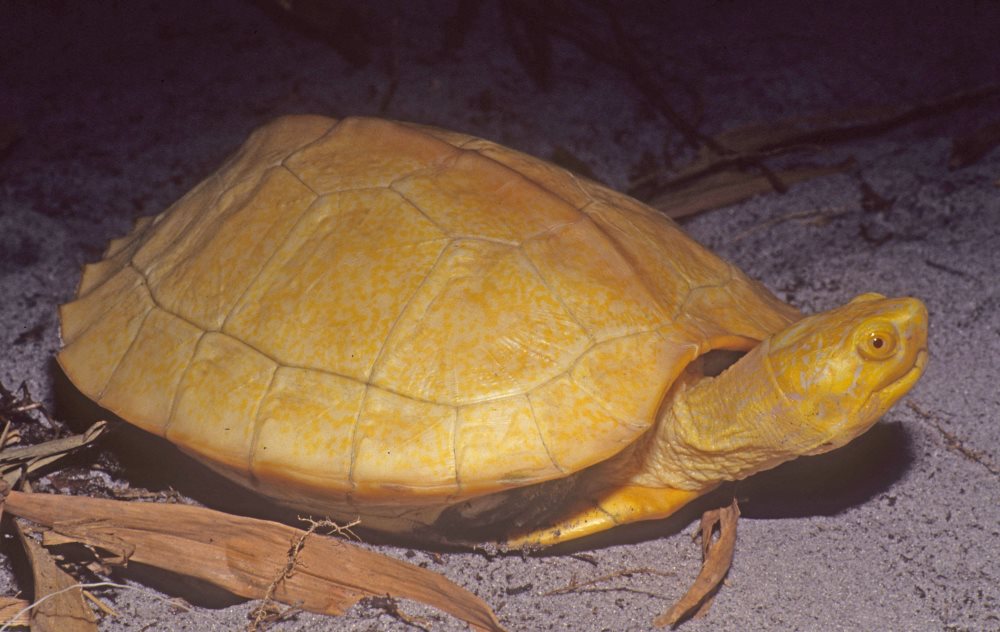
This is a prettily colored albino Giant Asian Pond Turtle
The times?
They have changed.
And they have changed BIG time.
Herp species that used to cost $10 or $20 are now priced in the hundreds or even the thousands of dollars if they are available at all.
Why, you may ask have prices changes so radically? Two major reasons are species population control by origin countries and a stricter adherence to International Wildlife Laws by our US Fish and Wildlife Svc.
Compare these hurdles to yesteryear when the collecting, importation and exportation of many (if not most) herp species were basically unregulated.
An example would be one of my very favorite Asian turtle species, the Giant Asian Pond Turtle, Heosemys grandis Before the turn of the century Thailand (Bangkok was a MAJOR collecting, clearance and shipping center) the sales and shipping of this turtle species were basically unregulated. Young examples, meaning those in the 4 to 6 inch shell length range, arrived at USA dealers on almost every shipment. The price for those of normal color was in the $50, range (albinos, of course, were more expensive). If you want a normal color morph today (2024) start saving . At this writing, no young ones seem available but several 15+ inch long adults are being offered at $950 each.
Capable of living in water or on land the Giant Asian Pond Turtle may be found along bodies of water such as lakes, ponds, rivers, streams, and canals. It is omnivorous and finds food in both aquatic and terrestrial environments. Their diet consists of worms, larvae, insects, snails, carrion, and aquatic and terrestrial plants. Hungry captives do not hesitate to dine on turtle companions. Similar to other species of turtles, the giant Asian pond turtle has developed adaptations and different techniques for capturing prey in both types of environments.
A bit more about this impressive species: This turtle species attains a full size of 17” straight measure. In nature it inhabits waterways as diverse as rivers and streams to swamps, marshes, and rice paddies.
The dark carapace may be brown or black, the yellow plastron is heavily streaked with radiating dark lines. The jaws are powerful and in closing I’ll simply say “although they seldom go out of their way to bite, watch where you place your fingers”.
Read full article
By Richard Bartlett · April 15, 2024
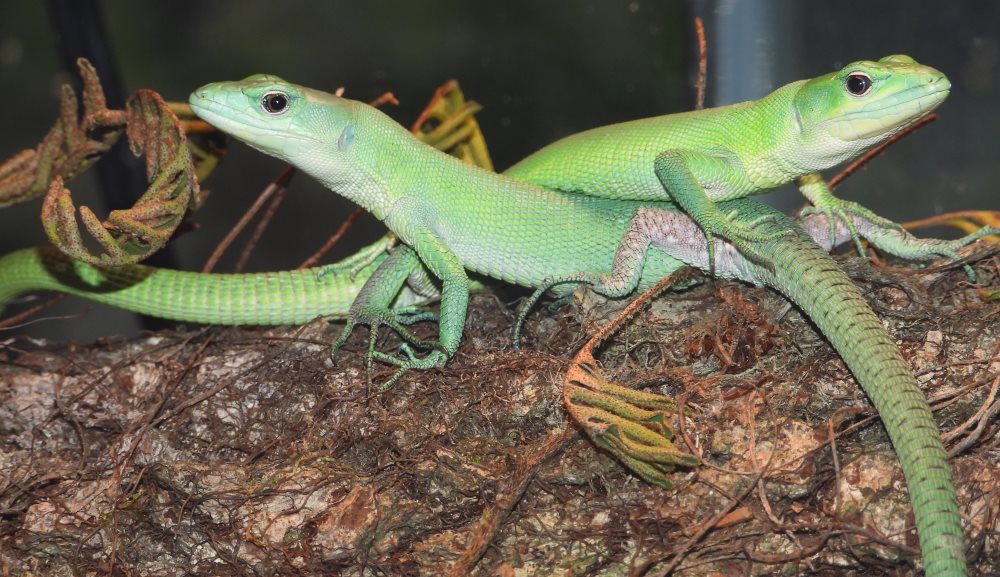
All 3 photos are of this beautiful East African taxon. Why, a lizard of course. In fact, the lizard taxon of which I’m thinking has derived its common name from these features. Now identified scientifically as Gastropholis prasina, it is commonly referred to as the Green Keel-bellied Lizard.
The genus name, Gastropholis, refers to the belly and prasina, the species name refers to the green coloration.
Family: Lacertidae; Wall and Jewel Lizards.
Color: Basically a vibrant green except for rear of legs that is blue-gray. Often has a bluish tinge on lips and throat. If frightened/insecure the overall color may fade to a duller green. Females may be a bit paler than the males.
Lizard Size: A relatively slender 12 to 16+ inches of which 70% is the weakly, but effectively, prehensile tail. The digits are long, slender, visibly jointed, and ideal for an arboreal existence.
Scalation: Scales keeled and finely granular dorsally. Lateral scales are smallest in the upper rows but increase in size as they descend and meet the 6 longitudinal rows of visibly keeled belly (ventral) larger and visibly keeled.ventral ing-Disposition: Males (and occasional females) are agonistic to others of the same sex.
Preferred Temperatures and activity period:Diurnal; 75-85F (24-30C)
Terrarium Size/Type suggested: Upright format at least 30 and preferably 40 gallon size, planted, humid forest with sturdy climbing limbs.
Natural History: Coastal area of Tanzania and Kenya. An arboreal lizard of variable forested conditions, trees and shrubs.
Comments: Of the 4 species in this genus, three, G. tropidopholis, G. vittata, and G. prasina, are green in color and arboreal. The 4th taxon G. vittata,is basically terrestrial and buff-striped brown in color..Ventral scales are strongly keeled. Only one, G. prasina, is currently (Feb. 2024) available in the American pet industry.
Much has been learned about the natural history of this lizard from both captive breeders and field observers. Notes from the field observers, published in “A Field Guide to the Reptiles of East Africa (written by Stephen Spawls Robert Drewer, Kim Howell and James Ashe) informs us of the arboreal tendencies of prasina in the coastal woodlands, but mentions also that examples have been found in terrestrial locations. Eggs have been found both in damp tree hollows and in terraria. One clutch numbered 5 eggs and incubation duration was 61 days at 79F.
Read full article