Search
Archive: 2024-04
kingsnake.com · Apr 30, 2024
What a beautiful shot of a Pacific Tree Frog in our Herp Photo of the day, uploaded by kingsnake.com user emvee! Be sure to tell them you liked it here!
Upload your own reptile and amphibian photos at gallery.kingsnake.com, and you could see them featured here!
kingsnake.com · Apr 29, 2024
After 16 months of incubation this wee lil Sambava Panther Chameleon in our Herp Photo of the day, uploaded by kingsnake.com user tylerstewart is checking out the world for the first time! Be sure to tell them you liked it here!
Upload your own reptile and amphibian photos at gallery.kingsnake.com, and you could see them featured here!
Richard Bartlett · Apr 29, 2024
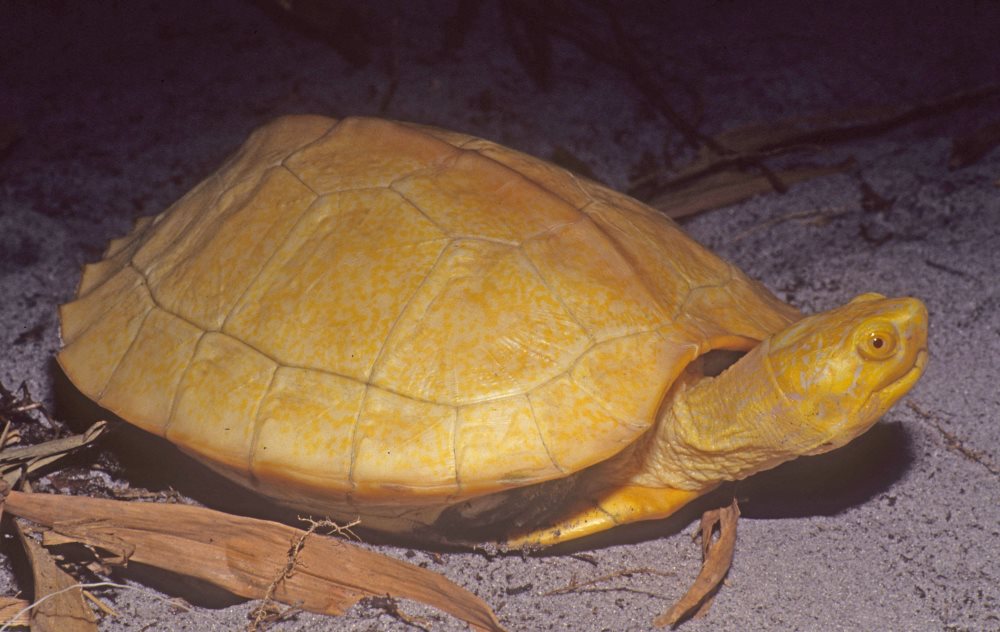
This is a prettily colored albino Giant Asian Pond Turtle
The times?
They have changed.
And they have changed BIG time.
Herp species that used to cost $10 or $20 are now priced in the hundreds or even the thousands of dollars if they are available at all.
Why, you may ask have prices changes so radically? Two major reasons are species population control by origin countries and a stricter adherence to International Wildlife Laws by our US Fish and Wildlife Svc.
Compare these hurdles to yesteryear when the collecting, importation and exportation of many (if not most) herp species were basically unregulated.
An example would be one of my very favorite Asian turtle species, the Giant Asian Pond Turtle, Heosemys grandis Before the turn of the century Thailand (Bangkok was a MAJOR collecting, clearance and shipping center) the sales and shipping of this turtle species were basically unregulated. Young examples, meaning those in the 4 to 6 inch shell length range, arrived at USA dealers on almost every shipment. The price for those of normal color was in the $50, range (albinos, of course, were more expensive). If you want a normal color morph today (2024) start saving . At this writing, no young ones seem available but several 15+ inch long adults are being offered at $950 each.
Capable of living in water or on land the Giant Asian Pond Turtle may be found along bodies of water such as lakes, ponds, rivers, streams, and canals. It is omnivorous and finds food in both aquatic and terrestrial environments. Their diet consists of worms, larvae, insects, snails, carrion, and aquatic and terrestrial plants. Hungry captives do not hesitate to dine on turtle companions. Similar to other species of turtles, the giant Asian pond turtle has developed adaptations and different techniques for capturing prey in both types of environments.
A bit more about this impressive species: This turtle species attains a full size of 17” straight measure. In nature it inhabits waterways as diverse as rivers and streams to swamps, marshes, and rice paddies.
The dark carapace may be brown or black, the yellow plastron is heavily streaked with radiating dark lines. The jaws are powerful and in closing I’ll simply say “although they seldom go out of their way to bite, watch where you place your fingers”.
Read full article
kingsnake.com · Apr 26, 2024
Happy Rattlesnake Friday! This certainly is not a rattlesnake, but it is a beautiful venomous creature. What a great close up of a Gaboon Viper, uploaded by kingsnake.com user magnum26 is full of sassy and potentially life-saving venom! Be sure to tell them you liked it here! As always on Friday, we celebrate all of our venomous reptiles for their contribution to the world.
Upload your own reptile and amphibian photos at gallery.kingsnake.com, and you could see them featured here!
kingsnake.com · Apr 25, 2024
It's like a glamour shot for Horned lizards with this handsome Phrynosoma solare in our Herp Photo of the day, uploaded by kingsnake.com user ninetynine is hoping for some tasty snacks! Be sure to tell them you liked it here!
Upload your own reptile and amphibian photos at gallery.kingsnake.com, and you could see them featured here!
kingsnake.com · Apr 24, 2024
This Western Fence Lizard is chilling like a villain in our herp photo of the day, uploaded by kingsnake.com user chrish ! Be sure to tell them you liked it here!
Read full article
kingsnake.com · Apr 23, 2024
Does a kingsnake really need an intro for our herp photo of the day, uploaded by kingsnake.com user trevid ? Nope, but hey nice grayband. Be sure to tell them you liked it here!
Read full article
kingsnake.com · Apr 22, 2024
Happy Earth Day! This copperhead in our herp photo of the day, uploaded by kingsnake.com user AlexNevgloski reminds us to only leave footprints when out in the field! Be sure to tell them you liked it here!
Read full article
kingsnake.com · Apr 19, 2024
Happy Rattlesnake Friday! Let's celebrate in the mighty southwest beauty of the Rock Rattlesnake here in our Herp Photo of the day, uploaded by kingsnake.com user Janne ! Be sure to tell them you liked it here!
Upload your own reptile and amphibian photos photos at gallery.kingsnake.com, and you could see them featured here!
kingsnake.com · Apr 18, 2024
Stunning headshot of an Eastern Indigo in our herp photo of the day! Uploaded by kingsnake.com user CtrsOfNightshade . Be sure to tell them you liked it here!
Read full article
kingsnake.com · Apr 17, 2024
This vibrant Cape Gopher Snake (Pituophis catenifer vertebralis) in our herp photo of the day, uploaded by kingsnake.com user pitparade will brighten your day for sure! Be sure to tell them you liked it here!
Upload your own reptile and amphibian photos at gallery.kingsnake.com, and you could see them featured here!
kingsnake.com · Apr 16, 2024
Sometimes you need to look outside the box! This stunning Sunbeam Snake may not be the most colorful on first glance, but as you can see in our Herp Photo of the Day, they are a truly beautiful snake, uploaded by kingsnake.com user mecdwell! Be sure to tell them you liked it here!
Read full article
Cindy Steinle · Apr 16, 2024
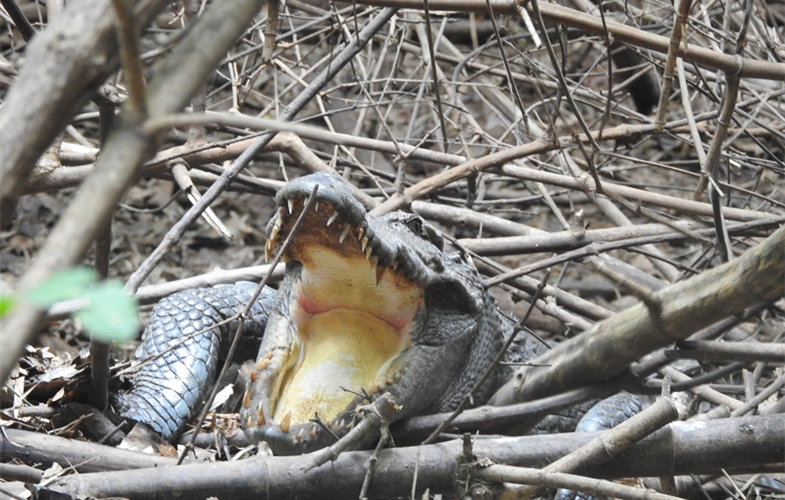
Photo Credit: ©WCS A head-started female Siamese crocodile nesting in the wild
In a huge win for conservation, the first ever nesting behavior has been observed by reintroduced female Siamese crocodile that resulted in two hatchlings! The hatchlings are now being headstarted by the Wildlife Conservation Society.
The authors note: “While collecting eggs for incubation in May 2022, we were able to identify a unique series of notched tail scutes on a female C. siamensis as she aggressively defended a nest.
“From these markings we determined the female was hatched on 11 August 2012 (age = 9.75 years) and released in March 2014. A camera-trap placed at the nest on 11 May 2022 and recovered on 5 July 2022 recorded 1724 images.
“These images indicated the female remained in attendance at the nest throughout the monitoring period. Camera-trap imagery captured eight nest repair events and two nest defense events; during the later the female defended the nest from village dogs.”
Read full article
Richard Bartlett · Apr 15, 2024
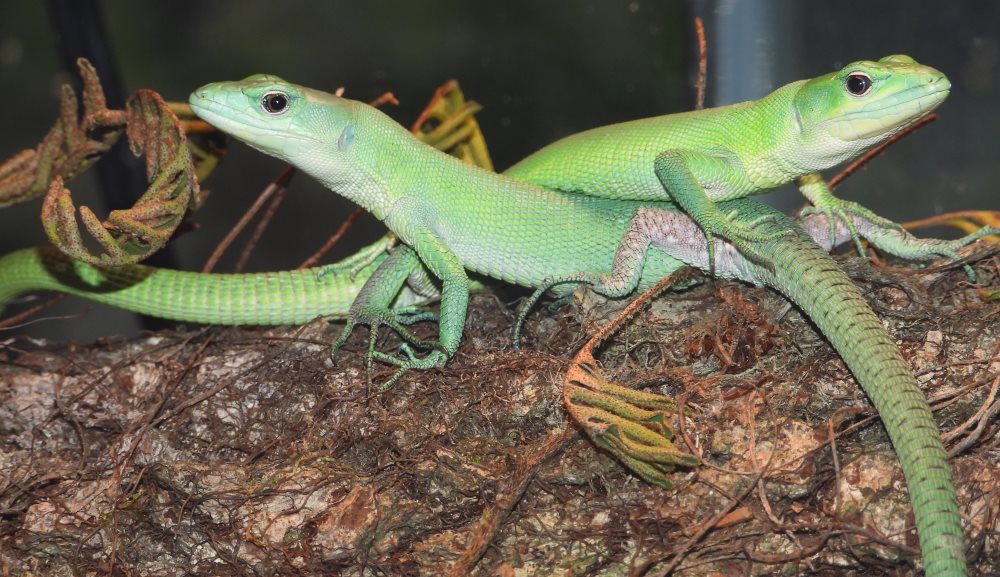
All 3 photos are of this beautiful East African taxon. Why, a lizard of course. In fact, the lizard taxon of which I’m thinking has derived its common name from these features. Now identified scientifically as Gastropholis prasina, it is commonly referred to as the Green Keel-bellied Lizard.
The genus name, Gastropholis, refers to the belly and prasina, the species name refers to the green coloration.
Family: Lacertidae; Wall and Jewel Lizards.
Color: Basically a vibrant green except for rear of legs that is blue-gray. Often has a bluish tinge on lips and throat. If frightened/insecure the overall color may fade to a duller green. Females may be a bit paler than the males.
Lizard Size: A relatively slender 12 to 16+ inches of which 70% is the weakly, but effectively, prehensile tail. The digits are long, slender, visibly jointed, and ideal for an arboreal existence.
Scalation: Scales keeled and finely granular dorsally. Lateral scales are smallest in the upper rows but increase in size as they descend and meet the 6 longitudinal rows of visibly keeled belly (ventral) larger and visibly keeled.ventral ing-Disposition: Males (and occasional females) are agonistic to others of the same sex.
Preferred Temperatures and activity period:Diurnal; 75-85F (24-30C)
Terrarium Size/Type suggested: Upright format at least 30 and preferably 40 gallon size, planted, humid forest with sturdy climbing limbs.
Natural History: Coastal area of Tanzania and Kenya. An arboreal lizard of variable forested conditions, trees and shrubs.
Comments: Of the 4 species in this genus, three, G. tropidopholis, G. vittata, and G. prasina, are green in color and arboreal. The 4th taxon G. vittata,is basically terrestrial and buff-striped brown in color..Ventral scales are strongly keeled. Only one, G. prasina, is currently (Feb. 2024) available in the American pet industry.
Much has been learned about the natural history of this lizard from both captive breeders and field observers. Notes from the field observers, published in “A Field Guide to the Reptiles of East Africa (written by Stephen Spawls Robert Drewer, Kim Howell and James Ashe) informs us of the arboreal tendencies of prasina in the coastal woodlands, but mentions also that examples have been found in terrestrial locations. Eggs have been found both in damp tree hollows and in terraria. One clutch numbered 5 eggs and incubation duration was 61 days at 79F.
Read full article
Cindy Steinle · Apr 15, 2024
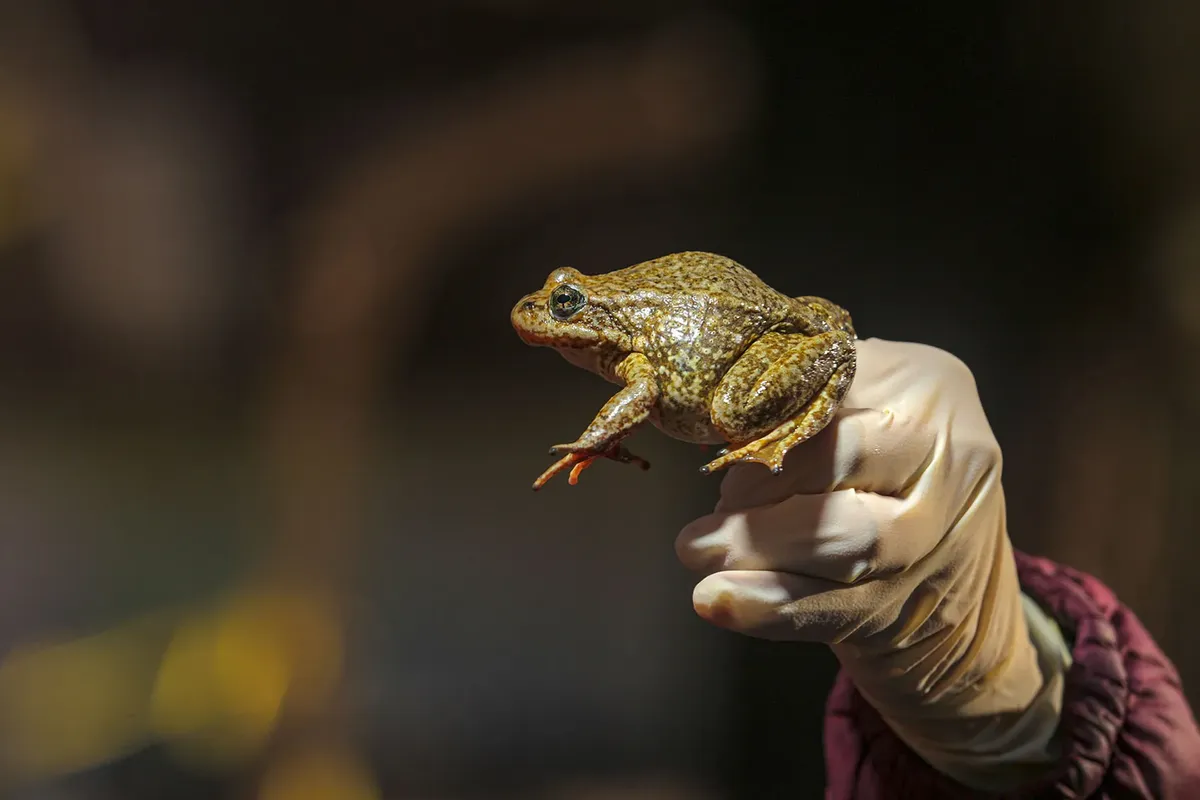
USGS biologist holds an endangered yellow-legged frog recovered from a fire-ravaged stretch of Little Rock Creek, just off Angeles Crest Highway 2 near Wrightwood in the San Gabriel Mountains. (Irfan Khan / Los Angeles Times via Getty Images)
For over 500 species of frogs, Batrachochytrium dendrobatidis or more easily BD has been devastating. It has decimated populations worldwide and lead to extinctions of of 90 possible species threatening more world-wide. Scientists have been struggling to come up with a cure of any sort and have started to look at the possibility of infecting the fungus with a virus.
Meet BdDV-1, a viral fragment discovered by scientists whose paper was recently published by the journal Current Biology. The researchers found it in much the same way that one disentangles a knot, by pulling on individual threads to see where they lead. While examining the BD fungus to learn about weaknesses, they discovered a single-stranded DNA virus trapped within the genome of the fungus. Although this only applied to certain strains, when infected they produced fewer spores than the uninfected fungi. Now the next step is to see if researchers can clone and engineer this virus so that it kills BD and saves the frogs.
That will not be the easiest task to accomplish, however, for a big reason: Currently the virus makes the fungus more deadly to the frogs, rather than less so.
Read full article