
Barking Treefrogs
By Richard Bartlett · May 13, 2016 12:30 am
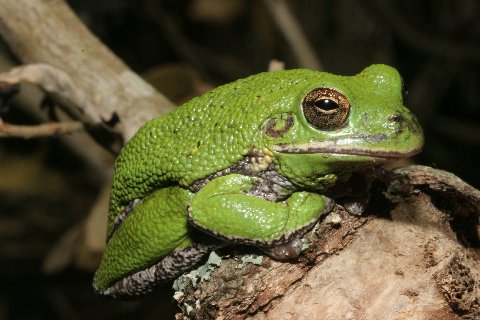
Green now, this barker may assume a spotted or brown color within minutes. The barking has started. Well, not barking really. The sound is more of an oft repeated explosive “toooonk,” the sound of barking treefrogs, Hyla gratiosa, at home. Now, rather than just being called the largest treefrog in Florida, when size is mentioned it requires the qualification of the word “native.” The barking treefrog is the largest NATIVE treefrog in Florida, its 2 5/8” snout-vent length now being far surpassed by the up to 5” long Cuban treefrog that is somehow steadily adapting to lower temperatures and expanding its range northward. Barkers breed in shallow, ephemeral, ponds and usually vocalize while floating. More often than not they anchor themselves at the preferred calling site by holding to a stem of water-surface vegetation with one front foot. Although in size they may now be surpassed, they cannot be surpassed in their chameleon–like color changes. Within minutes the same frog may change ground color from brown to olive to bright green and have unedged dorsal spotting, no dorsal spotting, or dorsal spotting edged with a narrow border of lighter pigment. Time to go. A nice chorus of barkers are “tooonking” again.
Barkers often produce their vocalizations while floating in an ephemeral pond.
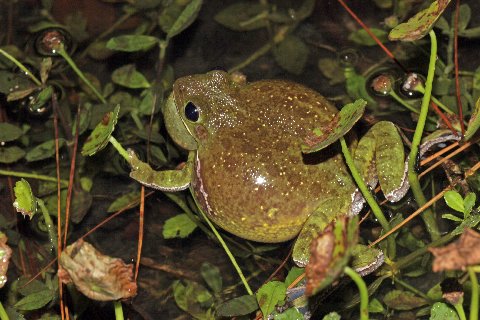
Barking treefrogs have been known to hybridize with other treefrog species. This one, a barker x a green treefrog, had an intermediate call.