RSS
Richard Bartlett
June 10, 2024
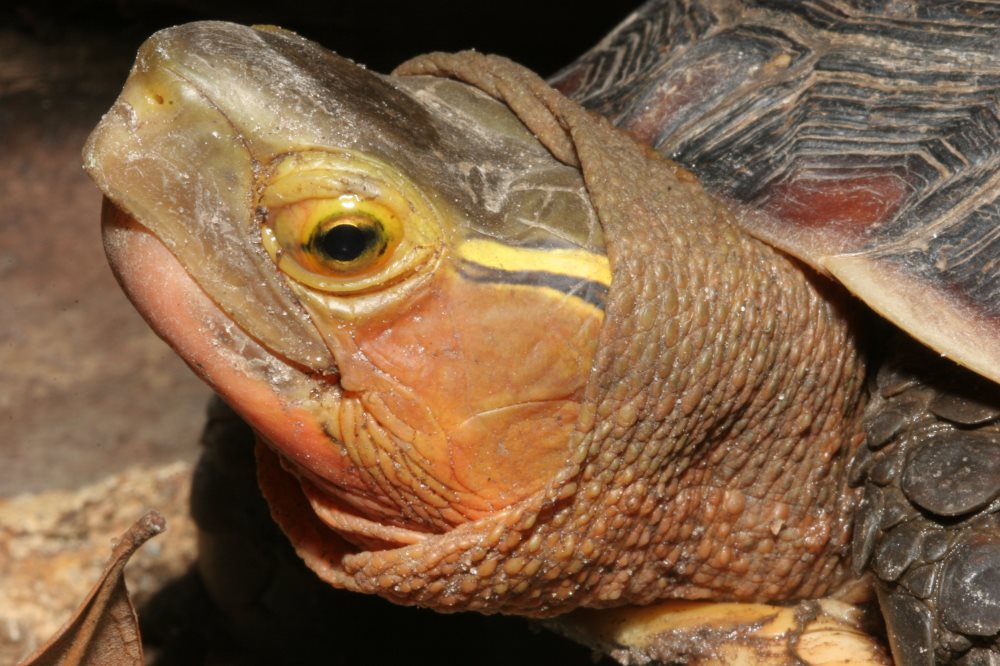
Note the yellow temporal line on this adult Chinese Box Turtle
At this point in time it has become difficult and quite expensive for hobbyists to acquire Asian herps, turtles included. Even prior to importation difficulties, hatchlings of several turtle species in the genera Cuora and Cistoclemmys were being priced by breeders in the many hundreds and even thousands of dollars each. Today (2024) the prices of many taxa are even higher.
Fortunately though, a few of the species that can still be imported and/or that are easily bred remain almost affordable. One of these, long a favorite of hobbyists (me included) is Cuora flavomarginata and is known to most as the Chinese Box Turtle. The 3 subspecies are divided between China mainland, Taiwan, and Japan. The subspecies, all remarkably similar in external appearances, are C.f. flavomarginata from Taiwan, C.f. sinensis from southern mainland China and C. f. evelynae from Japan.
Like the American Box Turtles its carapace is highly domed and the turtle has a very functional plastral hinge. The carapace may vary in color from dirty olive to black, with the latter being the more common. There is a yellowish vertebral stripe and the marginal scutes are a combination of dark and light pigment. The skin atop the head and on the limbs and tail is a dark charcoal, occasionally with pale olive overtones, The crown is separated from the pinkish cheeks by a prominent yellow bar on each side. All colors are at their brightest when the turtle is in breeding condition. Both males and females attain a straight measure of 5” (rarely to 6”).The external differences between male and female C. flavomarginata are slight. Males have a broader (but not much longer) tail than females. When extended the male’s tail is almost triangular in shape.
Like many terrestrial turtle species, the Chinese Box Turtle is omnivorous. Moistened tortoise diet, canned pet food, fresh succulent fruit, insects and worms are all accepted eagerly by most captives.
Summarizing, the common name given this turtle is quite descriptive, although not brightly colored they are pretty, personable, longlived, and proving that they are easily kept, some of mine have been captive for 40+ years.
Read full article
June 3, 2024
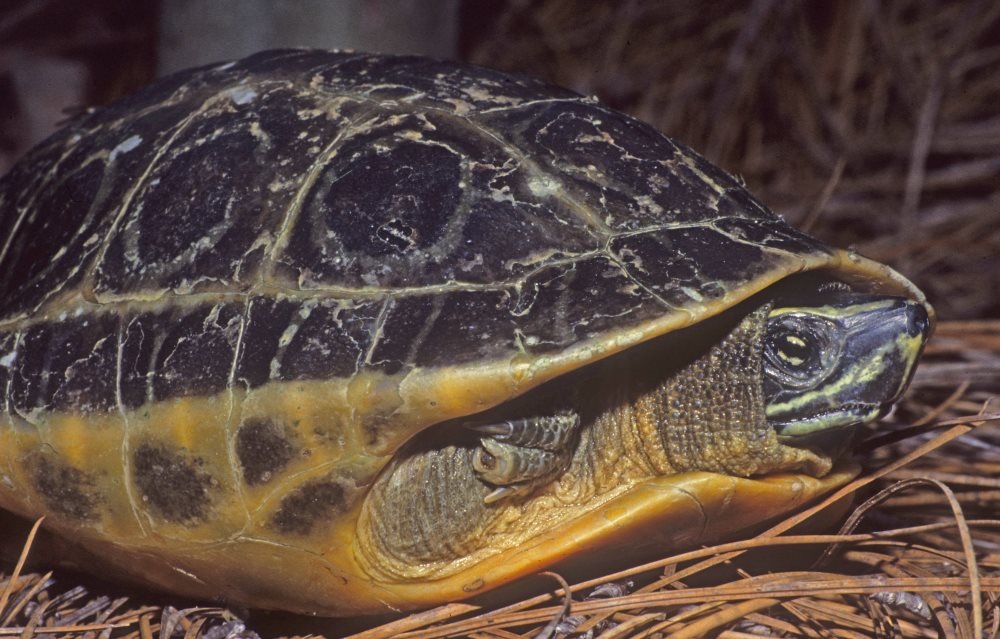
This is the seldom seen Indian Eyed Turtle. Note the dark smudges on the bridge plates.
Morenia petersi, the Indian Eyed Turtle, a Geoemydid species, was once available to American hobbyists, but this seems no longer the case.
Like its very closely related Burmese relative, M. ocellata, it is also known as the Swamp Turtle. It seems at home both in and out of the water. Adult size for females is about 8 inches. The smaller males are adult at 4 to 5 ½ inches.
Diet is said to consist of both plants and carrion.
This interesting but rather poorly known turtle has a black carapace with a light ocellus on each plate including the vertebrals, a yellow-orange plastron, and a black head with 3 yellow facial stripes on each cheek. The yellowish bridge plates bear darker smudges.
Wild females nest about half way through the dry season. Each clutch consists of 5 to 9 eggs. Incubation seems to be about 70 days..
M. petersi is found in northeastern India and in Bangladesh.
Read full article
May 27, 2024
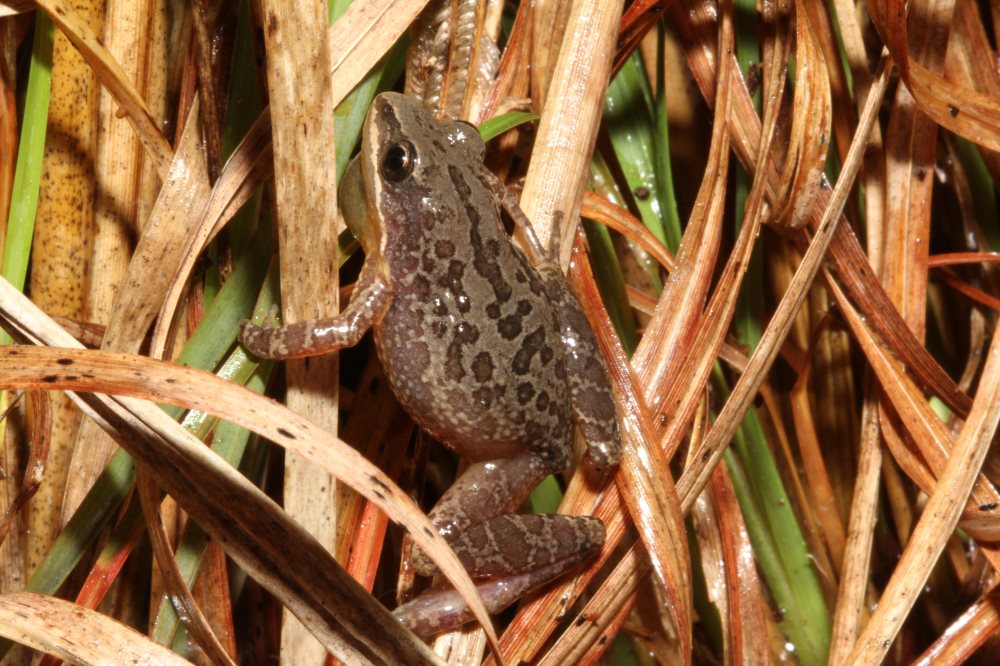
Southern Chorus Frog, once abundant but now seemingly less so.
Well, it was not really spring but 22 February 2024 was a fairly decent northcentral Florida day. The high had been about 73F and the low was forecast about 10 degrees cooler. Not bad. But then I remembered that the herping spot I was thinking about was about 100 mile further north, so I subtracted 3 or 4 degrees, thought for a minute or two, and decided, what the heck. I was tired of sitting home, so I washed the car’s windshield, and headed northward beneath a sky filled overhead with skudding clouds, and looking ahead into a horizon of gray. Ten miles up the road it clouded up a bit more, sprinkled for a couple of miles and then as I drove on the rains came. In a flash the car had me amidst a literal downpour. It rained and rained some more. But no herps, not even the rain-loving amphibians seemed to be moving..
After a pass or two on the tried and true (and now failing) roadway I decided to head towards home. A couple of miles south I ran out of the downpour. Here the rain was barely falling, and whoops—frogsong—Southern Chorus Frogs, Pseudacris nigrita, from the roadside. The car, or I, had been well trained. No cars behind, onto the grassy roadside, stop, grab flashlight and camera, and I was heading for frogsong from the newly freshened roadside ditch.
What had been an uneventful night soon became a joyful one for the chorus frogs were not the only species calling. Before midnight I had added spring peepers, Pseudacris crucifer, and even a few unexpected warmer weather (=springtime) species-, green and squirrel treefrogs, Hyla cinerea & H. squirella, a few southern toads, Bufo (Anaxyrus) terrestris and oak toads, B (A) quercicus, among them. And although they were not chorusing, Southern Leopard Frogs, Rana utricularia, were out and very active.
Ahhhhh, Florida and spring in Midwinter. Always good to experience.
Read full article
May 20, 2024
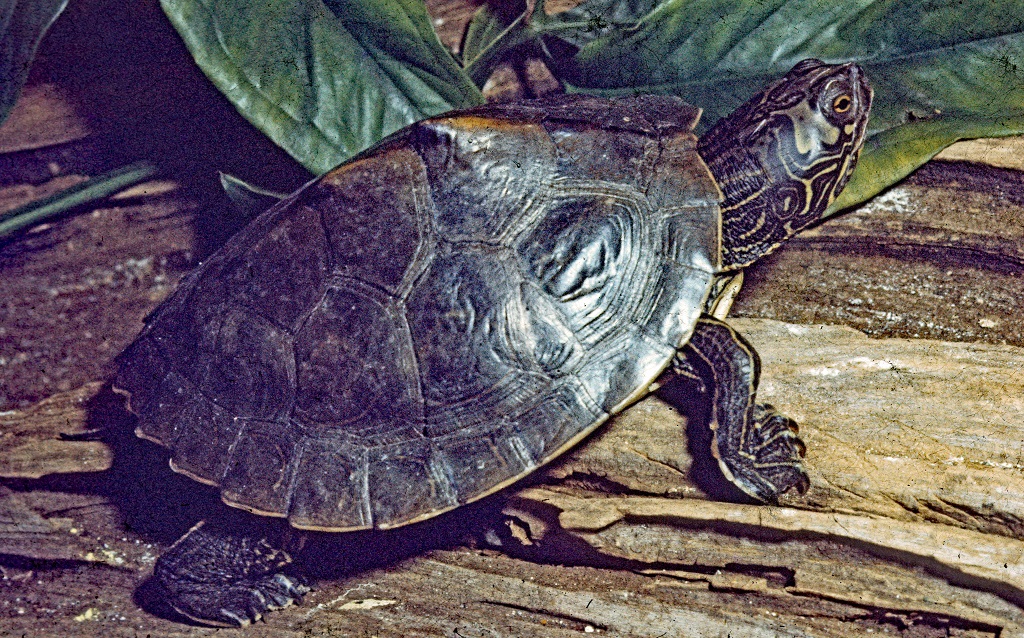
Young adult Barbour's Map Turtle
Back around 1960-something or the other, Patti and I used to take roadtrips much more frequently than we do today. As I think back, that was understandable because so much, including the various herps, was new to us. So we meandered from one end of the state to the other, and then westward to the 3rd end of the state, the Panhandle that reaches from Madison to Escambia counties. Somewhere along these craggy lines I began photographing again with the goal of depicting each and every amphibian and reptile that called Florida home. And and with that fixed firmly in mind, a beautiful dimorphic aquatic Panhandle turtle.caught my eye.
This was and is Barbour’s Map Turtle. It took only a few minutes research to learn that to do photographic justice to this persistently aquatic turtle would require pics being taken of 3 stages in its life, a hatchling, an adult male, diminutive though these may be, and a hulking adult female that, when fully grown is more than twice the size of the males. To apply a measurement to carapace sizes, hatchlings are about 1 ½ inches, adult males are about 4 ½ inches, and adult females are about 12 inches, impressively notable differences.
To shorten an unwieldy tale, hatchlings and males were easily photographed. It took only a couple of slow and enjoyable canoe rides, stopping here and there at submerged or protruding snags to take the “needed” pix. But the adult females were another several stories. Over the years Patti and I tried and failed. 4 decades rolled on by. 20 years ago Carl May and I tried. Again, failure. Now here we are in 2024 and I’m going to try again—this time with Jake..
And, because of unexpected flooding we almost failed again. But at the last stop Jake came through. He spotted a single female, way downriver, clambered down an 8 foot vertical drop, and took pix for both him and me-----and you. .Thanks, Jake.
Read full article
May 13, 2024
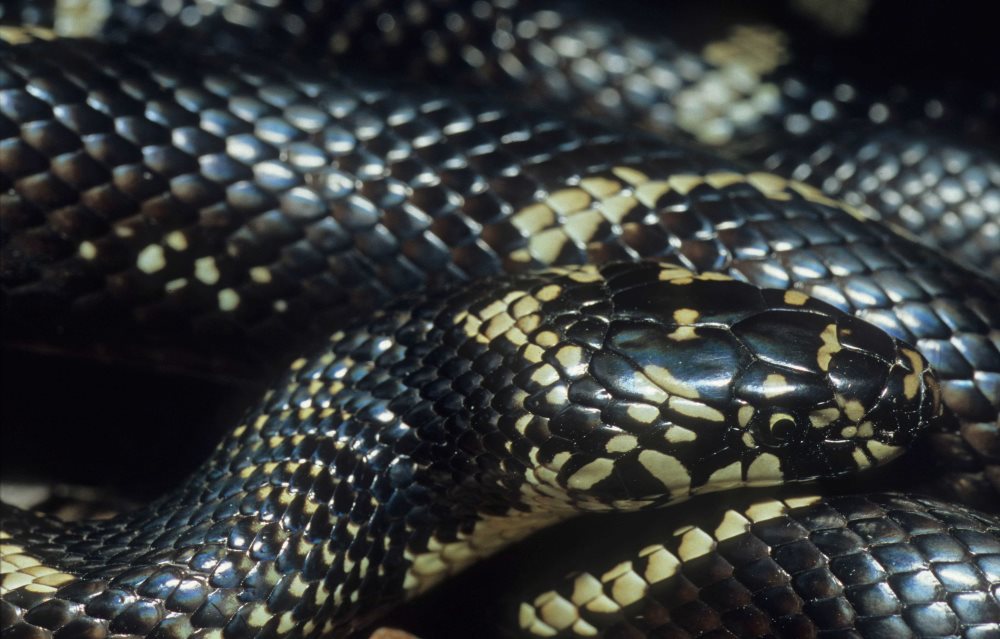
Typical eastern (chain) kingsnake from the FL-GA state line.
Well, firstly, if you are inclined to listen to the geneticists, the Florida Kingsnake, Lampropeltis getula floridana has become a nonentity, a snake having no special or interesting qualities. And that same disregard for subspecies would apply to the phases we have long known as “brooksi” and “goini.”. So for our purposes, herewith we’ll disregard the genetic findings and mention the various getula kingsnakes in FL as subspecies, as Linnaeus meant them to be.
In one subspecies or another the Kingsnake complex ranges throughout Florida
From the FL Keys in Monroe County, to the St Mary’s River in Nassau County, Fl and then westward to the Escambia River in Escambia County—In other words throughout all of FL---you will be treking through “Kingsnake Country”. These big, beautiful, secretive snakes are, or at least once were, found from border to border to border (and far beyond) in the sunshiney state of FL.
the USA.From the FL Keys to GA and AL a Kingsnake of some color could be encountered.Not only are these Found in one or another color beautiful snakes
When adult the various subspecies of the Eastern Kingsnake, including the nominate form, are big, occasionally attaining or even exceeding by a few inches, 6 feet in length. The base color may vary from yellow or black in northern FL to brown or yellow in southern FL.In northern FL the yellow occurs primarily in 2 discrete areas—Apalachicola Natl Forest and coastal neFL. A darker narrow vertebral stripe may or may not be present. They are rare in the former area and have not been seen for many years in the latter region.
Most individuals seen from north of the Ocala, FL area and except for Apalachicola area have been of rather typical eastern (Eastern Chain Kingsnake) pattern. The keywords in that sentence are “rather typical.” The differences usually most visible are in the variable amount of white—the thickness of the white bands both dorsally and laterally.Kingsnakes from the Panhandle , except fo the Apalachicola area, are white chain-patterned black snakes.
Florida Kingsnake pattern and colors are usually lighter overall than other subspecies, but some have a truly bungled light pattern over the black, or vice versa. Look for these from Ocala southward on the peninsula to Miami..
South Florida or Brook’s phase: Most King Snake enthusiast have searched eagerly for this Kingsnake having greenish ground color near Andytown—what? You don’t remember Andytown? No wonder. It was swallowed decades ago by the Interstate Highway System!—and more of a golden yellow down Everglades National Park way. Although variable both in ground color and the amount of dark patterning, all are well worth the search to find your choice.
Appalachicola or Goin’s phase may be virtually patternless ot have large often elongate oval darker dorsal pattern. Although variable they are often quite similar to Brook’s King variant from southwestern FL.
Ahhhhh. Florida! The land of the Kings.
Read full article
May 6, 2024
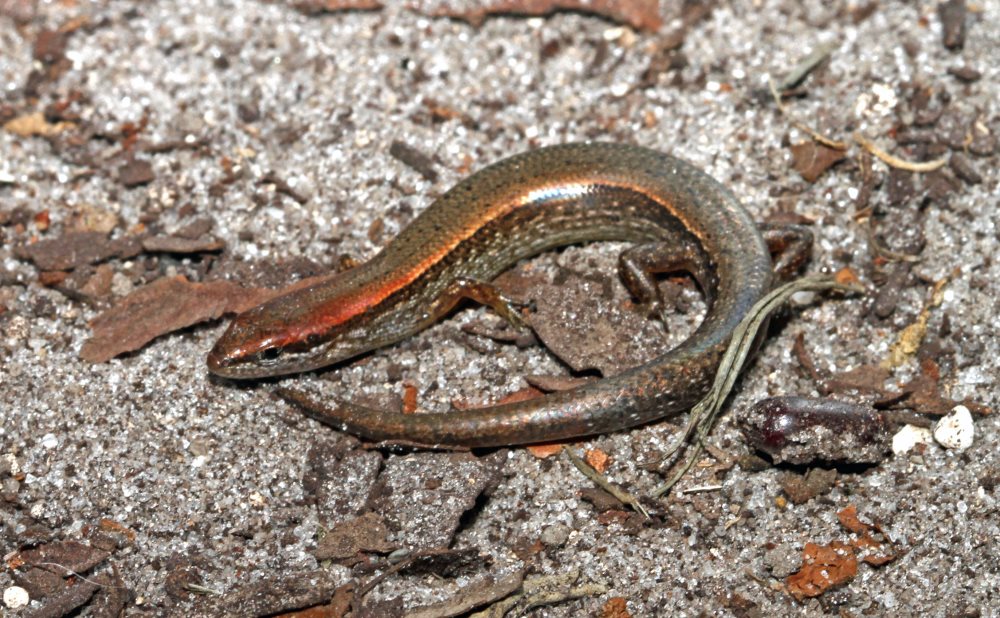
This is a typical, but rather dark Ground Skink, also known as Brown-backed Skink.
Ground Skink, Scincella lateralis. This tiny, slender (adult at 3 ½ inches including tail) and occasionally to as much as 5 inches) ranges southward from central eastern NJ to the southernmost of the FL Keys and westward to western TX. It was common in yards, open woodlands, grassy lake and pond edges, where in the latter it does not hesitate to take shelter if frightened. Likewise, it can climb agilely but seldom chooses to do so.
At no stage in its life is this species colorful. The 1 ½ inch long hatchlings are of some shades of brown from nose to tailtip. Adults are also some shade of brown, have a dark, and usually well defined, dorsolateral stripe on each side, are lightest dorsally and laterally, and have a cream to yellowish belly. The species has a smooth, transparent spectacle in each lower eyelid, allowing vision even when the eye is closed.
At one time, this skink was easily found and observed throughout its extensive range. Perhaps in some regions this is still the case. Until 6 years ago they were abundant in our north central FL yard. Today (March 2024) marks the 5th year I have seen none. I’ve flipped cardboard, both damp and dry, rolled long-fallen logs, turned plywood and roofing tins, looked by day, dusk, and nighttime, but no Ground Skinks were to be seen.
A few afternoons ago, on an 85F afternoon,100 miles north of home, I was so excited to see a ground skink crossing the pavement I almost went facedown exiting the car to photograph it
Now this tiny lizard assuredly belongs on the “Why Are The Herps Disappearing” list.
Read full article
April 29, 2024
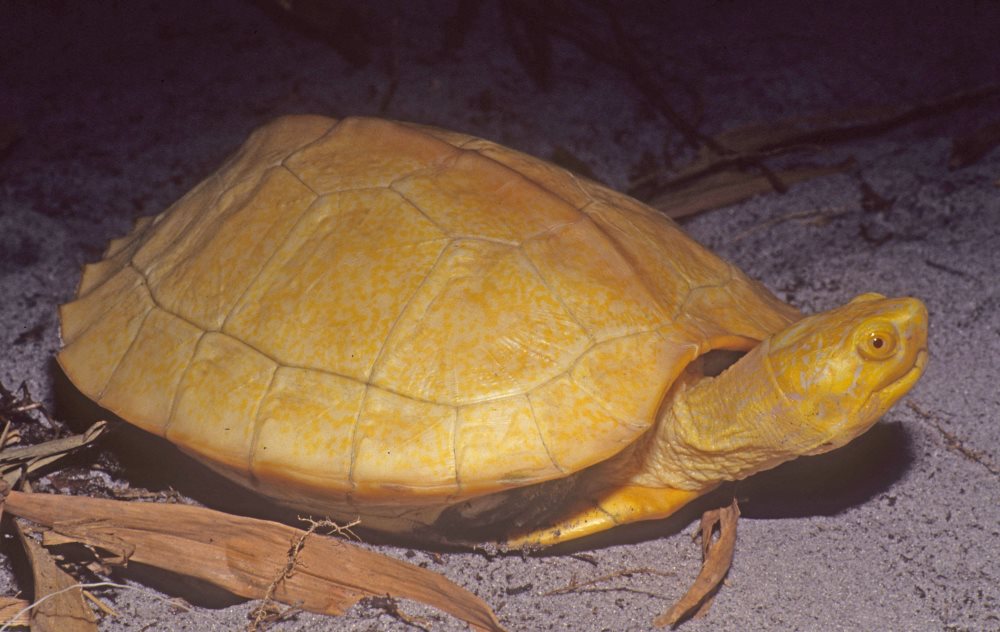
This is a prettily colored albino Giant Asian Pond Turtle
The times?
They have changed.
And they have changed BIG time.
Herp species that used to cost $10 or $20 are now priced in the hundreds or even the thousands of dollars if they are available at all.
Why, you may ask have prices changes so radically? Two major reasons are species population control by origin countries and a stricter adherence to International Wildlife Laws by our US Fish and Wildlife Svc.
Compare these hurdles to yesteryear when the collecting, importation and exportation of many (if not most) herp species were basically unregulated.
An example would be one of my very favorite Asian turtle species, the Giant Asian Pond Turtle, Heosemys grandis Before the turn of the century Thailand (Bangkok was a MAJOR collecting, clearance and shipping center) the sales and shipping of this turtle species were basically unregulated. Young examples, meaning those in the 4 to 6 inch shell length range, arrived at USA dealers on almost every shipment. The price for those of normal color was in the $50, range (albinos, of course, were more expensive). If you want a normal color morph today (2024) start saving . At this writing, no young ones seem available but several 15+ inch long adults are being offered at $950 each.
Capable of living in water or on land the Giant Asian Pond Turtle may be found along bodies of water such as lakes, ponds, rivers, streams, and canals. It is omnivorous and finds food in both aquatic and terrestrial environments. Their diet consists of worms, larvae, insects, snails, carrion, and aquatic and terrestrial plants. Hungry captives do not hesitate to dine on turtle companions. Similar to other species of turtles, the giant Asian pond turtle has developed adaptations and different techniques for capturing prey in both types of environments.
A bit more about this impressive species: This turtle species attains a full size of 17” straight measure. In nature it inhabits waterways as diverse as rivers and streams to swamps, marshes, and rice paddies.
The dark carapace may be brown or black, the yellow plastron is heavily streaked with radiating dark lines. The jaws are powerful and in closing I’ll simply say “although they seldom go out of their way to bite, watch where you place your fingers”.
Read full article
April 15, 2024
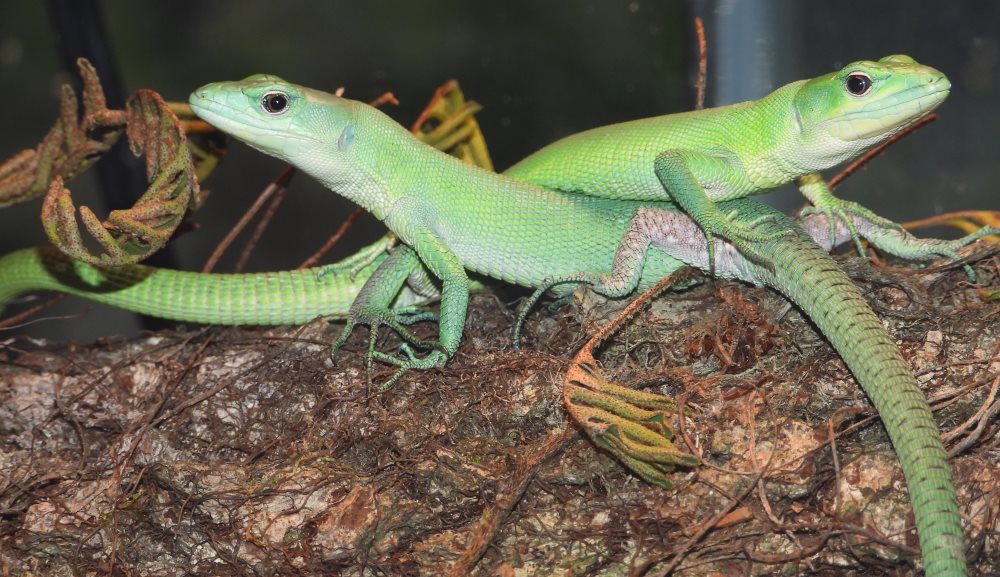
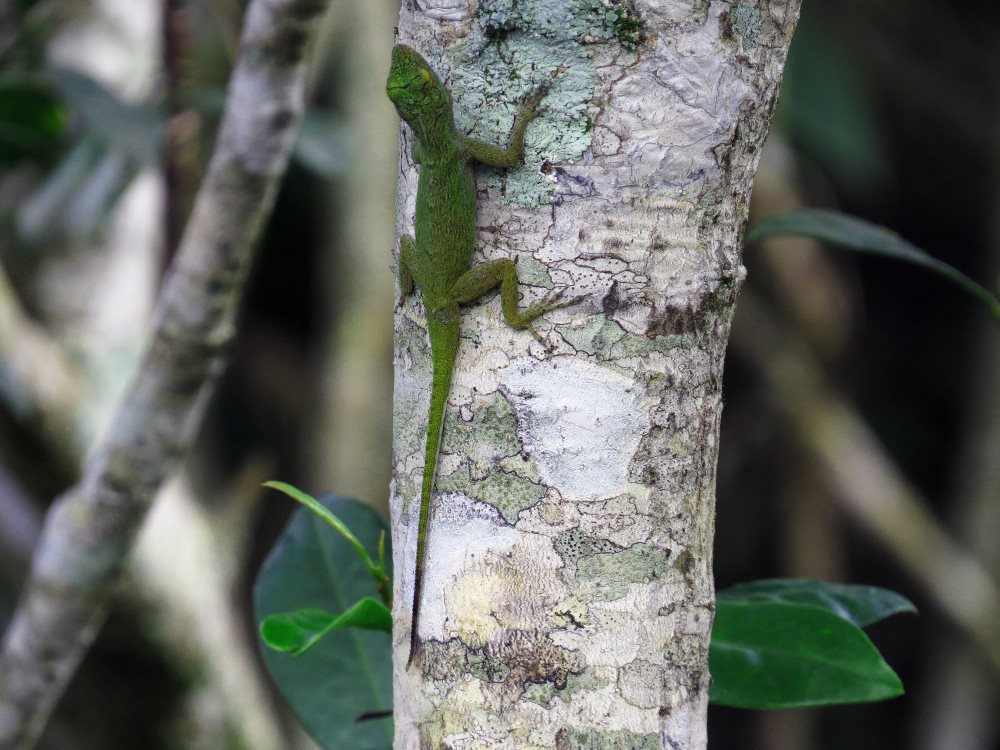
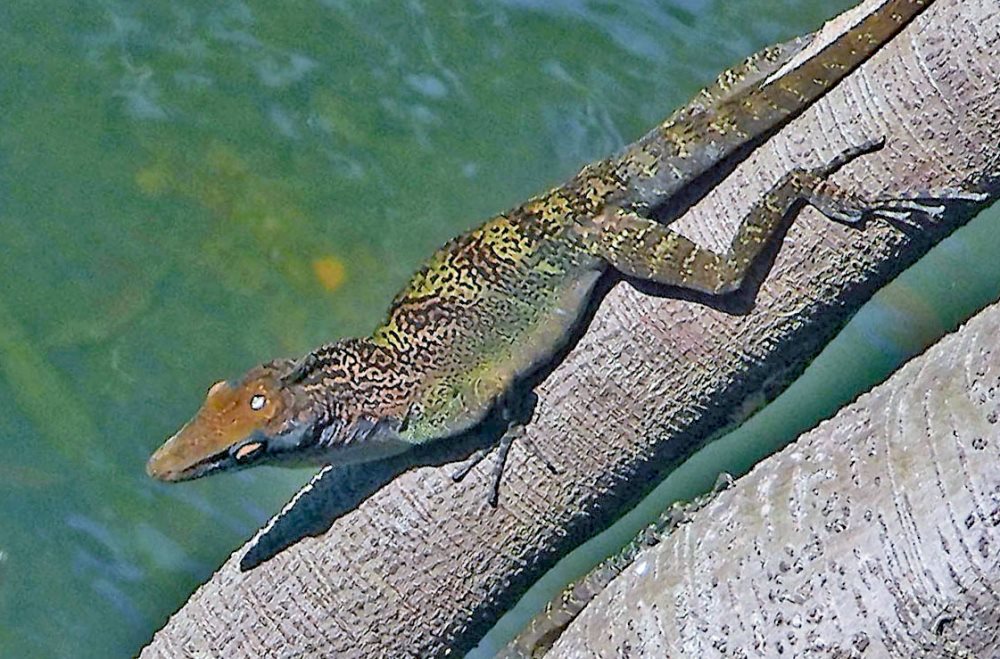
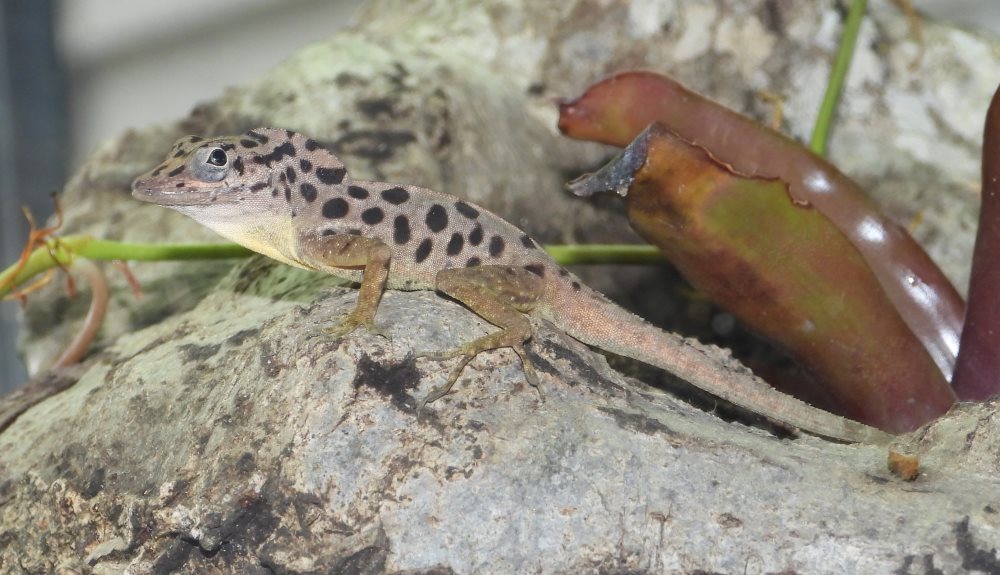
All 3 photos are of this beautiful East African taxon. Why, a lizard of course. In fact, the lizard taxon of which I’m thinking has derived its common name from these features. Now identified scientifically as Gastropholis prasina, it is commonly referred to as the Green Keel-bellied Lizard.
The genus name, Gastropholis, refers to the belly and prasina, the species name refers to the green coloration.
Family: Lacertidae; Wall and Jewel Lizards.
Color: Basically a vibrant green except for rear of legs that is blue-gray. Often has a bluish tinge on lips and throat. If frightened/insecure the overall color may fade to a duller green. Females may be a bit paler than the males.
Lizard Size: A relatively slender 12 to 16+ inches of which 70% is the weakly, but effectively, prehensile tail. The digits are long, slender, visibly jointed, and ideal for an arboreal existence.
Scalation: Scales keeled and finely granular dorsally. Lateral scales are smallest in the upper rows but increase in size as they descend and meet the 6 longitudinal rows of visibly keeled belly (ventral) larger and visibly keeled.ventral ing-Disposition: Males (and occasional females) are agonistic to others of the same sex.
Preferred Temperatures and activity period:Diurnal; 75-85F (24-30C)
Terrarium Size/Type suggested: Upright format at least 30 and preferably 40 gallon size, planted, humid forest with sturdy climbing limbs.
Natural History: Coastal area of Tanzania and Kenya. An arboreal lizard of variable forested conditions, trees and shrubs.
Comments: Of the 4 species in this genus, three, G. tropidopholis, G. vittata, and G. prasina, are green in color and arboreal. The 4th taxon G. vittata,is basically terrestrial and buff-striped brown in color..Ventral scales are strongly keeled. Only one, G. prasina, is currently (Feb. 2024) available in the American pet industry.
Much has been learned about the natural history of this lizard from both captive breeders and field observers. Notes from the field observers, published in “A Field Guide to the Reptiles of East Africa (written by Stephen Spawls Robert Drewer, Kim Howell and James Ashe) informs us of the arboreal tendencies of prasina in the coastal woodlands, but mentions also that examples have been found in terrestrial locations. Eggs have been found both in damp tree hollows and in terraria. One clutch numbered 5 eggs and incubation duration was 61 days at 79F.
Read full article
April 8, 2024
Hispaniolan Cat-eyed Snakes occur in many colors and patterns.
I’m revisiting this species hoping that somewhere in the world, someone has a breeding pair and will offer additional information on this Hispaniolan beauty.
Hypsirhyncus ferox, the Hispaniolan Cat-eyed or Hog-nosed Snake, is an interesting little dipsadine species about which very little is written. It is occasionally called the Haitian Hog-nosed Racer. All common names are well deserved, this snake having elliptical pupils, a flattened slightly upturned rostrum, and quickly and agilely fleeing any undue disturbances.
This little snake occurs in several colors that vary from dark gray to red with various browns and pinks between the 2. The snake may lack dorsal and lateral patterning or be heavily patterned, often moreso dorsally than laterally, but may also have light or dark lateral striping.
Long a single species found in both Hispaniolan countries and having 3 subspecies, recently it has been revisited by geneticists and (surprise, surprise!) has now been split into 2 species, one of which has 2 ssp. Adult size is about 15 inches and prey includes lizards and frogs. Cat-eyed Snakes can move agilely and quickly, rapidly disappearing when disturbed, escaping into or benearh underbrush or other readily available cover.
Over the years I have maintained a few as captive and found them to be secretive but hardy, readily feeding on anoles. Other than the fact that this is an oviparous snake, little is known about its breeding methodology.
This snake was not often offered even in the heyday of herp importing. Should you see them offered today and choose to have a small, easily maintained oddity, act quickly. And please let me know if there are extras. I’m looking too.
Read full article
April 1, 2024
Once seen, our attention immediately turned from birds to snakes.
We looked long and hard for this little Trope, Tropidophis maculatus, and when they were found is was entirely by accident. Accident or not, we were elated. Our tour leader, Dr. Luis Diaz, had taken us to a Conservation Area where he and we were welcomed by the caretaker. We were looking in particular for Cuban Grassfinches, and we were delighted to see two small flocks along a grassy, palm shaded, roadway.
Of course, lying beneath each palm were fair numbers of dead fronds that we simply could not walk by without turning. Smart move, that. Because beneath the fallen fronds were numbers of broken cinderblocks and many turnable,flat rocks and chunks of concrete.Together these all held a bit of moisture on the reddish earth, so several rocks were carefully turned and just as carefully replaced. Soon someone said “snake!”
So, within moments of arriving we had in hand one of our several target species, the Spotted Red Trope (old name, Dwarf Boa) that had found suitable temperatures and moisture beneath the debris. And we truly had lucked out, because under the fronds and beneath other rocks, we found several additional examples.
This is one of the smaller trope species,being fully adult at 12 to 15 inches in length. Most found by us were in the 8-10 inch range indicating this to be a good breeding site.
Great memories to share, of a species seldom seen except in its homeland.
Read full article
March 25, 2024
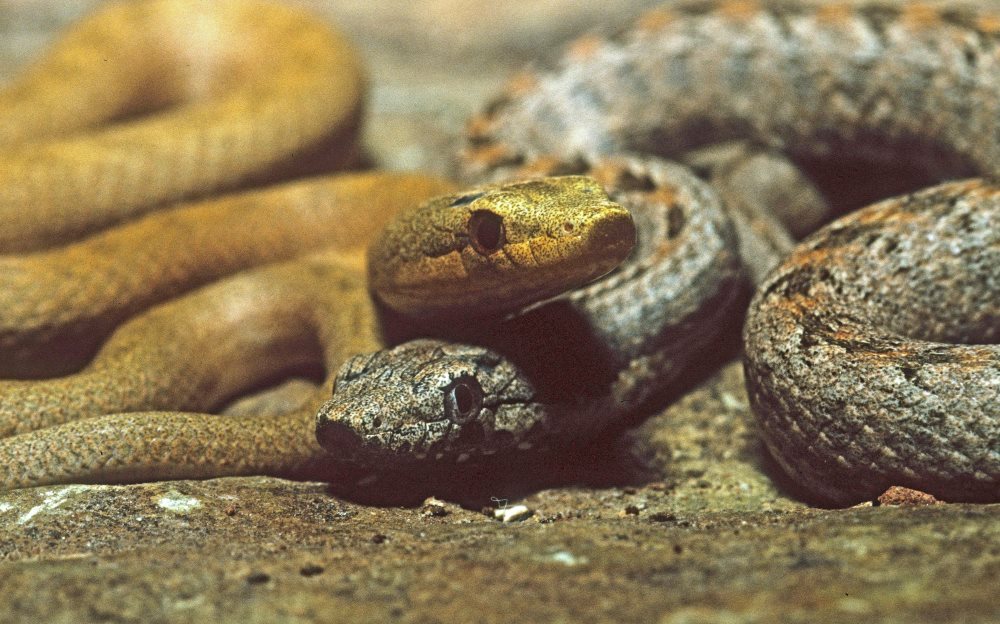
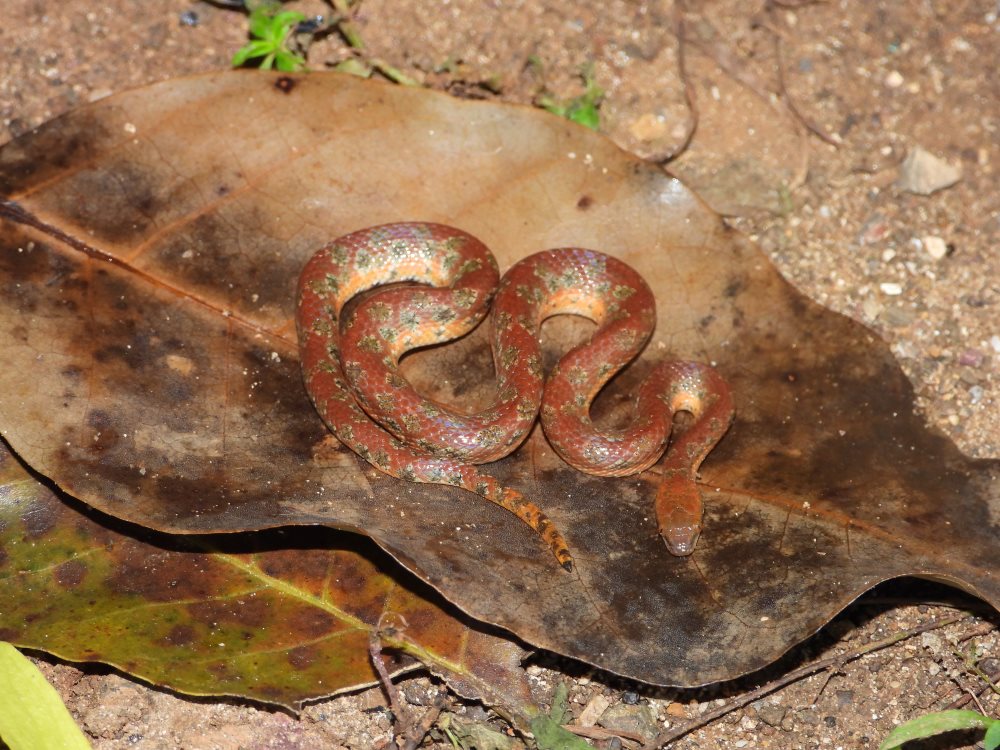
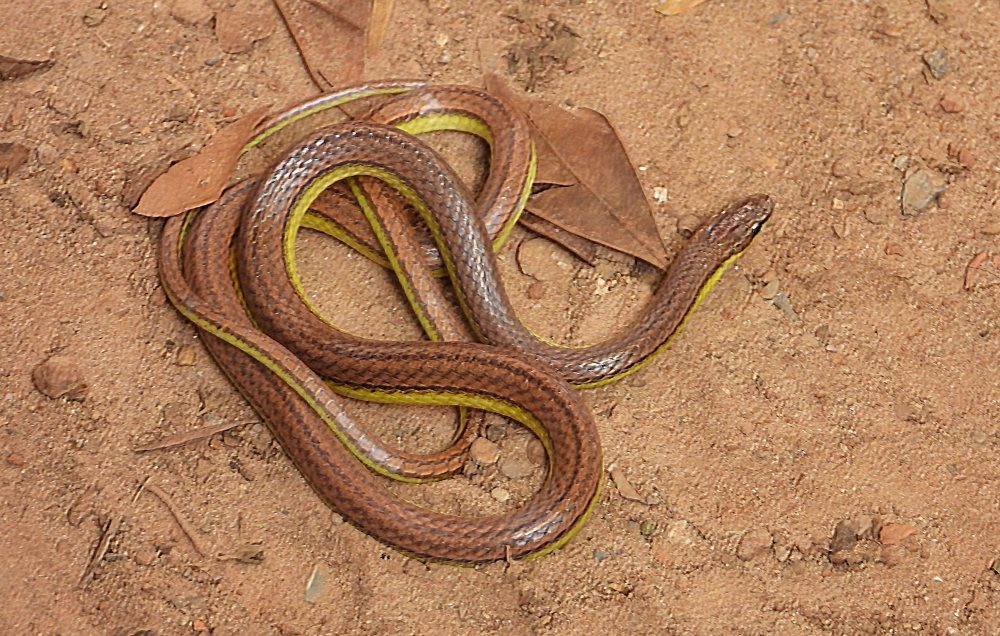
Arrhyton tanyplectum, Guaniguanico Racerlet
Small, slender, speedy, and quite secretive describes the appearance and habits of all members of this grouping. All, like the much larger Cuban Racer, Cubophis cantherigerus, are rear-fanged members of the family Dipsadidae. Those pictured here are of the genera Arrhyton, the Racerlets, and Caraiba, the Lesser Racer.. All are usually reluctant to bite, and of no danger to humans.
I make no attempt to identify or differentiate Arrhyton taxa herein, but merely mention some often overlapping generalities as to colors and patterns.
Dorsally and laterally, snakes of the genus Arrhyton are clad in shades of brown. The hues may varying from near-black to a light bronze or silvery-gray. The belly is yellowish. Depending on species, as well as on individual variations, vertebral and lateral stripes may be strongly present or absent. One species has a prominent whitish collar, another has a yellowish collar broken dorsally, and many have black or brown crowns.
The Cuban Lesser Racer, Caraiba andreae, on the other hand is a small but variably marked black and white snake (black above, white below) with a prominent light stripe from nose, to above each eye, and continuing to the back of the head. The labials (lip scales) are also white to cream. The result of these light stripes, of course, leaves a prominent dark stripe through each eye.
And now to the pix.
Read full article
March 11, 2024
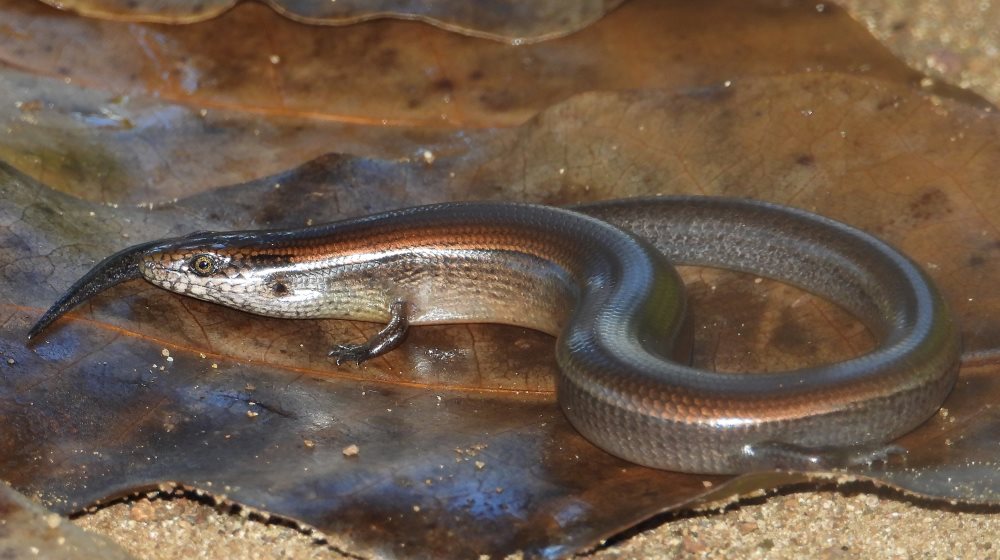
An adult male D. delasagra
In Cuba, the family Diploglossidae is represented by 3 species of secretive, fossorial, forest dwelling lizards of the genus Diploglossus, that look overall, very much like skinks. In fact, with their polished scales and narrow head, they were at one time classified as skinks. This species is known to hybridize with at least one, and possibly with both, other species in the genus at the eastern end of its large range.
Luckily, we found 1 species, D. delasagra. It, a small, shiny, and short, legged species, will writhe quickly beneath leaf litter if exposed. It also seeks shelter beneath rocks and fallen tree trunks and limbs.
It is adult at a length of about 9 inches, of which a bit more than half is tail length.
Dorsal color is a warm brown, the sides vary from chocolate brown to black. The belly is yellowish. Oviparous, one female found recently was coiled around 5 soft-shelled eggs. Hatchlings are colored like the adults.
Read full article
December 18, 2023
An Hispaniolan Bark Anole on the ascent in A Florida Hammock.
In some cases this variable species might be referred to as “that other Florida anole.”
It seems that no one is 100% certain how this Hispaniolan/Bahaman species reached Florida in 1946, but reach it, it did, perhaps as a whim of Mother Nature, but more likely the result of multiple whims by humans.
The species history of the Bark Anole, Anolis distichus, might be termed as “active.” At one point in time the Bark Anole was overloaded with 18 subspecies. But people seemed unable to decide if several of these were truly subspecies or were actually full species. Today nothing is definitive (so who is surprised?).
There are probably 2 subspecies of the Bark Anole in Florida. Except for overall color a single description fits both equally well.
There is the always some- shade- of- dark- banded- brown- or- gray A. d. floridana , and the often some- shade- of -green A. d. dominicensis.The throat fan of the males may vary individually from pale yellow to light orange. In all, the dark banding is straight and most prominent across the head from eyelid to eyelid and on the tail. Dorsal banding is in the form of narrow, often difficult to see, chevrons.
Both anole subspecies are arboreal, predominantly tree trunk/low limb, species.
Bark Anoles are one of the smaller species attaining an adult size of 4 to 5 inches of which a little more than half is tail length.
In Florida these little anoles are often found in colonies, are wary, and can be difficult to approach.
Ants and other small crawling insects seem to be the favored prey of this species.
Read full article
December 11, 2023
Aquatic Anole, A. vermiculatusLet’s take a look at the anoles in general.
The Anoles are a huge grouping of small (Carolina Anole, Anolis carolinensis, 5 to 8 inches overall) to relatively large (Knight Anole sp., Anolis equestris 14-19 inches overall) sized New World lizards. Number-wise there are more than 275 (probably closer to 400) species.
Males are larger than females; males have dewlaps (throat fans), and both sexes have expanded toe pads. Most species are primarily arboreal, some dwell in canopy locations, others on lower twigs, many are at home on tree trunks, while a few are at least partially aquatic (A. aquaticus & A. vermiculatus are examples of this latter).
Most are insectivorous, some add fruit to the daily diet. Cannibalism by large taxa on smaller is well documented. Color-changing ability of some have led to the vernacular of “American Chameleon.” In some cases the color changes from green to brown or yellowish, gray, or brown may be accomplished in only seconds. Many other taxa can only alter the intensity of their normal coloration, let’s say from light brown or tan to deep chocolate brown being the norm.
Of the huge species number (most reside in the West Indies, Central and South America) we have in the USA only one taxon, the green or Carolina Anole, that qualifies as a confirmed native. Some folks consider a second, a subspecies of the Bark Anole, A. distichus floridanus, as a second native form, but this remains questionable.
But given suitably warm temperatures, such as those normal in central and southern Florida, several exotic species (I list these below) have been introduced and become established. To date, the most successful of these exotics has been the Brown (often called the Cuban or Cuban Brown) Anole,
Anolis sagrei. This species is now seen, at least sparingly, from the Carolinas to Texas. Established in southern Florida:
Anolis allisoni, Cuban Blue-fronted Anole,
Anolis.callainus, Dominican Green Anole (hold on – there are two more species with this common name)
Anolis cristatellus,. Puerto Rican Crested Anole
Anolis coelestinus, commonly known as the Hispaniolan Green Anole
Anolis cybotes, Large-headed Anole (Hispaniola)
Anolis distichus, Bark Anoles (originally 3 subspecies)
Anolis equestris, Cuban Giant or Knight Anole
Anolis garmani Jamaican Giant Anole (FL population now greatly reduced in numbers by unusual dips in winter temperatures.
Anolis peynadoi, Dominican Green Anole (1 of 3 species also known as as “Hispaniolan Green Anole)
Anolis porcatus, Cuban Green Anole
Anolis sagrei, Cuban Brown Anole
Read full article
December 4, 2023
An adult male Saba Isle Anole. Anolis sabanus
Saba!
What is Saba?
Saba, it turns out, is a tiny upthrusting in the northeastern Caribbean. Only about 5 miles across, this tiny island has sandy beaches (expensive hotels), 4 main villages having descriptive names such as The Bottom (Saba's capital), Windwardside, St. John's and Zion's Hill (aka Hell's Gate), and even has some rainforest. Oh yes, it also has 3 indigenous and endemic reptiles, an anole, a Sphaerodactyline gecko and a Colubrine snake.
But initially it was only the anole that I found of interest. I had learned of this lizard through Jake, who had talked of both its homeland and beauty for months. In fact, Jake wanted to fly to this lizard’s dot of land to photograph it. But to me it seemed a long journey simply to photograph a single lizard species, and an anole at that.
Then Jake found an online pic and my attitude was swayed. I had just about made up my mind to opt into the “Jake’s Anole Expedition” when an online ad for that exact species popped up on my computer screen. Rather than take the trip. I bought a couple of the lizards…both gender. The live lizards that arrived were even prettier than the pix I had seen. The anoles are sexually dimorphic, the female lacking the polka-dots of the adult males.
Both the male and the female, seem to be doing well, eating tiny crickets and flightless fruit flies. Males have a beautiful, large, deep yellow throat fan. I hope you’ll agree that, although not one of the larger species, it is a species well worth looking at.
Read full article