That Other Lancehead
By Richard Bartlett · May 9, 2016 12:15 am
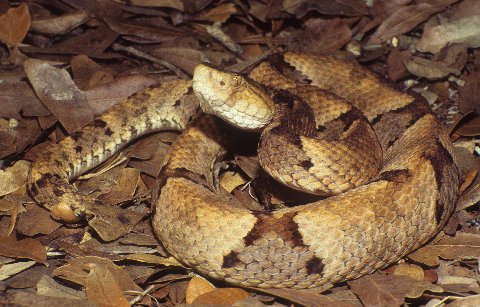
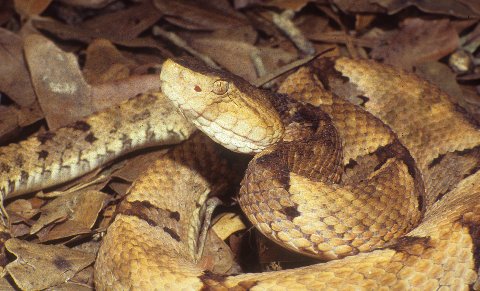
The seemingly uncommon Brazil's pit viper is heavy bodied and rather precisely patterned. “That guy on the bank has a snake.” The speaker was Rob. The place was a tributary of the mighty Amazon. We were on a riverboat. I don’t remember how Rob got that snake. I know the boat had slowed and I guess Rob hopped overboard and swam. But get it he did. And once there the snake—a Brazil’s lancehead, Bothrops brazili-- was temporarily housed in a small duffle. I also remember Rob exclaiming that he thought he had just gotten bitten and the relief we all felt when it was learned that Rob had just pricked his finger on a sharp projection. That was the first of my 3 meetings with a Brazil’s lancehead (a patronym honoring Dr. Vital Brazil of Instituto Butantan fame and not a place reference). Of these 3, 2 were alive and one had been freshly killed by a villager that had happened upon the snake while gardening. It would seem that the preferred habitat for Brazil’s lancehead is amidst the forest-floor litter in primary rainforest. This taxon is much less common than the sympatric fer-de-lance, B. atrox. The 2 species may usually be differentiated by the presence or lack of a postocular stripe—strongly defined on B. atrox and weakly defined or absent on B. brazili.
This is a dark phase Brazil's lancehead.
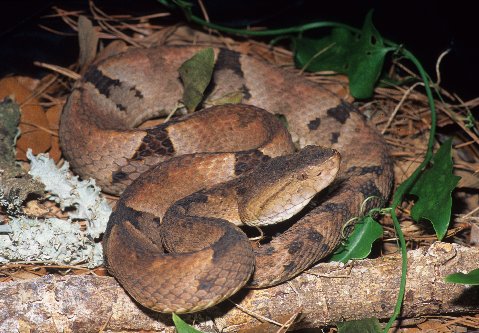
The postocular stripe is indistinct or lacking on this pit viper..