
Limbless wonders: The Western legless lizards
By Richard Bartlett · May 5, 2015 5:01 am
Although they have a superficial resemblance to the eastern glass lizards, the western genus Anniella, is contained in the family Anniellidae. Until very recently the genus was comprised of only 2 species, one in California and northern Baja and a second endemic to Baja California. Initially, based on coloration, the American species, Anniella pulchra, was thought to have 2 subspecies. A. p. pulchra, the California legless lizard, occurred over most of range with the black legless lizard, A. p. nigra replacing it in the Monterrey Bay and peninsula region. Examples intermediate between the California and the black in coloration were found elsewhere south of the range of the black examples.
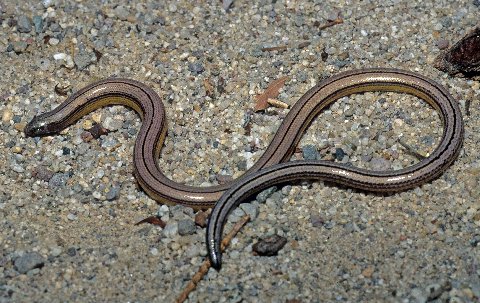
The subspecies concept had fallen into disfavor with geneticists, so for a while, no matter its color or where within its range it occurred, the California legless lizard was considered a single entity.
However, genetics, now in vogue, eventually came into play and within the single species researchers determined that there were 5 clades. A "clade" is a group consisting of an ancestor and all its descendants, a single "branch" on the "tree of life," and that ancestor may be an individual, a population or even a species whether or not still extant. Researchers hypothesized that there were now 6 full species contained in what was until their assessment a single species.
So add now to the still extant A. pulchra, the hypothetical species A. stebbinsi, A. alexanderae, A. campi, A. grinnelli, and A. stebbinsi.
And we still have to add A. geronimensis, from south of the border.
As 2 friends have told me, these and similar recent hypotheses by other researchers seem to be solutions to problems not yet asked. Believe me, the solution to the non-problem regarding the legless lizards does not stand alone.
These lizards, no matter their name, are accomplished burrowers. Besides making their own burrows when substrate is of the proper consistency, they may seek seclusion beneath surface debris or may enter and follow a burrow premade by a small rodent or large insect.
Most that I have found have been only a half inch or so beneath the surface or beneath boards atop a yielding sand substrate or in shallow seaside burrows.
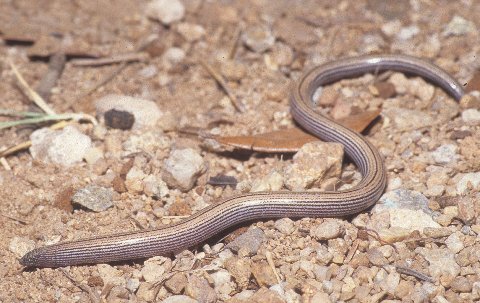
Once known as Anniella pulchra nigra, when adult the legless lizards of the Monterey region are of dark coloration.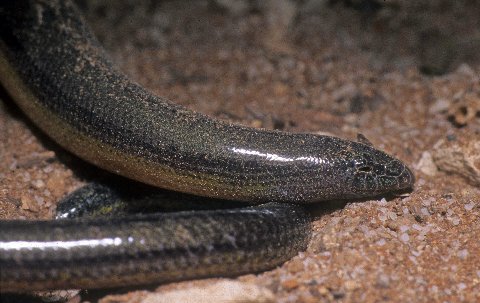 This is the prominently striped Baja legless lizard, Anniella geronimensis, a resident of coastal dunes.
 Author, photographer, and columnist Richard Bartlett is one of the most prolific writers on herpetological subjects in the 20th century. With hundreds of books and articles to their credit, Richard and his wife Pat have spent over four decades documenting reptiles both in the field and in captivity. For a list of their current titles, please visit their page in our bookstore. Author, photographer, and columnist Richard Bartlett is one of the most prolific writers on herpetological subjects in the 20th century. With hundreds of books and articles to their credit, Richard and his wife Pat have spent over four decades documenting reptiles both in the field and in captivity. For a list of their current titles, please visit their page in our bookstore. |