Looks can be deceiving when it comes to the leopard rat snake
By Richard Bartlett · March 10, 2015 5:16 am
Many, many, years ago when I first saw a photo of Elaphe situla (now Zamenis situla) I did a double take. Although it was captioned "Leopard Rat Snake," at first glance (and even at second glance) it sure looked like a corn snake.
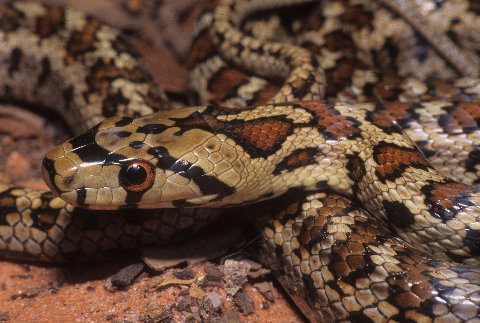
Eventually I was lucky enough to see a leopard rat snake and to learn there are two distinctly different patterns, a saddled and a striped. Later still, I acquired a pair of each phase and bred the taxon. I learned that despite the similarity of the saddled phase to our corn snake the slender, Old World, leopard rat snake was and is quite unlike the New World species.
Please allow me to introduce you.
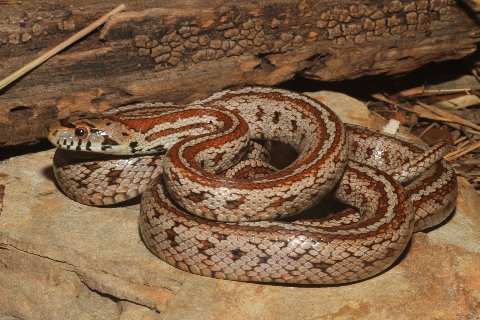
First, although often referred to as a European taxon, the leopard rat snake is actually Eurasian in distribution. This snake has a ground color of warm brown to gray and, depending on the phase, either a pair of dark-edged red stripes or neck-to-tail irregular dark bordered red saddles.
Both phases have a row of prominent black spots along each side. A dark interocular crescent is present as are other dark markings on neck and face. The venter varies from being nearly solid black to being light with black checkers. This scrubland snake is adult at a slender 2 to 3 feet in length.
I was told that captive bred examples will feed readily on suitably sized lab mice. Those I had, though, were wild caught and refused lab mice, but readily accepted wild mice of the genus Peromyscus (white-footed and cotton mice). To comply with their tastes we began a breeding program of the desired mouse species. This was a bit time consuming but proved well worth the effort. The snakes thrived, bred, and as I had been told the hatchlings did indeed feed readily on pinky lab mice.
A blotched phase leopard rat snake with prekilled cotton mouse prey.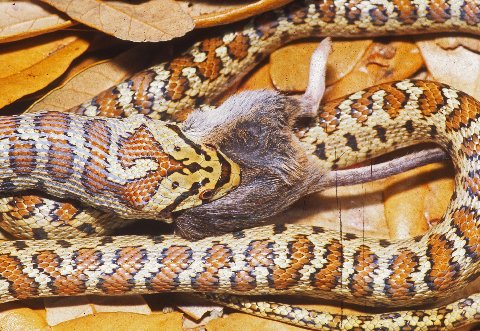 A striped phase leopard rat snake.
 Author, photographer, and columnist Richard Bartlett is one of the most prolific writers on herpetological subjects in the 20th century. With hundreds of books and articles to their credit, Richard and his wife Pat have spent over four decades documenting reptiles both in the field and in captivity. For a list of their current titles, please visit their page in our bookstore. Author, photographer, and columnist Richard Bartlett is one of the most prolific writers on herpetological subjects in the 20th century. With hundreds of books and articles to their credit, Richard and his wife Pat have spent over four decades documenting reptiles both in the field and in captivity. For a list of their current titles, please visit their page in our bookstore. |