


Hide and seek with a greenhouse frog
By Richard Bartlett · February 5, 2015 5:35 am
Today the range of the greenhouse frog, Eleutherodactylus planirostris, (now one of the most common of Florida's frogs) extends, at least locally, as far north as coastal southern South Carolina and eastern Texas. This tiny Bahaman, Cuban, and perhaps Cayman Island interloper has a weak, almost tremulous voice: a chirping whistle that is often mistaken for the stridulations of crickets.
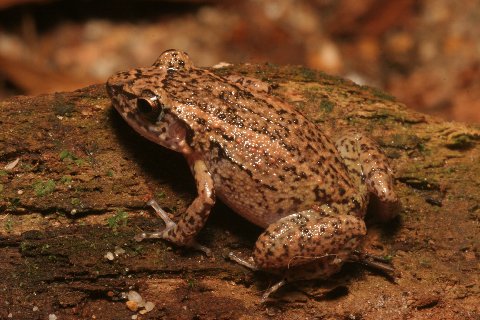
However, the tinkling calls are more musical and have less of a cadence. Loose mulch, leaf litter and the moisture holding cups of terrestrial bromeliads are among the favored habitats, but any and all manner of surface debris - discarded newspapers, construction materials, or vegetable debris, be it in backyard or woodland - provide ready homes for this inch long tropical frog.
Since this frog has direct development (no free-swimming tadpole stage), standing water is neither necessary nor sought. The eggs are laid in moist locales,such as on a bromeliad leaf, and when the young emerge they are miniatures of the adult.
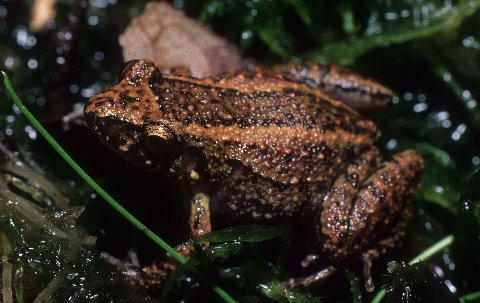
The ground color of this frog may be brown to reddish brown and usually blends remarkably well with the background. The pattern of lighter striping or darker reticulations serves to break up the outline making this anuran even more difficult to see. In fact it is only the almost imperceptible stirring of a dead leaf made as the alert frog darts quickly from sight that discloses its presence.
So if you're herping in the deep south and you think you see a leaf move when you turn debris, take a moment and check it out. You might have just seen a departing greenhouse frog. It would be good to keep tabs on their actual distribution.
Direct development: fully developed froglets (not tadpoles) emerge from the egg capsules.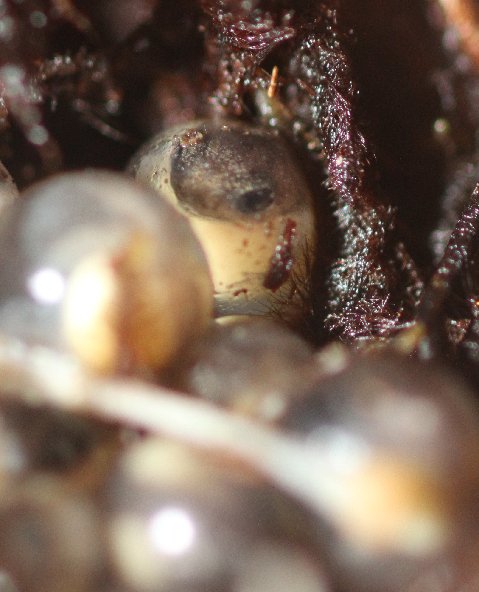 A prominently striped greenhouse frog.
 Author, photographer, and columnist Richard Bartlett is one of the most prolific writers on herpetological subjects in the 20th century. With hundreds of books and articles to their credit, Richard and his wife Pat have spent over four decades documenting reptiles both in the field and in captivity. For a list of their current titles, please visit their page in our bookstore. Author, photographer, and columnist Richard Bartlett is one of the most prolific writers on herpetological subjects in the 20th century. With hundreds of books and articles to their credit, Richard and his wife Pat have spent over four decades documenting reptiles both in the field and in captivity. For a list of their current titles, please visit their page in our bookstore. |