


The giant false viper
By Richard Bartlett · August 19, 2014 5:50 am
Xenodon (Waglerophis) merremi, the giant false viper, is a variably colored and patterned dipsadine snake that has several well-developed defensive mechanisms including body inflation or hood spreading, hissing, and striking.
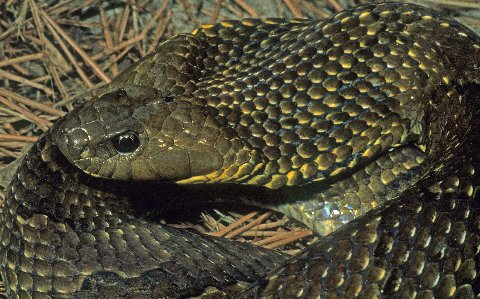
In these actions, this three and one-half foot long snake is much like North American hog-nosed snakes. Unlike the hog-noses, which are reluctant to bite, the false viper displays no such hesitancy. It is an opisthoglyphid species with enlarged teeth at the rear of the upper jaw and a venom that quickly immobilizes its anuran prey, and which can be painful to humans should they be bitten.
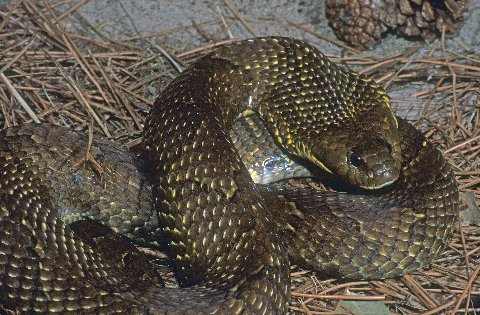
This is an oviparous species and clutches between fifteen and thirty-nine eggs have been recorded. Hatchlings, juveniles, and subadults usually bear light edged hourglass shaped bands that are darker than the ground color. Once adult, the pattern fades and many of the older adults are basically an overall dark olive-gray with a light fleck on each scale.
More photos below...
Strongly banded when young, the pattern of adult giant false vipers is barely discernable.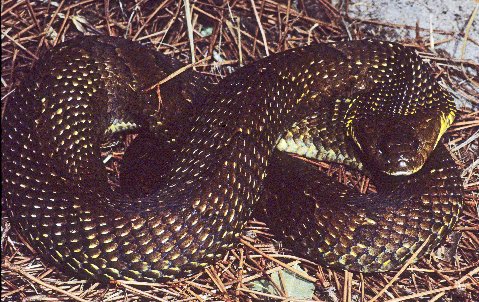 The light flecking ads a touch of brilliance to the otherwise dark colored giant false vipers.
 Author, photographer, and columnist Richard Bartlett is one of the most prolific writers on herpetological subjects in the 20th century. With hundreds of books and articles to their credit, Richard and his wife Pat have spent over four decades documenting reptiles both in the field and in captivity. For a list of their current titles, please visit their page in our bookstore. Author, photographer, and columnist Richard Bartlett is one of the most prolific writers on herpetological subjects in the 20th century. With hundreds of books and articles to their credit, Richard and his wife Pat have spent over four decades documenting reptiles both in the field and in captivity. For a list of their current titles, please visit their page in our bookstore. |