
On the trail of the Eastern newt
By Richard Bartlett · July 1, 2014 6:08 am
I had followed an old "woods road" through a hemlock forest to a beautiful pond of about an acre in size. As I had plodded slowly through the shady woodlands that were still enshrouded and dampened by the morning's fog, I took pleasure in seeing that the forest floor was literally acrawl with red efts.
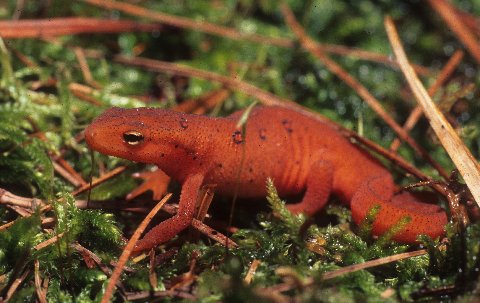
These, the terrestrial stage of the red-spotted newt, Notophthalmus v. viridescens, were the most obvious and seemingly the most common amphibian species along my trek. But by the time I had reached the pond-bank the fog had dissipated and the sun was shining brightly.
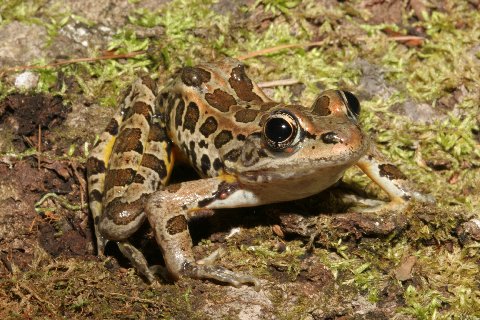
Pickerel frogs, Rana (Lithobates) palustris, leapt to the safety of the shallows as I walked slowly along the sunny banks.
Here and there a stirring in the water would draw my attention to an aquatic adult newt or a diving beetle.
But unbeknownst to me at that moment there was a grand finale just a few steps ahead. There in a narrow and shallow inlet, partially shaded by a fallen tree, I encountered a breeding congregation of red-spotted newts.
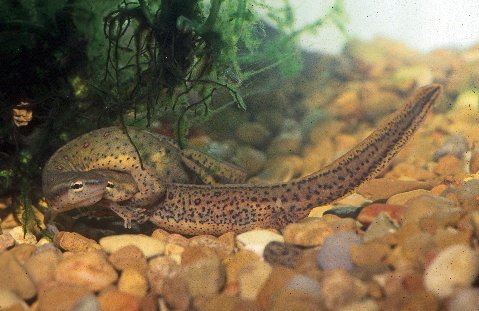
Numbering in the low hundreds, dozens of pairs were in amplexus while others were still in the courtship stage, The population in this one small inlet would certainly account for the vast population of efts I had seen earlier. It is always good to see Mother Nature hard at work.
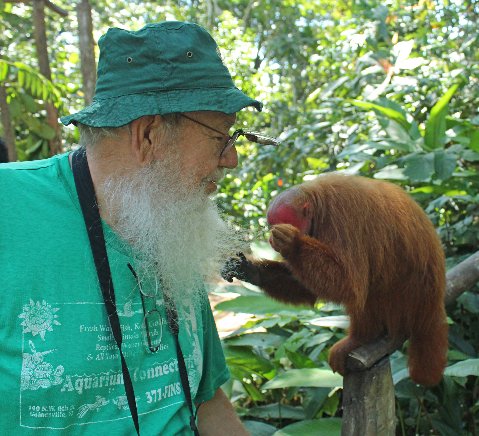 Author, photographer, and columnist Richard Bartlett is one of the most prolific writers on herpetological subjects in the 20th century. With hundreds of books and articles to their credit, Richard and his wife Pat have spent over four decades documenting reptiles both in the field and in captivity. For a list of their current titles, please visit their page in our bookstore. Author, photographer, and columnist Richard Bartlett is one of the most prolific writers on herpetological subjects in the 20th century. With hundreds of books and articles to their credit, Richard and his wife Pat have spent over four decades documenting reptiles both in the field and in captivity. For a list of their current titles, please visit their page in our bookstore. |