
On the Western (ornate and desert) box turtles
By Richard Bartlett · November 8, 2013 6:30 am
The ornate box turtle, Terrapene ornata ornata, is the more easterly and northerly of the two Western box turtle subspecies. It ranges in suitable habitats (and disjunct populations) from northwestern Indiana to southeastern Wyoming and then southward to the Pecos and Rio Grande Rivers of Texas and eastward into southwestern Louisiana.
The easternmost range of the desert box turtle, T. o. luteola, begins at the Pecos River of Texas From there it ranges westward to southeastern Arizona and southward to northern Sonora and Chihuahua, Mexico.
Of the two, the ornate is usually the darker, the more contrastingly marked, and, having nine or fewer radiations on costal scute number two, the less busily patterned.
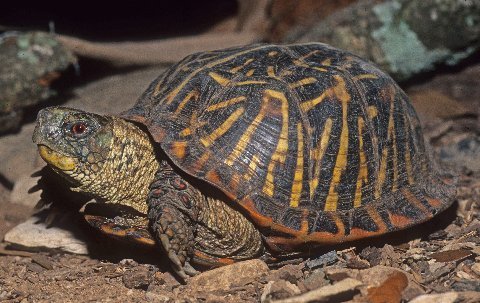
From the desert box turtle side of the slate, at adulthood this latter usually has a muddier colored carapacial ground color, the light markings are less precise, and the busier pattern consists of ten or more radiations on carapacial scute number two.
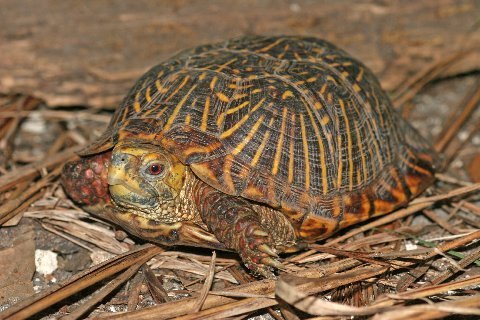
Intergradation is well documented in a wide swath on both sides of the Pecos. Males of both subspecies have red irides. The irides of females are white.
Both subspecies of the western box turtle are strongly insectivorous, seemingly with a preference fof orthopterans (grasshoppers and crickets).
Desert box turtles often hunt down their orthopteran prey by walking slowly along the edges of roadways where the grasses are tall and the grasshoppers plentiful. I have watched them sidle along an inch away from and angled 30 to 45 degrees toward the overhanging road-edge grasses. A quick dart of the head and a grasshopper "bit the dust." The turtles seemed quite at home with this strategy and very successful in catching the insects.
I have also observed western box turtles (both subspecies) eating roadkill (lizards, anurans, rodents, lagomorphs, and spiders). It seems that olfactory senses play some part in finding dead items, for on one occasion I watched an insect-hunting female pivot suddenly while in insect-hunting mode and run almost 18 inches onto the pavement to consume a recently killed spadefoot.
Sadly, as seen by occasional box turtles that have themselves been traffic victims at other roadkill, eating roadkill places the turtles at considerable danger from traffic.
 Author, photographer, and columnist Richard Bartlett is one of the most prolific writers on herpetological subjects in the 20th century. With hundreds of books and articles to their credit, Richard and his wife Pat have spent over four decades documenting reptiles both in the field and in captivity. For a list of their current titles, please visit their page in our bookstore. Author, photographer, and columnist Richard Bartlett is one of the most prolific writers on herpetological subjects in the 20th century. With hundreds of books and articles to their credit, Richard and his wife Pat have spent over four decades documenting reptiles both in the field and in captivity. For a list of their current titles, please visit their page in our bookstore. |