Tree vipers in the night
By Richard Bartlett · September 17, 2013 6:17 am
When I saw my first living Western two-lined forest pit vipers, Bothriopsis bilineatus smaragdinus, in the wilds of Amazonian Peru, it was more or less because of a fortuitous rest, During that rest, a clutch of four neonates had been found coiled quietly on the broad leaves of a trailside shrub.
Patti and I were leading a herp photography tour, and earlier that day one of the participants had asked me what snake I had yet failed to see was highest on my list of "want to sees." My answer to her had been that it was this arboreal pit viper, a taxon that I had searched for on many other occasions but had failed to find.
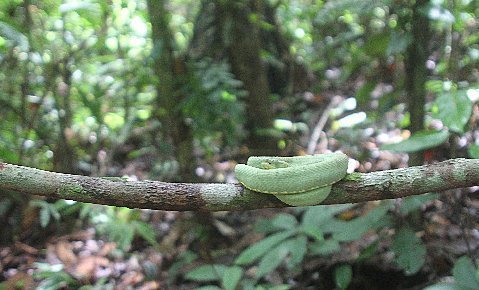
In fact, I had seen this black-peppered green subspecies only two times before. The first time had been in the cages of a northeastern reptile dealer. The second time had been an adult that had been killed by a Peruvian villager. Therefore I knew that the snake occurred in the forests that now surrounded us. But time and again Patti and I had walked various trails and failed to see the creature.
Our group was about a mile from camp on a forest trail that we had walked a few times previously and we had stopped for a short rest and regrouping. Our guides had just passed us by and a few hikers were coming up in back of us. Sandy was looking at the shrubs that were edging the trail and suddenly asked, "Is this the snake?"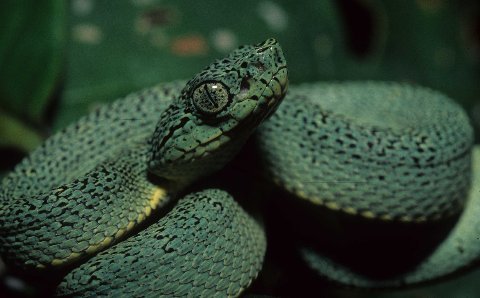 It was. I was elated, and when we found that there was actually four neonates, each on a separate leaf, I was ecstatic.
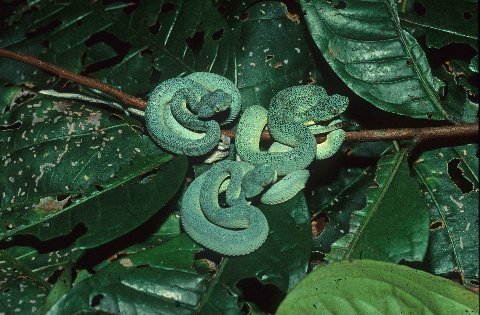 When it was brought to the attention of our guides that they had walked right by these babies they were crestfallen.
From the number of camera flashes that strobed the forest that night, I’m sure those snakes felt they were amidst a world class lightning occurrence. But at last the taxon had been found and documented. Now, several years later, each time I look at the photos I still think, "Thanks, Sandy!" That was a great trip.
When it was brought to the attention of our guides that they had walked right by these babies they were crestfallen.
From the number of camera flashes that strobed the forest that night, I’m sure those snakes felt they were amidst a world class lightning occurrence. But at last the taxon had been found and documented. Now, several years later, each time I look at the photos I still think, "Thanks, Sandy!" That was a great trip.
 Author, photographer, and columnist Richard Bartlett is one of the most prolific writers on herpetological subjects in the 20th century. With hundreds of books and articles to their credit, Richard and his wife Pat have spent over four decades documenting reptiles both in the field and in captivity. For a list of their current titles, please visit their page in our bookstore. Author, photographer, and columnist Richard Bartlett is one of the most prolific writers on herpetological subjects in the 20th century. With hundreds of books and articles to their credit, Richard and his wife Pat have spent over four decades documenting reptiles both in the field and in captivity. For a list of their current titles, please visit their page in our bookstore. |