


A dewlap of a different color
By Richard Bartlett · June 25, 2013 6:25 am
My yard in Ft. Myers, FL, was well-populated with Green Anoles, Anolis carolinensis. Although most males that I saw had dewlaps of bright pinkish red, dewlaps that I then referred to as “normal” a small percentage had dewlaps of greenish-white, gray, grayish green, or (I suspected) when a normal and a gray interbred the dewlap would be pale pink broadly edged with gray or white.
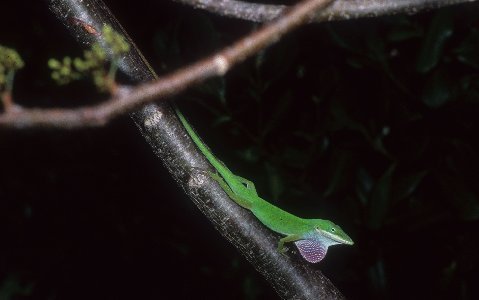
But if the dewlap wasn’t normal then the lizards were referred to as “abnormals.” But truthfully, I never thought too much about the dewlap color. I just enjoyed the lizards for what they were.
Then in 1991 the unthinkable happened. In the Bulletin of the Maryland Herpetological Society, Thomas Vance elevated these gray throats to subspecies status and dubbed them Anolis carolinensis seminolus.
I was perplexed by this listing then and remain so today, for as I understood the subspecies concept (and I am a believer in subspecies), two subspecies could not populate the self same niche, and to qualify as a subspecies 75 percent of a population must display the stated characteristics.
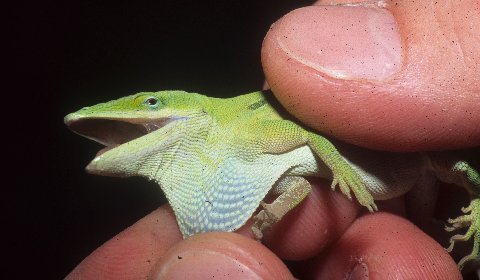 At no place where I had seen the gray-throats was that phase exclusive or even dominant. I do not believe that they constituted anywhere near 75 percent of the populations. There were pink-throats, gray-throats, and intermediate-throats present.
Admittedly I have never made an actual survey to compare the percentages of a given throat color of this arboreal lizard, but in areas where I have been told they are common I still see more pink-throats (now Anolis carolinensis carolinensis) than the grays. And, of course, the females, lacking dewlaps, are indistinguishable.
At no place where I had seen the gray-throats was that phase exclusive or even dominant. I do not believe that they constituted anywhere near 75 percent of the populations. There were pink-throats, gray-throats, and intermediate-throats present.
Admittedly I have never made an actual survey to compare the percentages of a given throat color of this arboreal lizard, but in areas where I have been told they are common I still see more pink-throats (now Anolis carolinensis carolinensis) than the grays. And, of course, the females, lacking dewlaps, are indistinguishable.
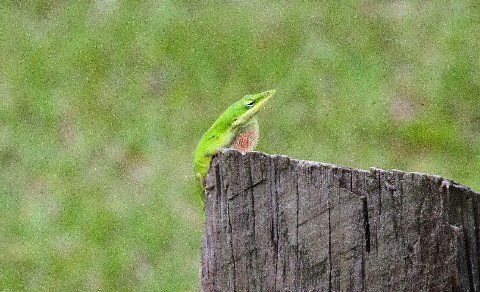 But with all this having been said, it seems certain that the anoles simply don’t care what you call them. Just don’t mess with their insect repast!
 Author, photographer, and columnist Richard Bartlett is one of the most prolific writers on herpetological subjects in the 20th century. With hundreds of books and articles to their credit, Richard and his wife Pat have spent over four decades documenting reptiles both in the field and in captivity. For a list of their current titles, please visit their page in our bookstore. Author, photographer, and columnist Richard Bartlett is one of the most prolific writers on herpetological subjects in the 20th century. With hundreds of books and articles to their credit, Richard and his wife Pat have spent over four decades documenting reptiles both in the field and in captivity. For a list of their current titles, please visit their page in our bookstore. |