The incredible disappearing fer-de-lance
By Richard Bartlett · April 23, 2015 5:40 am
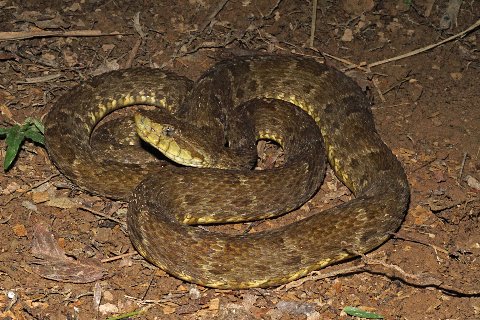
Everywhere and nowhere best describe where you may find this tropical American lance-headed snake. Certainly the fer-de-lance, Bothrops atrox, is one of the commonly seen venomous taxa on the Project Amazonas Biological Stations and in nearby villages, as well on trails far distant from all activity. Many seen are neonates or juveniles but some are 4 foot long adults.
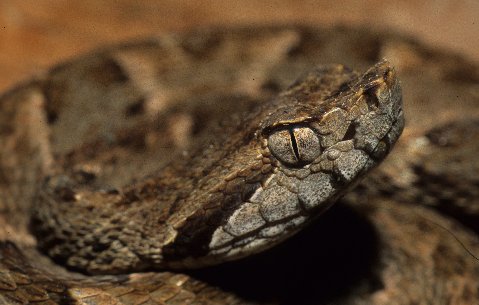
Depending on weather patterns, this snake may be seen in some numbers on one day and night and then be absent, or at least not seen, for several days.
Such was the case on one rainy trip. Small puddles along busy trails on Madre Selva Biological Preserve had drawn sizable populations of breeding frogs and the presence of the frogs had, in turn, drawn the fer-de-lances. Day or night for two days following the storm, we could check the perimeters of the puddles and find 3 or 4 of these snakes, often with body distended by a belly full of frog. However, by the third night we found that they had mostly dispersed and by the following day we saw none.
Then there was the time when a fer-de-lance wasn't present when we left the tambo (2-person cabin) to walk to the kitchen, but one was coiled tightly between the stepping stones when we returned a half hour later.
On another occasion, we hadn't seen a fer-de-lanc in the week we had been at the station. But one evening one person (who later told me he hadn't believed all of my warnings), was distracted in conversation with his son and almost stepped on one that was crawling slowly across the camp clearing.
We were sure glad it was "almost."
As I say, these brown on olive-brown snakes are everywhere, and nowhere. If you're in Amazonas use care - always. Plan ahead when out at night. Carry a flashlight and use it.
Fer-de-lances often seek shelter against the trunks of standing or fallen trees.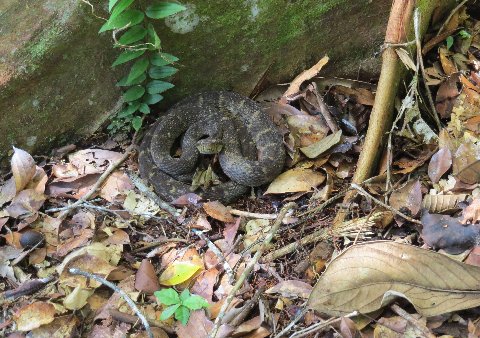 The pattern on this very common snake is variably distinct.
 Author, photographer, and columnist Richard Bartlett is one of the most prolific writers on herpetological subjects in the 20th century. With hundreds of books and articles to their credit, Richard and his wife Pat have spent over four decades documenting reptiles both in the field and in captivity. For a list of their current titles, please visit their page in our bookstore. Author, photographer, and columnist Richard Bartlett is one of the most prolific writers on herpetological subjects in the 20th century. With hundreds of books and articles to their credit, Richard and his wife Pat have spent over four decades documenting reptiles both in the field and in captivity. For a list of their current titles, please visit their page in our bookstore. |