


The little frogs with big voices
By Richard Bartlett · March 17, 2015 5:16 am
These elfin spirits of woodland and prairie care not whether you call them peepers, chorus frogs, or treefrogs. They are the various species of the genus Pseudacris, a genus comprised of about a dozen species.
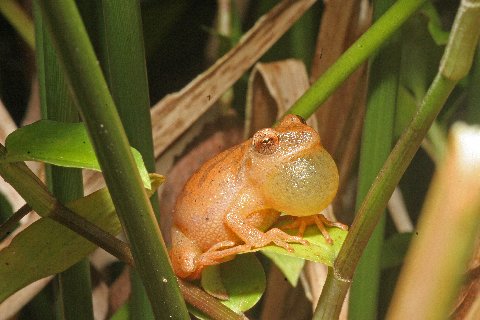
They include in their ranks the smallest frog of the United States, the southeastern little grass frog, P. ocularis, that is adult at only 5/8ths of an inch and the giant of the genus, the Pacific treefrog, P. regilla, that may be a full 2 inches long.
The majority of the species, however are adult at about 7/8ths inch to about 1 1/8th inches in length. In other words, all are diminutive.
Most of the chorus frogs have a vocalization that sounds like a fingernail being run along the small teeth of a plastic pocket comb. The pulse rate is slower and the frog's color darker when temperatures are cold. The trill is faster and the colors brighter when the frog is warm. Those that don't have an apparent ratcheting trill produce peeps. Truth be told though, if the pulse rate of the peeps were slowed you would again be listening to a very apparent ratcheting.
Even where populations of chorus frogs are producing boisterous choruses, the little frogs, usually clad in camouflage colors and patterns, can be difficult to see. More often than not they position themselves in a clump of grasses emerging from the shallows of an ephemeral pond (or roadside ditch), nose pointing almost straight upward, and when so positioned are almost invisible. If searching, it is often the inflated and vibrating vocal sac that is most apparent.
Of all chorus frogs, spring peepers, P. crucifer, and little grass frogs are the most arboreal. They may call from almost any available vantage position from water's edge to several feet high in vegetation.
I wish you happy hunting and much luck as you search for these little frogs. You will probably need it.
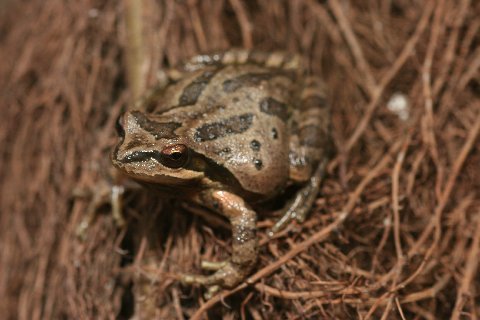
The high pitched tinkling calls of the little grass frog may be heard throughout the warmer months.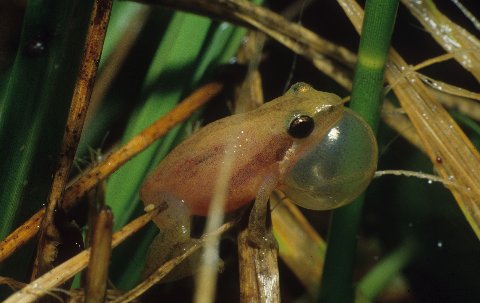 Although termed the Pacific treefrog, this robust anuran is actually a chorus frog.
 Author, photographer, and columnist Richard Bartlett is one of the most prolific writers on herpetological subjects in the 20th century. With hundreds of books and articles to their credit, Richard and his wife Pat have spent over four decades documenting reptiles both in the field and in captivity. For a list of their current titles, please visit their page in our bookstore. Author, photographer, and columnist Richard Bartlett is one of the most prolific writers on herpetological subjects in the 20th century. With hundreds of books and articles to their credit, Richard and his wife Pat have spent over four decades documenting reptiles both in the field and in captivity. For a list of their current titles, please visit their page in our bookstore. |