
Chicken turtles wander, but they aren't lost
By Richard Bartlett · March 3, 2015 5:15 am
It was late spring, in the Apalachicola National Forest (ANF) and I happened to have an hour to kill before meeting Kenny for a couple of days of herping. I was within a few miles of a favorite puddle, so decided to stop by for a hurried visit. During the winter this bit of water was a breeding site for ornate chorus frogs, I had seen a banded water snake or two there, and in previous years had seen a few mole salamanders beneath water edge logs.

But this time when I pulled up the site was unrecognizable. We had had an unusually wet winter and the rains had continued into the spring. The site, including the road-edge drainage ditch, was filled and overflowing with water. For a moment or two I contemplated whether I wanted to get wet just before leaving on a trip. But then a turtle surfaced in the flowing water of the ditch--a turtle with a narrow head and a prominently striped neck-- an eastern chicken turtle, Deirochelys r. reticularia.
Unlike many of their semi-aquatic emydine stay-at-home relatives, the chicken turtles (3 subspecies) are known for their peregrinations. These turtles wander widely from flooded meadow to vernal pond to the still waters of canal edges. If things get uncomfortably dry they dig down and aestivate. And although I consider them one of the "everywhere and nowhere" turtles (meaning they are widespread but seldom readily seen), they are seen infrequently enough to consider each sighting a mini-event.
So now, if you have interpreted the last paragraph correctly, you know I wasn't about to leave without at least trying to get some data from the chicken turtle. Yep. I got wet, but I was able to catch the turtle, a perfect example, an adult male. Hopefully he is still wandering, stopping now and again to sire more generations of wandering turtles. They are a delight to see.
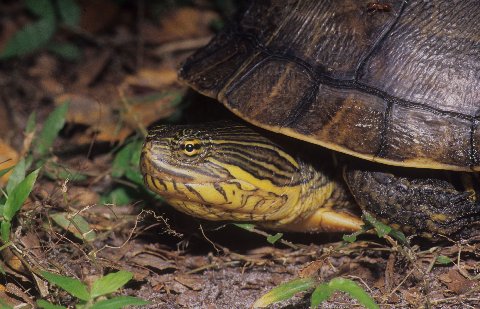
An eastern chicken turtle basks on an exposed snag.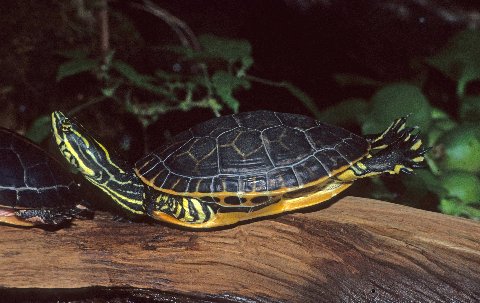 Busy striping on the narrow head and long neck typify a chicken turtle.
 Author, photographer, and columnist Richard Bartlett is one of the most prolific writers on herpetological subjects in the 20th century. With hundreds of books and articles to their credit, Richard and his wife Pat have spent over four decades documenting reptiles both in the field and in captivity. For a list of their current titles, please visit their page in our bookstore. Author, photographer, and columnist Richard Bartlett is one of the most prolific writers on herpetological subjects in the 20th century. With hundreds of books and articles to their credit, Richard and his wife Pat have spent over four decades documenting reptiles both in the field and in captivity. For a list of their current titles, please visit their page in our bookstore. |