


Whiskered vipers in the sand
By Richard Bartlett · January 6, 2015 5:40 am
Letters (remember the days when correspondence was via written letters?) were zipping back and forth from Tampa to Karachi. Jerry mentioned having just collected a "nice" half grown whiskered viper (also known as the McMahon's or leaf-nosed viper), Eristicophis mcmahoni from Balochistan.
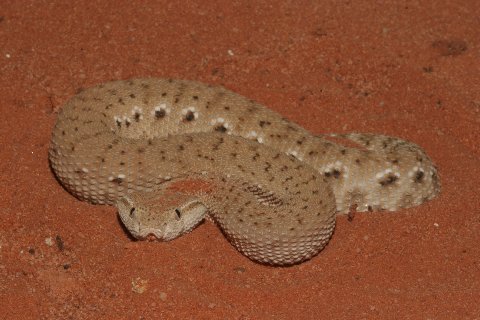
Since he was going to ship me a couple of hundred leopard geckos in a week, he was wondering whether I might want the snake as well. My answer was "yes, you bet I want it." About two weeks later, I was settling a whiskered viper into a sandy terrarium. And to say I was enamored with the beast would be a monumental understatement.
Whiskered vipers are not colorful but what they lack in that respect is more than made up for by their impressively defensive attitude. Until recently, when I decided to not keep "hots" any longer, whenever possible I had an Eristicophis or two in the collection. Although I have never succeeded in breeding this taxon, I have found them hardy and very responsive - the kind of snake that will meet you at the top of its terrarium to accept food from long forceps.
If startled this snake will inflate its body and exhale loudly and/or assume an "S" position and rub the scales together producing a very audible rasping sound.
Like many desert or savannah snakes, the whiskered viper is an ambush hunter that sinks all but its eyes and nostrils just below the surface of loose sand. From this position they are able to strike and envenomate their prey of unwary lizards or rodents .
Males, the smaller sex, are adult at less than a foot and a half. Females may near thirty inches in length but are usually only about two feet long.
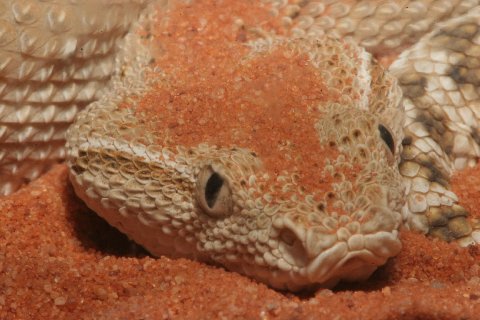
A whiskered viper in full ambush position. Only the eyes show.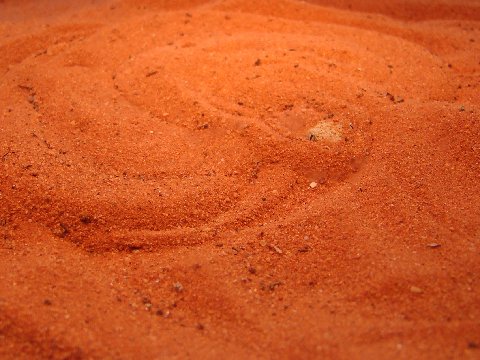 A closeup look at a whiskered viper.
 Author, photographer, and columnist Richard Bartlett is one of the most prolific writers on herpetological subjects in the 20th century. With hundreds of books and articles to their credit, Richard and his wife Pat have spent over four decades documenting reptiles both in the field and in captivity. For a list of their current titles, please visit their page in our bookstore. Author, photographer, and columnist Richard Bartlett is one of the most prolific writers on herpetological subjects in the 20th century. With hundreds of books and articles to their credit, Richard and his wife Pat have spent over four decades documenting reptiles both in the field and in captivity. For a list of their current titles, please visit their page in our bookstore. |