
Baby boxies
By Richard Bartlett · September 25, 2014 6:07 am
We sure don't live in the country, but there is enough undeveloped land around us to support a few Florida box turtles, Terrapene carolina bauri.
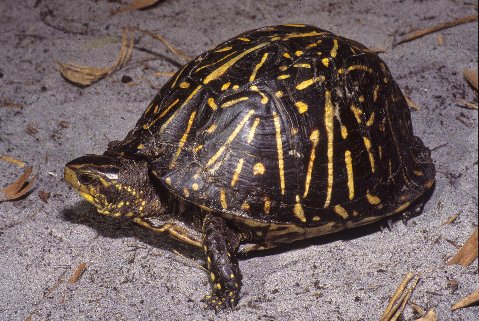
This pretty subspecies of the eastern box turtle is variably but quite consistently marked with yellow striping against a black carapacial ground color. Most seen here are adults and although it is always a pleasure to see them, I occasionally wonder where these turtles nest and how can the babies remain so successfully hidden?
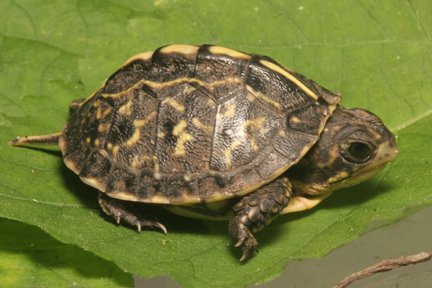
A couple of years ago, I got lucky. A gravid female Florida box turtle wandered up to the edge of a restraining board in our yard, dug her nest, and laid 4 eggs. I was able to watch the whole nesting and incubation sequence, and I happened to be nearby when three of the four eggs hatched (one appeared infertile). I decided to keep all and give them a "head start" before loosing them into the wilds.
As with other subspecies of the eastern box turtle, the carapacial color of the quarter-sized hatchlings was fragmented and the carapace itself was far less domed that of the adult. The hatchlings ate ravenously and at the end of the year I allotted for head start, they were more than one and half inches in length, carapacial doming was noted, and the carapacial markings were forming into the radiating stripes so typical of this turtle.
Although they have no identifying marks, I'll forever hope that at least some of the box turtles that I meet near my house are these babies, now grown.
More photos below...
After laying, this female Florida Box Turtle failed to carefully cover her eggs.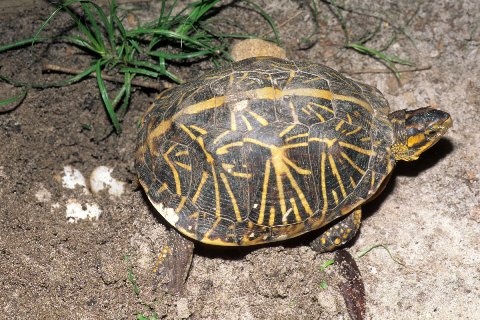 A young adult Florida Box Turtle.
 Author, photographer, and columnist Richard Bartlett is one of the most prolific writers on herpetological subjects in the 20th century. With hundreds of books and articles to their credit, Richard and his wife Pat have spent over four decades documenting reptiles both in the field and in captivity. For a list of their current titles, please visit their page in our bookstore. Author, photographer, and columnist Richard Bartlett is one of the most prolific writers on herpetological subjects in the 20th century. With hundreds of books and articles to their credit, Richard and his wife Pat have spent over four decades documenting reptiles both in the field and in captivity. For a list of their current titles, please visit their page in our bookstore. |