


Spiny-headed tree frog
By Richard Bartlett · September 16, 2014 5:56 am
Ranging in Atlantic versant tropical forests from Mexico southward to Panama, the spiny-headed tree frog, Anotheca spinosa, is a beautiful and unique hylid species.
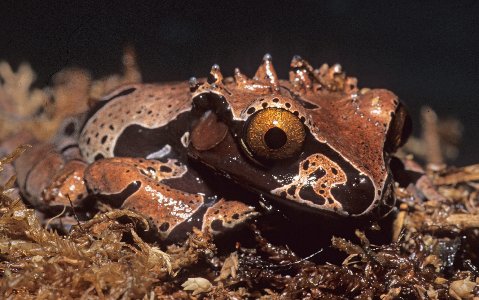
It is the only species in the genus Anotheca. Although it may occasionally call from arboreal bromeliads, it is more often found and heard in treehole situations. It is easier to find by following the hollow-booping nocturnal calls to their source than by sight.
Interestingly, the eggs are deposited above the water level and take nearly a week to develop and hatch. The light colored larvae darken within a few days after hatching into typically dark tadpoles. The tadpoles feed on various aquatic organisms including unfertilized eggs produced at several day intervals when the female returns to the breeding site.
Laying of these food-eggs seems induced by nudging the female by the tadpoles. As an aside, this tree frog has now been bred in captivity, and it is from these captive breedings that we have learned much of the reproductive biology.
Anotheca is a relatively large hylid with adults varying between 2 1/2 and 3 1/4 inches. The pattern of variably sized dark spots and blotches against a grayish ground color produces a pleasing but easily overlooked camouflaged tree frog.
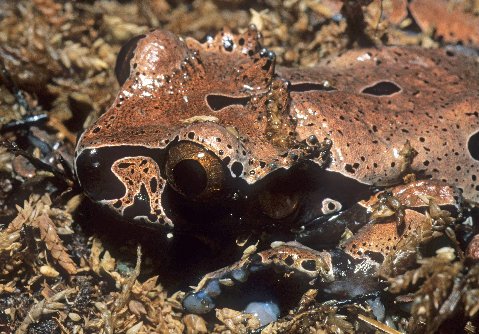
Metamorphs and juveniles lack the head spines from which both common and specific names are derived, but on adults the coronet of conical spines is very apparent.
More photos below...
The Spiny-headed Treefrog is well camouflaged.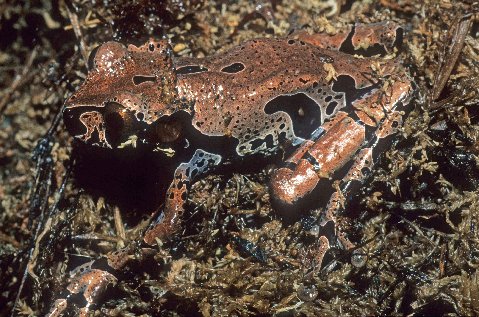 The coronet is not as conspicuous when seen from above or from the side.
 Author, photographer, and columnist Richard Bartlett is one of the most prolific writers on herpetological subjects in the 20th century. With hundreds of books and articles to their credit, Richard and his wife Pat have spent over four decades documenting reptiles both in the field and in captivity. For a list of their current titles, please visit their page in our bookstore. Author, photographer, and columnist Richard Bartlett is one of the most prolific writers on herpetological subjects in the 20th century. With hundreds of books and articles to their credit, Richard and his wife Pat have spent over four decades documenting reptiles both in the field and in captivity. For a list of their current titles, please visit their page in our bookstore. |