


The South Florida Mole Kingsnake: Hidden in plain sight
By Richard Bartlett · June 24, 2014 5:26 am
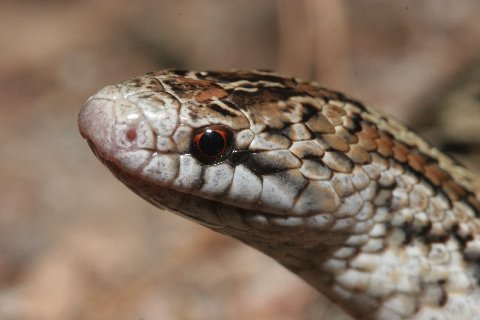 In the late 1900s, say around 1980 or so, it was finally realized that the range of the mole kingsnake, Lampropeltis calligaster rhombomaculata, as then shown in field guides was woefully inaccurate.
Rather than stopping just south of the Georgia and Alabama state lines as then suggested, the snake actually ranged to the Gulf Coast on the Florida Panhandle and perhaps even further south on the peninsula. But then, even as now, the actual range of this persistently fossorial snake was (and is) imperfectly known.
How little we actually knew about this subspecies was further demonstrated when in 1987 R.M. Price described a mole king from the southern peninsula of Florida that bore sufficiently different facial markings to warrant the erection of a new subspecies that he called L. c. occipitolineata, and that is now known by the common name of Southern Florida mole kingsnake.
Despite having been recognized for more than a quarter century, this small (usually less than 3 feet long), strongly blotched lampropeltine is still considered a comparative rarity. Like its more northerly relative(s) the head of the southern Florida mole king is not much broader than the neck, and, although the head pattern comverges on the neck, it is not as precise as the diagnostic "spearpoint" of the corn snake, the only species with which this mole king is apt to be confused.
For additional information on this interesting snake, please look up Price, R. M. 1987, Disjunct occurrence of mole snakes in Peninsular Florida, and the description of a new subspecies of Lampropeltis calligaster. Bull. Chicago Herpetol. Soc. 22(9):148.
More photos under the jump...
Juvenile Southern Florida mole kings are strongly patterned: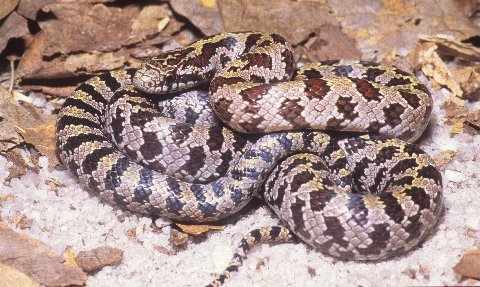 1
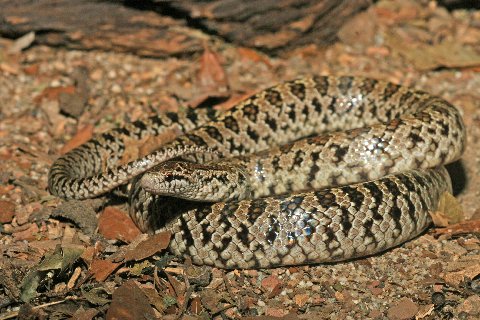
The pattern of adult Southern Florida mole kings (like that of this male) may not contrast sharply with the ground color:
1
The pattern of adult Southern Florida mole kings (like that of this male) may not contrast sharply with the ground color:
 3
3
 Author, photographer, and columnist Richard Bartlett is one of the most prolific writers on herpetological subjects in the 20th century. With hundreds of books and articles to their credit, Richard and his wife Pat have spent over four decades documenting reptiles both in the field and in captivity. For a list of their current titles, please visit their page in our bookstore. Author, photographer, and columnist Richard Bartlett is one of the most prolific writers on herpetological subjects in the 20th century. With hundreds of books and articles to their credit, Richard and his wife Pat have spent over four decades documenting reptiles both in the field and in captivity. For a list of their current titles, please visit their page in our bookstore. |