

Big, beautiful, and abundant: The broad-headed skink
By Richard Bartlett · January 28, 2014 6:00 am
For decades they were contained in the cosmopolitan skink genus Eumeces, but with the advent of genetic assessments they are now Plestiodon. But the specific name of laticeps has remained intact. They are the largest of the three East Coast five-lined skinks, surpassing the common five-line, P. fasciatus, and the southeastern five-line, P. inexpectatus, in both length and body mass.
The body color of adult males, marginally the larger gender, is a beautiful stripeless fawn brown. When adult they may attain an overall length of 12 inches.
The somewhat smaller females tend to retain at least vestiges of the striping. During the spring and early summer breeding season the temporal region of the head of the adult males broadens and the entire head turns fire orange.

Hatchlings and juveniles are vividly striped and have a blue tail. The blue tail coloring of the hatchlings is intense but it pales as the lizard grows.

In late summer and autumn the orange head color of the adult male fades, the temporal broadening is lessened, and by the time it accesses its winter hibernating locale it would hardly be recognizable as the same lizard.
Broad-heads (once called "greater five-lined skinks") are quite arboreal and may often be seen high up in trees. Females often choose damp tree crotches as a deposition site but may nest terrestrially. Communal nesting is well documented with each female laying 8 to 15 eggs. At least one female usually remains in attendance of the eggs.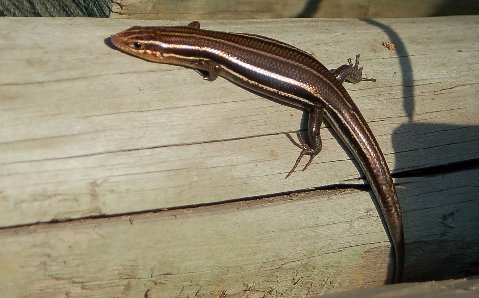
 Author, photographer, and columnist Richard Bartlett is one of the most prolific writers on herpetological subjects in the 20th century. With hundreds of books and articles to their credit, Richard and his wife Pat have spent over four decades documenting reptiles both in the field and in captivity. For a list of their current titles, please visit their page in our bookstore. Author, photographer, and columnist Richard Bartlett is one of the most prolific writers on herpetological subjects in the 20th century. With hundreds of books and articles to their credit, Richard and his wife Pat have spent over four decades documenting reptiles both in the field and in captivity. For a list of their current titles, please visit their page in our bookstore. |