


Flattened aquatic toads
By Richard Bartlett · July 16, 2013 2:49 pm
A group of us had just seated ourselves for lunch at the dining area of Madre Selva Biological Preserve on the Rio Orosa of Amazonian Peru. We had spent most of the morning photographing herps and were discussing what trails we would walk following the meal. A few yards down slope were the waters of a small, quiet inlet.
Suddenly, all talked stopped. A small Suriname toad, Pipa pipa, had just surfaced in the center of the inlet. Action was nearly immediate. Segundo went out one door shedding clothes as he ran. Ian ran out another door. The contest was on. May the best (or at least the fastest) man win!
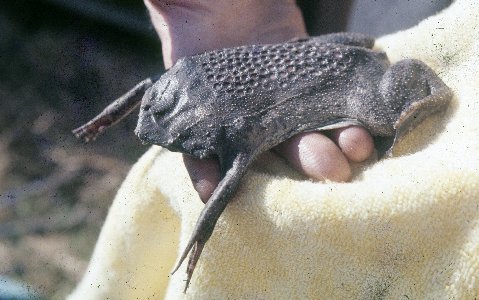
Segundo hit the silted water from one side and Ian from the other, but either Segundo’s leap had been longer or the toad had been a bit closer to his launching point. When he left the water Segundo was gently clutching the toad, one of the strangest of Amazon amphibians.
When trying to describe a Suriname toad, I usually liken the 5 to 6 ½ inch long creatures to an anuran that has held a losing battle with a steam roller. And the fact that it is a size 10 toad in a size 12 skin cannot be overlooked either.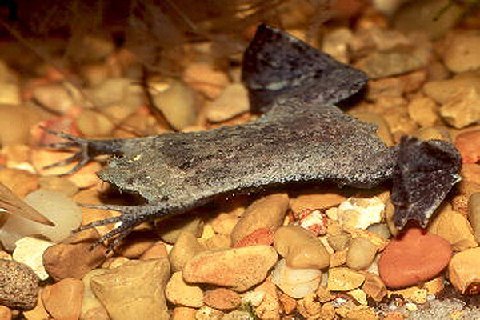 Suriname toads are entirely aquatic. They are muddy colored anurans in a muddy/silted habitat. They have small, lidless eyes, tiny tactile flanges on fingertips, a skin flap on each side of the jaw and an elongate flap in the center of the lower jaw. After a complex courtship and breeding sequence the up to 80 adhesive eggs are placed on the dorsal skin of the female and are soon covered as the female’s skin swells around them. Within these tiny integumentary cocoons the larvae develop, metamorphose, and finally break free as tiny replicas of the adults.
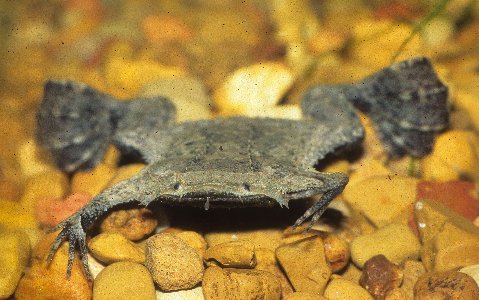 Mother Nature must have worked nights and weekends when designing the Suriname toad!
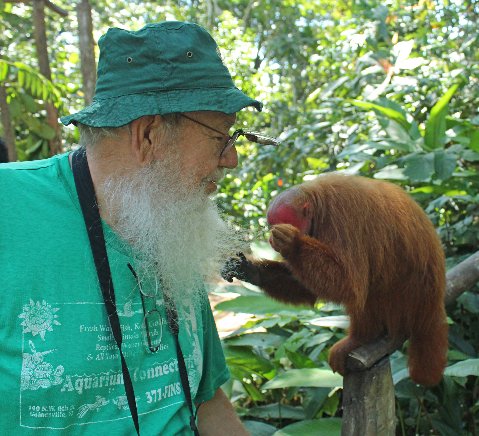 Author, photographer, and columnist Richard Bartlett is one of the most prolific writers on herpetological subjects in the 20th century. With hundreds of books and articles to their credit, Richard and his wife Pat have spent over four decades documenting reptiles both in the field and in captivity. For a list of their current titles, please visit their page in our bookstore. Author, photographer, and columnist Richard Bartlett is one of the most prolific writers on herpetological subjects in the 20th century. With hundreds of books and articles to their credit, Richard and his wife Pat have spent over four decades documenting reptiles both in the field and in captivity. For a list of their current titles, please visit their page in our bookstore. |