Community blog
Are you a herper with something to say? Say it here on the new
kingsnake.com community blog. Registered site users can log in with
their existing username and password to create their own blog, make
blog posts, and comment on other people's posts. We'll be enforcing
some basic community blog guidelines, but beyond that, your blog is just that: yours.
Saturday, January 21 2012
By Varanid
Sat, January 21 2012 at 10:33
One of the side effects of the recent legal issues is that people are talking about education--not just lobbying. This is a good thing, and HAS to happen for us to survive (and frankly needs to be part of our lobbying efforts).
I've done (admittedly) intermittent public education with herps. Not hard core, non stop, but I have done some. I've spoken to Scout groups back when I was younger (and still involved in Scouts).
I've done volunteer work at our local zoo, where I can educate people about herpetofauna and sometimes let them touch and handle a snake, while being told how beneficial and harmless most of them are. I've tried to answer questions at pet stores, even when I don't work there.
It's not enough, but it is something.
The long and short of it is that lobbying will not, by itself, save us. We have to garner some sort of public acceptance of us, and for our animals. The most successful lobbying groups (like the NRA) all seek to EDUCATE the public--why their issues matter, why their take on it is right, and how to participate. You don't have to agree with the NRA to recognize it is an immensly successful organization--in part because it seeks to educate people about firearm safety and encourage people to try shooting as a hobby.
We have to do that. We have to educate people to realize:
Reptiles aren't on the whole particularly dangerous.
Many reptiles can be good pets.
Reptiles as pets are a responsibility you can't undertake lightly.
Reptiles are an important part of nature.
Reptile people come from all walks of life and can look like the guy next door--sometimes I think the most damaging stereotypes the public holds are about US not our animals.
You don't do that by writing letters to your state representatives (although you should also do that). You do it by giving talks at libraries, schools, scout meetings, things like that.
Doing this properly can help lessen the public perception of us as weird---and trust me, people still think it's weird to keep herps as pets. We spend enough time around each other we forget that, but I was recently told "but you seemed so normal!" when my new boss found out I had snakes at home. And she's an educated, early 30s, woman, with a masters degree, not some ignorant yokel.
People still have frequent misconceptions about reptiles and what they can and can't do--a poster on a conservation message board I'm on, who is ALSO educated (a botanist) was convinced that reticulated pythons posed a threat to the US ecosystems. I tried (perhaps not as nicely as I should have) that they can't handle any place that regularly freezes.
I still see people that are convinced bull snakes and rattlesnakes hybridize, that reptiles won't grow past thier enclosure, all sorts of awful myths that should have died 50 years ago. We have to combat the dual dragons of misinformation (about the animals) and stereotypes (about both the animals and US). The only way to do that is to dress nicely, speak correctly and politely, and present our animals in a factually accurate, non threatening manner. We HAVE to do this or we will fall.
Education and talks, hopefully, swell our ranks--and moreever, get the new members of the club off on the right foot.
There's a lot to doing public talks well, but that's the subject for a different blog.
Tuesday, January 3 2012
By Varanid
Tue, January 3 2012 at 11:18
I've been keeping a good percentage of my life, and have seen, and gone through, burnout. Burnout is what happens when it all gets to be too much--to much cage cleaning, too much worrying about this animal being too humid and this one not humid enough. In extremes, worrying about how you'll afford to feed them. Too much worry to have any fun, to appreciate the animals.
For people just getting started, let me caution you against getting too many animals. That may sound a bit funny coming from a guy with nearly 40 herps right now (and a lot more in baby season!) but it is important to note that I've developed this slowly.
There's two ways to get overburdened, and have herps go from joy to chore. You can either get too many species, or just too many individuals (you can do both too--whooo boy).
Everyone's got a limit of h ow many herps they can care for well, and how many herps they enjoy caring for. That number isn't constant--it changes person to person and depending on their circumstances. It also changes depending on the animal--a florida kingsnake isn't nearly the same amount of time, money, space and occasionally blood as a reticulated python for instance.
There really isn't an exact way to know what your limit is--so while you're building your collection take it slowly. Don't go from 1 ball python to 40 in 3 months.
And, I'd caution against getting tons of babies (of any species) before you have one or two adults and know what that workload is like--I nearly did that with the reticulated pythons, because even at a smallish 10' or so they weren't that awful hard or expensive...but I backed out and it is good I did, because at 15'? Way different, and I couldn't manage 10 of them.
You can also, and perhaps less intuitively, burn yourself out by getting too diverse. There are hundreds of species available at least semi-regularly in the pet trade, and many of them are interesting--I've never seen a snake I didn't like at least a little.
But, they need different care. And take it from me, trying to care for a wandering garter in the same room as your reticulated pythons can be awkward since they need widely different ambient temps and humidity and diet. Trying to breed something like mountain racers (cool, somewhat humid) in the same facility as a rosy boa (dry, warm) will result in complications--if your species all need similar care, it's just easier to manage it. If all you do is truly tropical snakes, you can heat the whole building to 80 F and run a humidifier and that makes managing the cage temps a ton easier. One of the worst mistakes I made as a herpetoculturist was when I was a kid, I wanted to have a good diversity--so many pretty animals right? But that shot me in the foot fairly quickly. It's a lot easier to handle 40 animals of one or two species than 40 animals of 20 species.
It isnt impossible to manage care for widely diverse species of course, but it is more work. It's something to consider.
so take it slow, have fun and don't overload yourself. Keeping herps is a hobby, so enjoy it!
Sunday, July 10 2011
By Varanid
Sun, July 10 2011 at 17:10
I have 1.1 checkered garter snakes, soon to be 1.2. They're an interesting, active species that remains small and does very well in captivity. They seemed to be the perfect fit for a naturalistic viv. Naturalistic tanks have been an interest of mine since I was a kid. They allow you to see a great range of behaviors, and can look simply stunning. I have some experience with them but primarily desert or near desert vivariums, not a temperate vivarium, so this is somewhat experimental. I've been kindly advised by several people that are more experienced with this than I am and I wish to say thanks ya'll!
Naturalistic tanks are certainly not easy to create. They take more time and more money than regular cages. They have to be larger than a usual tank, and a lot of work goes into putting them together. Most often they'll need special lighting even when your animal doesn't. So why do it?
Naturalistic tanks will help you observe behaviors you'd never seen in a standard cage. That same extra size and effort equates into a beautiful living work of art. It allows your animal to explore, to move, to have a more fulfilled life. It can act as a centerpiece for a living room or as a lesson for a class room in a way a normal tank could never do. This doesn't happen easily; you have to think, research and plan. What plants are compatible with your animals needs? Can you find them in your area? What sort of invertebrates are safe to have in with your animal (more on inverts later). How big do these get? Which of these plants play well together? Which ones will provide ground cover? Which ones are climbers? Are they sturdy enough to handle a snake crawling over/under them day in and out? Are they annuals or perennials? What sort of light do they need? Water? Soil type? You get to have fun researching all that. But it's worth it a month and a half later when you're looking at your nascent mini biodome--and more than worth it 6 months to a year later when the plants have grown, the animals are thriving and you're deriving more pleasure from that tank than you thought possible.
You know that thrill you get when you see a wild snake glide through the grass or emerge from it's hiding spot under a rock? You'll get nearly the same thrill observing it in a captive. You'll know you're providing excellent care. Your snake will be healthy, more active, and more alive seeming than it would in a tub. So take the plunge. You don't have to redo every cage in your collection (and some snakes aren't feasible for naturalistic setups--try doing it with a boa!). But choose one or two animals and do it. You won't regret it.
I'm going to post my step by step building of a naturalistic vivarium up here. I was going to try it in one post but it was far too long, even before putting photos in. So I'm going to try to do one a week. The tank is setting up, nearly done (I need to find some earthworms to add in), and the plants are getting established. You'll love the finished shots in a month or so!
Friday, June 17 2011
By Varanid
Fri, June 17 2011 at 23:56
I think it's fair to call this season a success. I got 3 clutches of Florida kingsnake eggs--two of which have hatched so far, one of which still has a month to go. I didn't get good eggs out of my house snakes--I got eggs, but they were bad. I'll try again next year on them.
It was my first time intentionally setting out to breed. I bred a few geckos as a kid, mostly by accident (leopard and pictus geckos) but that's longer ago than I want to admit.
I've got 11 healthy hatchlings thus far and 7 more eggs incubating. I got a group of 4 double het for axanthic and white sided out of one clutch. The other clutch gave me 4 double het axanthic/hypo and 3 axanthic het hypos. Hatching started while I was out of town (eggs pipping) but was done by the 7th. Most of them have eaten 2-3 times on frozen thawed pinky mice and are going to move up to fuzzies in a week or two. I've got two hold outs I'm going to try on live pinkies tomorrow.
It was, certainly, a learning experience. I need a bigger baby rack for next year, as well as a bigger incubator. I wish I'd bit the bullet initially and purchased a 32 or 64 tub baby rack. I'm not a huge fan of racks but for raising babies they're functional and practical. I'm looking at getting both a bigger and better incubator; I've heard good things about Nature's Spirit, I may go with them. I plan to breed more snakes year--3 house snakes, 2-4 more king snakes, my reticulated pythons. So Bigger incubator is important. I also need a bigger cooling chamber probably. Mine was full this year, and next year I'll be cycling more snakes--a male garter to mate with my female, the extra kings, etc.
Take aways:
Incubation and hatching are stressful as heck, at least for me. It's like Christmas, but if you had to slowly unwrap each present over a 2-3 day period of time :)
It's a rush to watch babies pip the egg.
Get them started on F/t if you can, many of them will take it.
Feed females heavily. They lose a lot of body mass with egg laying, but can regain it fairly quick. My hypo Florida king double clutched, and she's still heavier than she was when she went into hibernation last year.
Selling is a bit of a pain. You have to figure out which ones you want to hold back (if any), which ones you want to sell, figure out how long to hold them for before offering them up, figuring out shipping and advertising, etc.
Put thought into your pairings. I had a pair of white sides, and I elected to not breed the male to the female, instead breeding her to the axanthic to produce double hets. In hindsight this was a mistake. White sideds don't sell for that much less than axanthinc white sides, and sell for more than double hets, they're still pretty snakes, and I could have had visual morphs to sell this year if I'd done that.
Next year the male white sided will mate to a female albino as well as the female white sided, my male axanthic will mate to a hypo female, and a mosaic female. My regular male will mate with a regular female. This ought to give the groundwork for some interesting double homos-albino white sides (PRETTY!), axanthic mosaics (which should look really pretty but I've never seen them), as well as some more regular morphs. I will probably back a pair of double het WS/Hypos poss het axanthics (that are incubating now) and hope for the odds to give me a WS ghost or two out of breeding them to each other--worst case scenario is hypo white sideds which are still nice.
I may also hold back a pair of the axanthic/white sided hets to produce a mix of axanthics, white sides and axanthic white sided. I'm unsure yet. Part of it depends on money--holding back more snakes means buying more cages as they outgrow the baby and grow-out racks. It also means bigger incubators, more food bills, etc.
What'll I change next year? Different pairings. Bigger incubator. I may cycle the house snakes (and I am working on getting the male bigger, he's a small thing).
Try not to worry myself sick over everything that can go wrong. Stuff like that.
Wednesday, February 16 2011
By Varanid
Wed, February 16 2011 at 16:29
It's not a secret that most herps are poorly studied. Even species that have, collectively, been studied (say, the common garter snake), have not been the subject of ongoing systematic surveys regarding populations in the same way that game animals are.
And why not?
I know state agencies have limited budgets, particularly in this economy, and I don't expect them to pay tens of thousands of dollars to study the population of every herp in their state. But there's almost nothing done on most herp species in most states.
How many Texas Horned lizards are in the state of Texas? Who knows? What about prairie ring neck snakes, or plains black headed snakes? Or western diamondback rattlesnakes? Or six lined racerunners?
How hard would it be to implement a program using volunteer labor to do surveys in state parks? If avocational bird enthusiast are used to help do population surveys of birds, why isn't this done with herps? It wouldn't be entirely free or effortless; there'd have to be some screening of volunteers to make sure they know how to ID the local and regional herps, and that they know how to safely mark/recapture different herps. But that should be fairly easy to do. Have the state herpetologist compile a quiz for different regions (what is the common and scientific name of the herp in this picture?) maybe, and have local parks people use those. Run background checks to make sure there's no poaching convictions.
If there was a program encouraging pairing skilled volunteers up, and assigning them a state park to survey on--say to plant board lines, to run drift fences--and do mark/recapture surveys on the herps of that park, how much knowledge could we gain? I know most herpers would jump at the chance to do surveys on large tracts of protected land--let me set up a good board line in Palo Duro State Park and I'll be more than happy to supply my own boards, tongs, medical insurance, etc.
Instead, many state agencies seem to view us as enemies, as poachers, as a threat. Most of us aren't. Most of the field guys love these animals. We want to know more about them, we want there to be good data on them, and the chance to help that in a meaningful way--where our observations will be published and the facts we find spread beyond the confines of whatever internet fora we frequent--well, that's a dream for us.
So come on, all you state parks and wildlife people--we're here. We're useful. Work with us.
Sunday, December 26 2010
By Varanid
Sun, December 26 2010 at 22:19
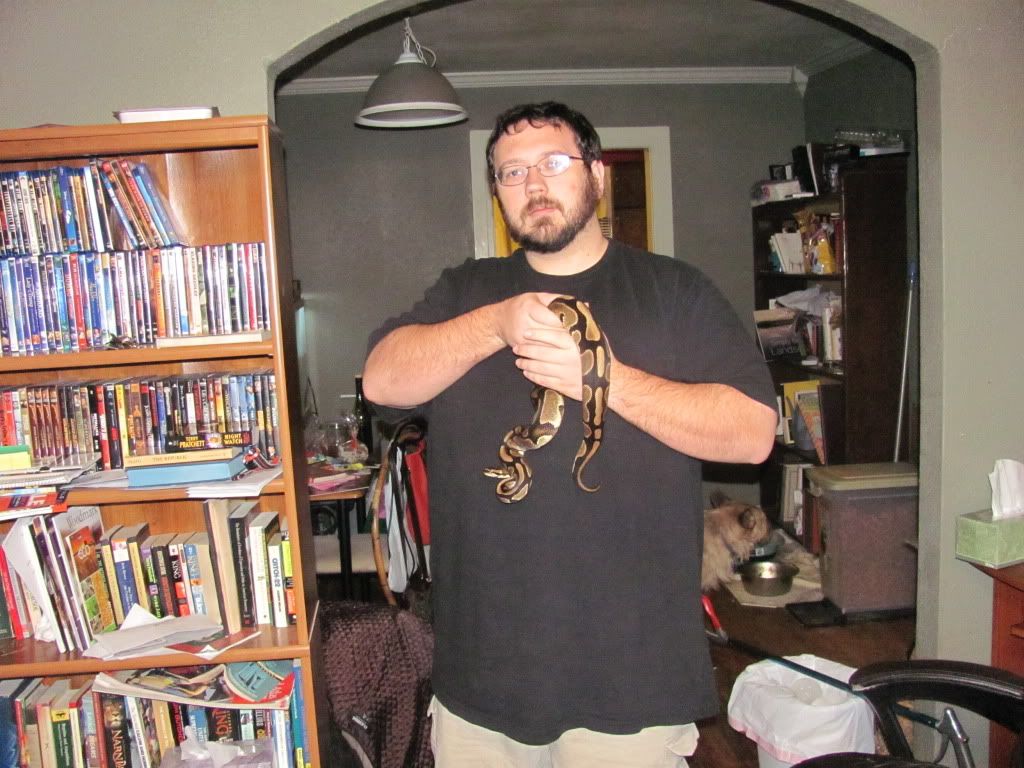
Lots of herpers get pictures of giant rattlesnakes (or other species) that have been killed and are being posed. These are frequently debunked, with people stating that they use forced perspective to make the snake look larger. That is 100% true. But I thought I could post an example, using my 30-36" ball python. This will help people to understand how much forced perspective can do. The pictures aren't that great, but they don't need to be artistic. And yes the house is a mess. I had my wife take pictures of me holding the ball python from several distances and angles, two shots with me actually holding trouble and several with me using 3' tongs to hold him out from my body.
Here's a picture of me holding Trouble normally. Now, like I said, Trouble is somewhere between 30 and 36" in length. He's a sweetheart despite his name (I got in trouble with the wife for bringing him home, hence the name).
Here's a picture with me holding trouble out in front of me with tongs; I had my wife get all of me, plus some of the house in the frame. He looks substantially larger this way.
Here's a photo with her standing closer, and focusing on Trouble. He looks honking gigantic.
Here's a side shot so you can see how much space was between Trouble and me.
Keep in mind, we did that using 3' tongs. Many of these pictures will have a dead snake dangling off a hoe, or shovel, with a 5-6' handle, so the effect will be even greater. There's no photoshop or editing involved here. This is just playing with your perception. So next time you see a photo with a seemingly gigantic rattler that someone's got at arm's length, or dangling from a hoe...realize just how much that distorts the apparent size. You may also want to keep this in mind for any pictures the fisherman in your life shows you.
|