


Fossil shows how snakes lost their legs
By Cindy Steinle · February 14, 2011 10:28 am
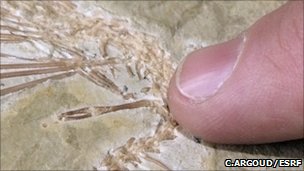 A limestone fossil found in Lebanon holds clues to how snakes lost their legs.
From BBCNews:
A limestone fossil found in Lebanon holds clues to how snakes lost their legs.
From BBCNews:
The scientists' high-resolution 3D images suggest the legs in this particular species, Eupodophis descouensi, grew more slowly, or for a shorter period of time. It is a conclusion made possible only after seeing all the bones obscured inside the limestone, and determining that although the creature possessed ankle bones, it actually had neither foot nor toe bones. "This study reveals the degree of regression of the legs," said Dr Alexandra Houssaye from the Museum National d'Histoire Naturelle (MNHN) in Paris, France. [....] Two theories compete. One points to a land origin in which lizards started to burrow, and as they adapted to their subterranean existence, their legs were reduced and lost - first the fore-limbs and then the hind-limbs. The second theory considers the origin to be in water, from marine reptiles. This makes the few known bipedal snakes in the fossil record hugely significant, because they could hold the clues that settle this particular debate.To read the full article and view an accompanying video, click here.