

Three Wondrous Amazonians
By Richard Bartlett · January 4, 2017 12:26 am
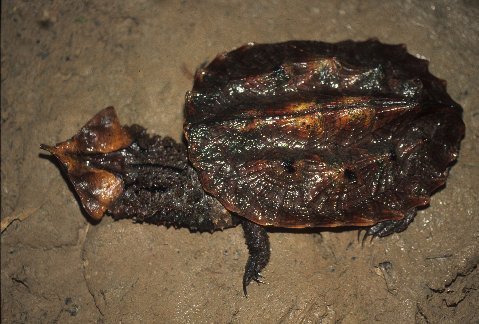
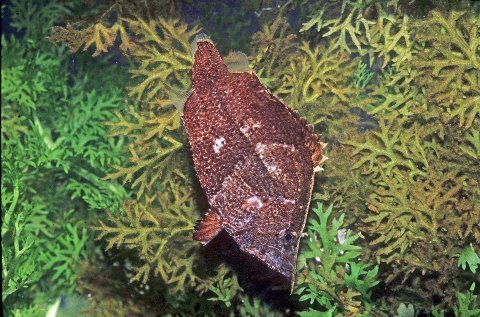
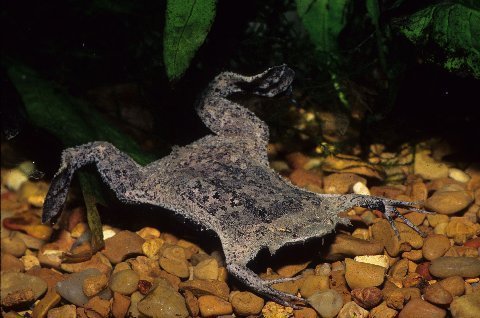
Matamatas are always difficult to find and a pleasure to see. I’m probably crossing some line or the other here by mentioning one of these 3 taxa but I’ll have a go at it anyway. The three species—wondrous Amazonians all-- that I have firmly in mind are the matamata, Chelus fimbriatus, the Suriname toad, Pipa pipa, and the Amazonian leaf fish, Monocirrhus polyacanthus, ambush predators all and all amazingly camouflaged aquatic predators. The matamata grows to 18”, is flattened, and is camouflaged both by its mud color and skin flanges. It is a fish eater that catches prey by extending its head rapidly forward while distending its throat. The resulting vacuum draws an unwary fish into the mouth where it is then quickly swallowed. The 6” long Suriname toad, primarily an invertebrate eater that will accept small fish, is also camouflaged by color and its flattened appearance. Rather than catching prey like a roving vacuum, this anuran shovels edible items into its wide mouth with its forefeet and fingers. At 3”, the leaf fish is by far the smallest of these 3 predatory species, and limits itself, at least when adult, to a diet of smaller fish. The mouth of the leaf fish is large, distensible and extendable and a single barbel, in appearance like the stem of a leaf, extends from the lower jaw. Camouflaged by color and a very slow head down approach, this little mud colored (sounds like a broken record doesn’t it?) fish is a hunter to be reckoned with. Do I see all 3 on every trip? No. But sometimes I do get lucky.
The Suriname toad is remarkably well camouflaged in mud bottomed creeks.
The leaf fish masquerades as a fallen leaf--right down to the stemlike projection on its lower lip.