Beautiful in sight and sound
By Richard Bartlett · March 19, 2015 5:17 am
The ringing peeps of a vocalizing ornate chorus frog, Pseudacris ornata, lack the upward slurring of the much more common spring peeper.
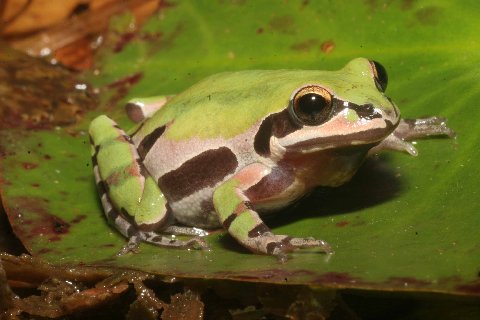
Although only one and one quarter inches in length, the ornate chorus frog, a heavy bodied species, looks larger. And this little frog of the southeastern United States, in some of its many colorations, is truly ornate. The ground color may vary from mud-brown, through russet, russet and green, to a clear pea green. There are often dorsal spots or stripes of a contrasting color. Black lateral and groin spotting is invariable and there is also a black eyestripe.
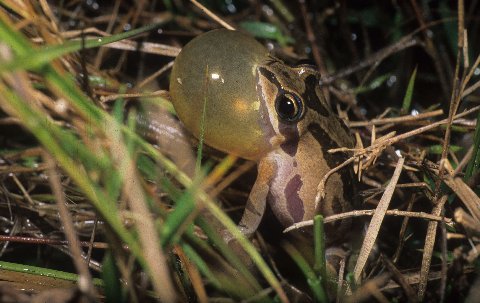
Despite its size, the ornate chorus frog can be perplexingly difficult to locate. It is ventriloquial to some degree, and a call that seems to be originating from close at hand may actually be originating from some distance away. On rare occasions, such as overcast, drizzly nights, ornate chorus frogs may sit on open muddy banks or float in the open while calling. But in most cases they call while tucked well away in tangles of blackberries or secluded in emergent grass clumps.
In some areas, such as its southernmost range on the Florida peninsula (the latitude of Lake Okeechobee), this frog is now present in reduced numbers (or extirpated). In fact, its current range in Florida may start well north of the Tampa Bay region. But in some more northerly areas it still seems common.
Take the time to look it up. It is a beautiful anuran.
The dark phases of the ornate chorus frog are more commonly seen than the green.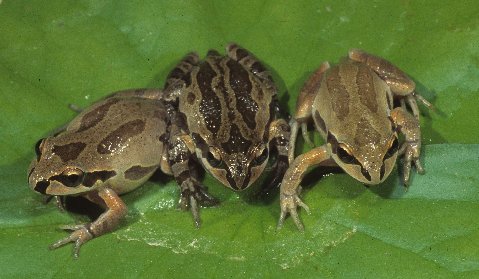 The vocalizations of the ornate chorus frog are strident peeps.
 Author, photographer, and columnist Richard Bartlett is one of the most prolific writers on herpetological subjects in the 20th century. With hundreds of books and articles to their credit, Richard and his wife Pat have spent over four decades documenting reptiles both in the field and in captivity. For a list of their current titles, please visit their page in our bookstore. Author, photographer, and columnist Richard Bartlett is one of the most prolific writers on herpetological subjects in the 20th century. With hundreds of books and articles to their credit, Richard and his wife Pat have spent over four decades documenting reptiles both in the field and in captivity. For a list of their current titles, please visit their page in our bookstore. |