


Digital conundrums and tree vipers
By Richard Bartlett · July 31, 2014 5:12 am
At first I thought it was just me, but when a half dozen of us each had the same problem with an array of different cameras, I'm now thinking the problem was digital. That's D-I-G-I-T-A-L.
We were all looking at the same Western two-lined forest pit viper, Bothriopsis bilineata smaragdina, and none of us was happy with the color rendition. This was a problem none of us had experienced with film. You'd point the camera, focus, snap the photo (or 10), and leave feeling confident that the camera and film had seen pretty nearly the same thing you had.
But now there was this. True, the snake, an adult, was lighter in color than most I had seen. But is wasn't yellow. In fact, it was a long way away from yellow. No matter how we tried, from all auto to all manual and every stop in between, our cameras were seeing yellow.
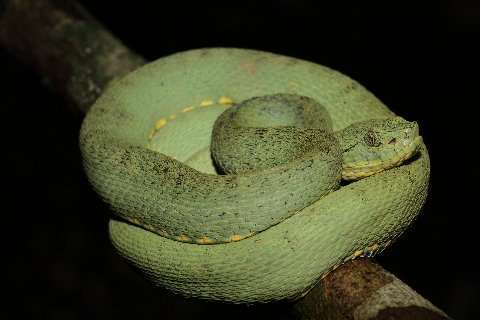
We changed apertures, speeds, every setting available. The snake was cooperating fully. After we all fiddled around, foamed and fumed for half an hour we gave up. We improved the scene from "almost" to "darn close," and it was time to take the pictures and move on. The snake was green when viewed from a distance. But the closer we got the yellower it became.
This gave us all plenty to discuss at dinner that evening. By the way, the pic of the neonates herewith was with film. The adult was not as intense in color as the juveniles, but it was brighter green than the pictures now detail.
More photos below...
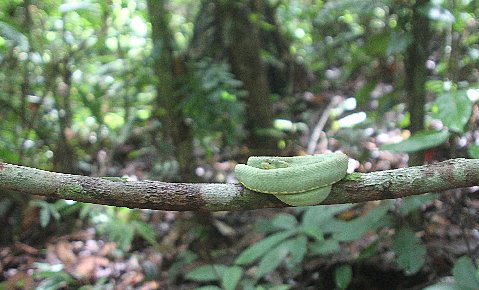
An accurate color portrayal of neonate tree vipers with film: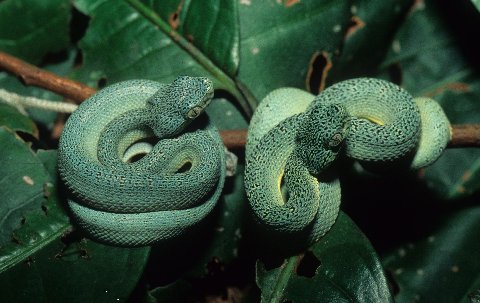 After a lot of finagling, I decided this was as close to accurate as I would get with the digital camera:
 Author, photographer, and columnist Richard Bartlett is one of the most prolific writers on herpetological subjects in the 20th century. With hundreds of books and articles to their credit, Richard and his wife Pat have spent over four decades documenting reptiles both in the field and in captivity. For a list of their current titles, please visit their page in our bookstore. Author, photographer, and columnist Richard Bartlett is one of the most prolific writers on herpetological subjects in the 20th century. With hundreds of books and articles to their credit, Richard and his wife Pat have spent over four decades documenting reptiles both in the field and in captivity. For a list of their current titles, please visit their page in our bookstore. |