
A Mediterranean gecko kind of night
By Richard Bartlett · July 11, 2013 6:06 am
It is always cause for comment when with the advent of warm nights the Mediterranean geckos, Hemidactylus turcicus, are drawn from their places of winter seclusion to forage on our house and sheds.
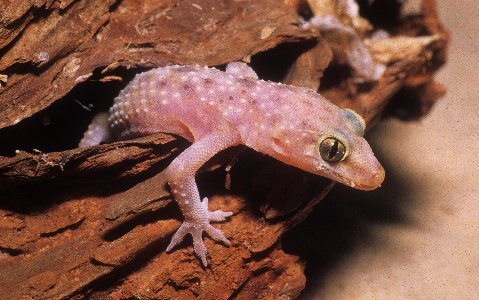
During some springs only one or two geckos initially appear; other years the lizards appear en masse, with every illuminated window disclosing one or more newly emerged foraging gecko. On those nights the life of every light-drawn small moth or beetle is in precarious straits. Patti and I sit and marvel at their adroitness on windows and walls, mostly outside, but occasionally finding their way through a nook or cranny yet unknown to us, or an open door to visit temporarily indoors.
In bygone years the Mediterranean gecko (also referred to as the Turkish gecko) was an abundant exotic that was distributed widely over much of the Florida mainland from the Keys northward to Tampa Bay and Vero Beach. It was more locally distributed in and beyond north Florida. Today it may be encountered in protected areas across the southern USA and is slowly expanding current ranges northward. But while expanding north of Florida, it had run into serious competition in South Florida, first from the parthenogenetic Indo-Pacific House gecko and now from the larger and seemingly more prolific Amerafrican House gecko.
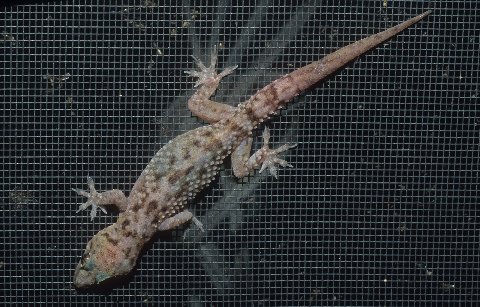
As geckos go, I think of the Mediterranean gecko as a medium-sized species. It attains a length of 4 to 5 inches, of which about half is tail. It is of fairly substantial girth.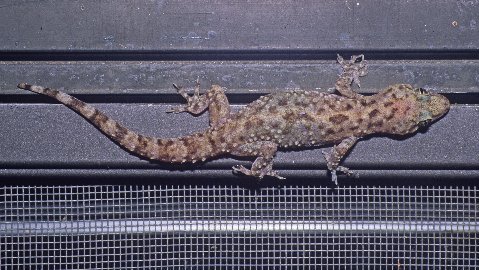 This gecko has large eyes, elliptical pupils, and well developed toepads. Metachrosis is obvious, with the gecko being the darkest and most strongly patterned by day, especially when resting quietly in a secluded hiding spot. It is lightest and may be almost patternless at night when active and on a light colored surface. The skin of the back is strongly tuberculate, that of te sides somewhat less so. This interesting species is capable of producing weak squeaks and when defending territory from an interloping male, males may voice clicking notes in series.
 As I finish these notes, darkness is approaching. Time to sit back for a few quiet minutes and await the arrival of the geckos. Life is good.
 Author, photographer, and columnist Richard Bartlett is one of the most prolific writers on herpetological subjects in the 20th century. With hundreds of books and articles to their credit, Richard and his wife Pat have spent over four decades documenting reptiles both in the field and in captivity. For a list of their current titles, please visit their page in our bookstore. Author, photographer, and columnist Richard Bartlett is one of the most prolific writers on herpetological subjects in the 20th century. With hundreds of books and articles to their credit, Richard and his wife Pat have spent over four decades documenting reptiles both in the field and in captivity. For a list of their current titles, please visit their page in our bookstore. |