


Robotic baby turtles can teach humans a thing or two
By kingsnake.com · April 24, 2013 5:13 pm
 Robots modeled on baby sea turtles may reveal secrets about evolution
From the LA Times:
Robots modeled on baby sea turtles may reveal secrets about evolution
From the LA Times:
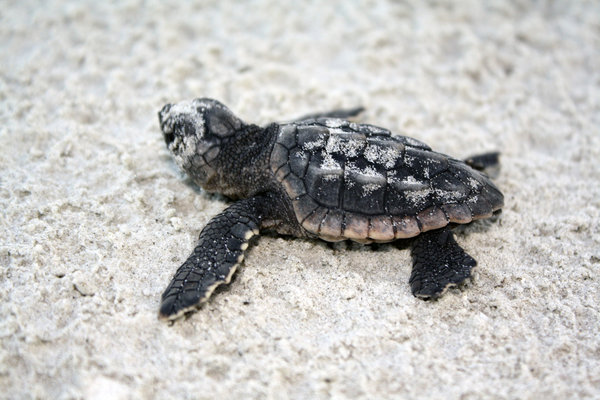
To better understand how the sea turtles' flippers work on land, researchers at Daniel Goldman's CRAB Lab (Complex Rheology and Biomechanics) at Georgia Tech studied the movements of just-hatched sea turtles on the beach of Jekyll Island, a coastal island of Georgia. The researchers noticed that the sea turtles were able to maintain the same speed on both sandy and firmer terrain, by bending their wrists on sandy ground and keeping their wrists rigid when running on hard ground. In order to study their movements more closely without bringing baby sea turtles into the lab, one of Goldman's students built FlipperBot, a robot model of a baby sea turtle that has the ability to bend its wooden flipper wrist or keep it rigid. After putting FlipperBot through a number of tests, the scientists found that Mother Nature, and the baby sea turtles, have got it right. The robot was able to traverse a manufactured poppy seed terrain more quickly when it was allowed to bend its wrist. They also found that the robot, as well as the baby sea turtles, slowed down when they encountered previously disturbed poppy seeds or sand. So, why does this matter? Well, the research can help engineers design robots that can successfully traverse many types of terrain. It might also help turtle conservationists understand what conditions can slow down baby turtles during that all-important first run, and finally, it may even help answer some evolutionary questions.Read the full story and watch video of the turtle robot here. Photo: Nicole Mazouchova / Georgia Tech