Burrow borrowers: the blotched tiger salamander
By Richard Bartlett · May 21, 2015 5:58 am
Black-tailed prairie dog burrows scar the landscape. Stop for a moment while driving through Wind Cave National Wildlife Refuge in the Black Hills during the hours of daylight and a dozen or more prairie dogs will come running in hope of a handout.
Look both ways before you begin driving again because a curious bison just might be standing in front of your vehicle. But things are quieter at night. Bison drift away from the road to bunk down on the open prairie. The prairie dogs are all snoozing in their burrows. As a great horned owl flies over on silent wings, a summering burrowing owl ducks into a prairie dog burrow for safety.
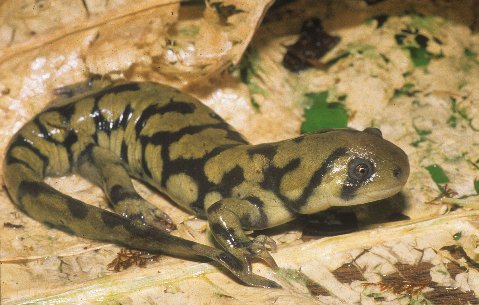
But what is that tiny head emerging from the next prairie dog burrow? It's a salamander - a blotched tiger salamander, Ambystoma mavortium melanostictum! And we were to learn that the use of these havens by the salamanders was not at all uncommon.
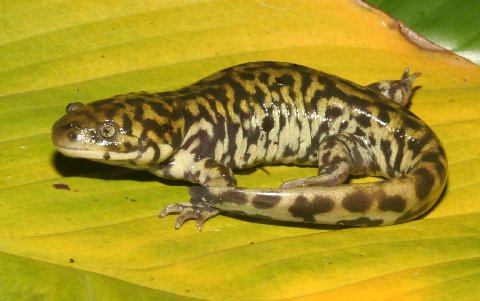
The blotched tiger salamander attains a robust 6 to 11 inches in total length. Some examples have a well-defined reticulum of black against the predominating olive-yellow to olive-green, while others are less precisely patterned.
Neoteny is well documented, and it is this subspecies that is often offered for sale as "waterdogs" in the pet trade. Captive conditions usually cause waterdogs to metamorphose so be ready to change its housing from aquarium to terrarium.
But, whether adult or larva, this is a hardy salamander that often survives for more than a decade as a captive and that is easily fed on pelleted salamander food and/or earthworms.
Albinism is well documented in this tiger salamander.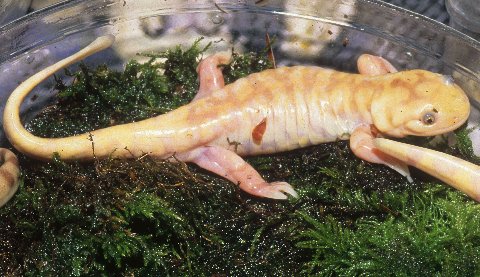 Either the light or the dark color may predominate.
 Author, photographer, and columnist Richard Bartlett is one of the most prolific writers on herpetological subjects in the 20th century. With hundreds of books and articles to their credit, Richard and his wife Pat have spent over four decades documenting reptiles both in the field and in captivity. For a list of their current titles, please visit their page in our bookstore. Author, photographer, and columnist Richard Bartlett is one of the most prolific writers on herpetological subjects in the 20th century. With hundreds of books and articles to their credit, Richard and his wife Pat have spent over four decades documenting reptiles both in the field and in captivity. For a list of their current titles, please visit their page in our bookstore. |