Barbour's map turtle
By Richard Bartlett · November 13, 2014 6:02 am
Florida has two species of naturally occurring map turtles, both riverine species. Both are wary. Very wary.
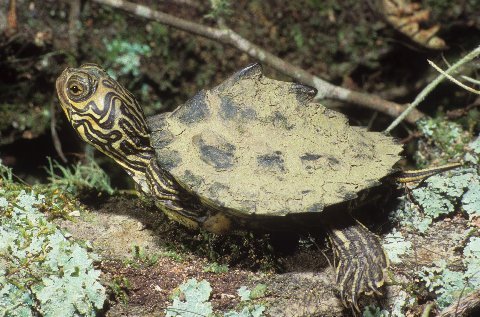
Since they are possessed of excellent eyesight, a hopeful observer is more apt to see only the ripples left behind a plunging map turtle than a view of the turtle itself. One of these species is the beautiful, dimorphic, Barbour's map, Graptemys barbouri. These map turtles are inhabitants of Florida's Apalachicola, Chipola, and Choctawatchee, Alabama's Pea and Flint, and Georgia's Chattahoochee and Flint river systems. In Georgia, the ranges of the Barbour's and the Escambia map turtles abut or overlap, and hybridization is known.
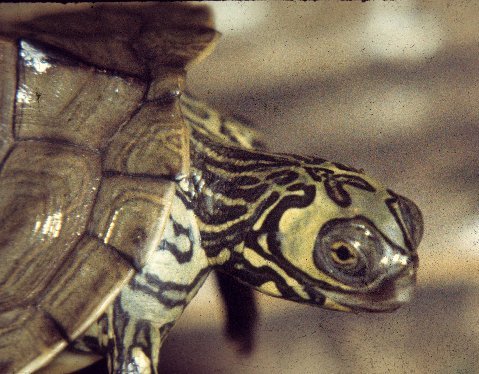
But, if you're both cautious and lucky, you may actually see one of these brownish gray, saw-backed, map turtles basking quietly on a protruding snag. Sometimes you'll catch them perched well above the water level on what would seem to be an impossibly thin branch. The broad, well developed, head markings vary from creamy-yellow to lime green and cover most of the temporal area.
Females of this species are adult at ten to twelve inches in length and probably first breed when they are between twelve and twenty years of age. Adult females develop enlarged heads and feed primarily on snails, clams, and mussels, both native and introduced. Males, narrow-headed, are adult at four to five inches in length, breed at four to six years of age, and like the juveniles feed largely on insects.
Barbour's maps are protected or of regulated take throughout their tri-state range.
This is a young adult female Barbour's map turtle.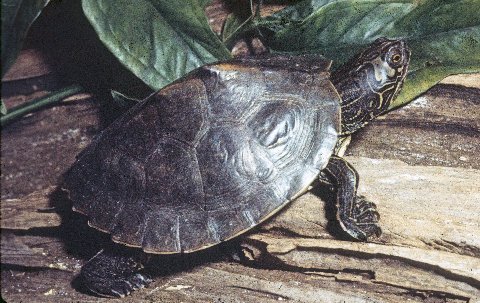 Adult male Barbour's map turtles are only 4 to 5 inches long.
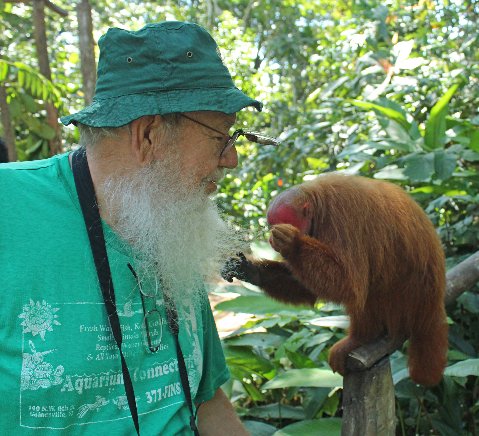 Author, photographer, and columnist Richard Bartlett is one of the most prolific writers on herpetological subjects in the 20th century. With hundreds of books and articles to their credit, Richard and his wife Pat have spent over four decades documenting reptiles both in the field and in captivity. For a list of their current titles, please visit their page in our bookstore. Author, photographer, and columnist Richard Bartlett is one of the most prolific writers on herpetological subjects in the 20th century. With hundreds of books and articles to their credit, Richard and his wife Pat have spent over four decades documenting reptiles both in the field and in captivity. For a list of their current titles, please visit their page in our bookstore. |