- Pale Milk Snake
- Lampropeltis triangulum multistriata
- Size:
- Hatchling: 5 - 8 inches
- Adult: 16 - 32 inches
- Scalation:
- Dorsal: 19 - 21 rows
- Ventral: 186 - 204
- Sub caudal: 42 - 55
- Infra labial: 8 - 10 (usually 9)
- Supra labial: 7 - 8 (usually 7)
- Anal Plate: Single
|
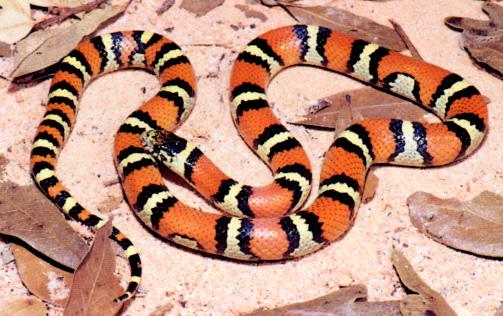
Photo courtesy Martin Schmidt
click to enlarge |
Written by Troy Hibbitts
- Coloration:
- Head:
The head of the pale milk is usually mostly white, with the black largely confined to the parietals and rear portions of the frontals. The snout, labials, and temporals are often flecked with black. In some individuals, there are large areas of red or orange on the head, particularly on the parietals (often partially replacing the black).
- Dorsal:
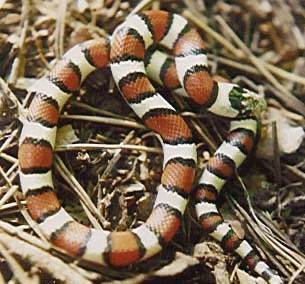
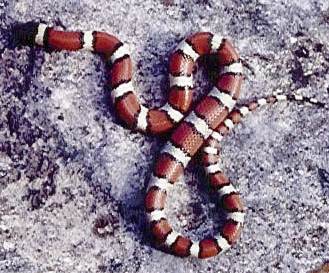
From 22 to 32 triads of red or orange (usually orange), black and white; the average is 27. The white rings are usually from one and a half to four scales wide (usually 2 or 3). The black and orange portions of the triads usually form blotches or bands that do not reach the ventral scales. The black ranges from one to two scales wide, and the orange ranges from one to three and a half scales wide. Usually, the orange is not interrupted by black middorsally, but this pattern can be found in occassional individuals.
Hatchlings tend to have white rings which are very bright and uncluttered with black flecking, while in most adults these bands often appear gray. Some specimens have their white tinted with cream. The orange blotches vay from individual to individual, as well as between populations. In some specimens the orange is very bright, while in others it is faded and very pale. Occassional snakes have the orange more red, but the red is rarely as bright as is seen in other subspecies. An orange and white pale milk, marked with very little black, is a very striking snake indeed.
- Ventral:
The ventral surfaces of most multistriata are white with small black marks. Usually, the the black is much reduced; in some specimens, the black is missing entirely, making the belly all white.
- Behavior:
- Multistriata can be found from May to September. It is surface active both day and night, temperatures permitting. They are occasionally found basking on rocks, logs, or open sand. They have also been found crossing roads at night. Rainfall seems to be a key to their surface movements. While some multistriata are fairly nervous and jumpy snakes, others can be quite calm.
- Breeding:
- Multistriata require a 3 (or more) month brumation period in order to stimulate breeding, and seem to require colder temperatures than other milksnakes. Breeding takes place shortly after the animals are warmed up. The male will usually bite the female behind the head while copulating, and copulation can occur for an extended period of time (several hours). A clutch of 2 to 9 eggs will be laid 30-40 days after fertilization. Egg size (and therefore neonate size) depends largely upon the size of the female. Incubation usually takes about 60 days at 82 degrees Farhenheit.
- Range:
- This subspecies is found on the northern plains from central Nebraska north and west through South Dakota and into Montana. It is also found in the eastern third of Wyoming. It intergrades with gentilis in southern Nebraska and northeastern Colorado and with syspila in eastern Nebraska.
- Habitat:
- Multistriata is primarily a snake of the open prairie. It is most common in the sandhills region of north central Nebraska, but is no where common. There are very few rocks or logs present in its habitat, and cover of all sorts is utilized.
- Prey:
- Most wild probably eat lizards - Fence Lizards (Sceloporus) and racerunners (Cnemidophorus) - and small rodents - mice (Peromyscus) and voles (Microtus). In captivity, juveniles can usually be started on Peromyscus or Peromyscus-scented mice, and most wild caught adults typically feed readily on pre-killed lab mice (fuzzies or small weanlings).
- Literature Cited:
-
Conant, R. and J.T. Collins. 1991. Reptiles and Amphibians of Eastern/Central North
America. Houghton Mifflin, Co., Boston.
-
Williams, K.L. 1988. Systematics and natural history of the American milk snake
(Lampropeltis triangulum), 2nd revised edition . Milwaukee Public Museum.
Cherry County, Nebraska
Photo by Kirk Setser
Click to Enlarge |
Charles Mix County, South Dakota
Photo by Kirk Setser
Click to Enlarge |
|
|
Sponsored Link
New & Updated Business Listings
Looking for a reptile or amphibian related business? A reptile store, breeder, importer,
maunfacturer or supplier? Our business directory lists some of the most popluar herp businesses in the world.
| Locate a reptile or amphibian business by name:
|
|
Recent Milk Snake Forum Forum Posts
• hypo-e pumpkin Sinaloan milk, posted by sballard
• What's getting paired this year?, posted by AaronBayer
• I'm here, too!, posted by Sunherp
• Kingsnake lives!, posted by exposito
• Hey Everybody, I'm here., posted by AaronBayer
• Scott Ballard Provided A Wealth Of Info, posted by Ameron
• Central America Milksnake Dilemma, posted by Ameron
• Retun to Forum / New Stuart's Milksnake , posted by Ameron
• Eggs ok?, posted by highley1980
• Splotched Sinaloan Variety, posted by bslugger551
• Splotched/Bullseye Sinaloans, posted by bslugger551
• Is my milk snake is getting TOO HOT?, posted by darbellah
• New owner looking for advice, posted by Irishfran
• New adoption biting and chewing fingers, posted by ajcur17
• Help*** Our milksnake won’t eat., posted by KieranSnake
Recent Milk Snake Classifieds:
- Black Milk Snake Male 20...
- 11 Stuarts Milks 2025
- Two Male Vanishing Patte...
Banner Pool
KINGSNAKE.COM
Enjoy all our content free of charge with a user account that gives you full access to every feature.
For added visibility, paid options are available - post in our Classifieds, showcase your business with
Banner Ads or a Directory listing, promote reptile events, and more.
|
Quick Links
|
Community
|
Legal & Safety
|
Support
|
|
|
Kingsnake.com ® is a registered trademark © 1997-
|
|
|