
Childhood love of lizards drives one man to save a species
By Cindy Steinle · October 3, 2011 11:02 am
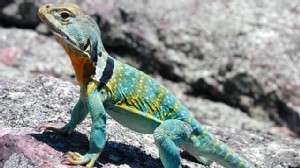 As a 13 year old boy scout, Alan Templeton met his first collared lizard in the Ozarks. Fast forward to today, when a colleague mentioned to him he was studying the animals but having a hard time locating them.
In 1987 Templeton transplanted collared lizards to three glades to see if he could repopulate the Ozarks. By 1993 they were still there, but they had not expanded to other glades, even though other rich habitats were no more than 200 feet away. If they remained that isolated, they would probably die out, as others had done before them. That led to a decade-long "experiment," as Templeton put it, in conservation biology. Every effort to protect, or restore, a critical habitat is an experiment, he said, because not enough facts are known in the beginning, and it's not always clear what the result will be. One thing did seem clear. Humans had been changing the Ozarks since the first Indians settled in the area, about 10,000 years ago. More recently, some areas had been carved out for ranching, and frequent fires had altered the landscape. And in the 1940s, authorities began controlled burning of forest areas in hopes of reducing the threat of major fires that could wipe out thousands of acres. But there was something wrong with that picture. That wasn't the way nature had protected the lizard's habitat prior to human occupation. When a fire started, it burned everything. Maybe, Templeton thought, that's the way it should be.To read the full article, click here.