Blunt-headed Tree Snakes
By Richard Bartlett · April 18, 2017 12:19 am
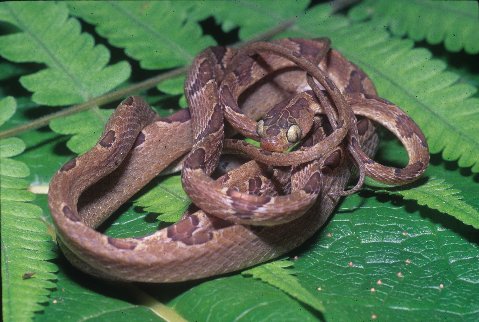
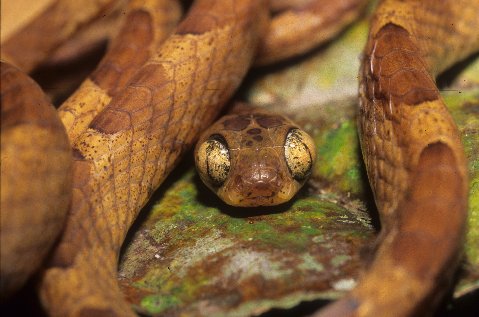
Blunt-headed tree snakes are blunt nosed and big eyed. This example is darker and with smaller blotches than usual. When is a head high broken vining tendril not a head high broken vining tendril? Why, when you grab a handful of tendrils to try and regain you balance and one of them suddenly turns a big-eyed head around on a slender neck to look at you, of course. And that is when you realize that you are doing exactly what you have warned your tour participants not to do—grab without ascertaining what it is that you are grabbing. This time, fortunately, no harm was done to either the grabber (me) or the grabee (snake—blunt headed tree snake, Imantodes cenchoa, to be exact). But the encounter did serve to rewarn me and there had been no one with me to witness the faux pas. Blunt headed tree snakes are among the commonest and most distinctive of the arboreal serpents of the neotropics. The short snout, big eyes, and supple slenderness are echoed in this region (Depto Loreto, Peru) by only this snake’s congener, the much less often seen Amazonian I. lentiferus. Nocturnal by preference, I. cenchoa bears prominent saddles, brown against a light reddish to chalk white ground color while the ground color of the tan saddled I. lentiferus is usually a lighter greenish tan. Both species prey on treefrogs and (usually) sleeping lizards. Adult size is 28 to 36 inches.
This is a normal appearing blunt-headed tree snake.
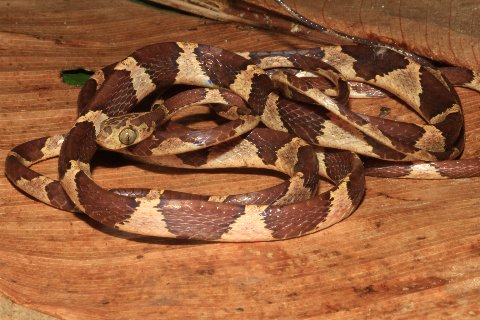
The Amazonian blunt-headed tree snake is rarer and of a richer color than its congener.