
Sequencing turtle genome may help humans
By kingsnake.com · June 20, 2013 6:10 am
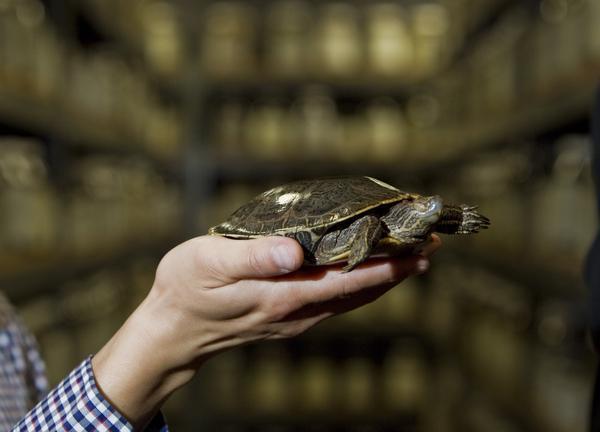 University of Texas at Arlington evolutionary biologists Todd Castoe and Matthew Fujita are part of the team unlocking secrets of the Western painted turtle genome to find ways to help humans.
From the Star-Telegram:
University of Texas at Arlington evolutionary biologists Todd Castoe and Matthew Fujita are part of the team unlocking secrets of the Western painted turtle genome to find ways to help humans.
From the Star-Telegram:
Castoe and Fujita were among nearly 60 co-authors of a paper published in the journal Genome Biology this spring that described the findings from the genome sequencing, only the second full genetic mapping on a reptile. The researchers found that the painted turtle’s genes used for tolerance of extreme cold and oxygen deprivation are common to all vertebrates but that they are more active in turtles that experience the extreme conditions. One gene that humans share became 130 times more active in turtles subjected to low-oxygen environments. Further study of the turtle genome could yield clues related to human health and well-being, particularly oxygen deprivation, hypothermia and longevity. “It’s very hard to do research on people,” said Pamela Jansma, dean of the UTA College of Science, “but if you know that animals have a similar gene pairing, you can study how those genes trigger responses to environmental stimuli. You can map that to humans, and you can then imagine developing gene therapies to address certain diseases.”Read more here. Photo: Brandon Wade/Star-Telegram.