Click for 65% off Shipping with Reptiles 2 You
https://www.crepnw.com/
Click for 65% off Shipping with Reptiles 2 You

RSS

Varanid

Education.

January 21, 2012

One of the side effects of the recent legal issues is that people are talking about education--not just lobbying. This is a good thing, and HAS to happen for us to survive (and frankly needs to be part of our lobbying efforts).

I've done (admittedly) intermittent public education with herps. Not hard core, non stop, but I have done some. I've spoken to Scout groups back when I was younger (and still involved in Scouts).

Read full article

Burnout

January 3, 2012

I've been keeping a good percentage of my life, and have seen, and gone through, burnout. Burnout is what happens when it all gets to be too much--to much cage cleaning, too much worrying about this animal being too humid and this one not humid enough. In extremes, worrying about how you'll afford to feed them. Too much worry to have any fun, to appreciate the animals.

For people just getting started, let me caution you against getting too many animals. That may sound a bit funny coming from a guy with nearly 40 herps right now (and a lot more in baby season!) but it is important to note that I've developed this slowly.

Read full article

Naturalistic vivarium

July 10, 2011

I have 1.1 checkered garter snakes, soon to be 1.2. They're an interesting, active species that remains small and does very well in captivity. They seemed to be the perfect fit for a naturalistic viv. Naturalistic tanks have been an interest of mine since I was a kid. They allow you to see a great range of behaviors, and can look simply stunning. I have some experience with them but primarily desert or near desert vivariums, not a temperate vivarium, so this is somewhat experimental. I've been kindly advised by several people that are more experienced with this than I am and I wish to say thanks ya'll!

Naturalistic tanks are certainly not easy to create. They take more time and more money than regular cages. They have to be larger than a usual tank, and a lot of work goes into putting them together. Most often they'll need special lighting even when your animal doesn't. So why do it?

Read full article

June 17, 2011

I think it's fair to call this season a success. I got 3 clutches of Florida kingsnake eggs--two of which have hatched so far, one of which still has a month to go. I didn't get good eggs out of my house snakes--I got eggs, but they were bad. I'll try again next year on them.

It was my first time intentionally setting out to breed. I bred a few geckos as a kid, mostly by accident (leopard and pictus geckos) but that's longer ago than I want to admit.

Read full article

Why can't hobbyist and state agencies work together?

February 16, 2011

It's not a secret that most herps are poorly studied. Even species that have, collectively, been studied (say, the common garter snake), have not been the subject of ongoing systematic surveys regarding populations in the same way that game animals are.

And why not?

Read full article

Forced perspective or: Giant Rattlesnake shots

December 26, 2010

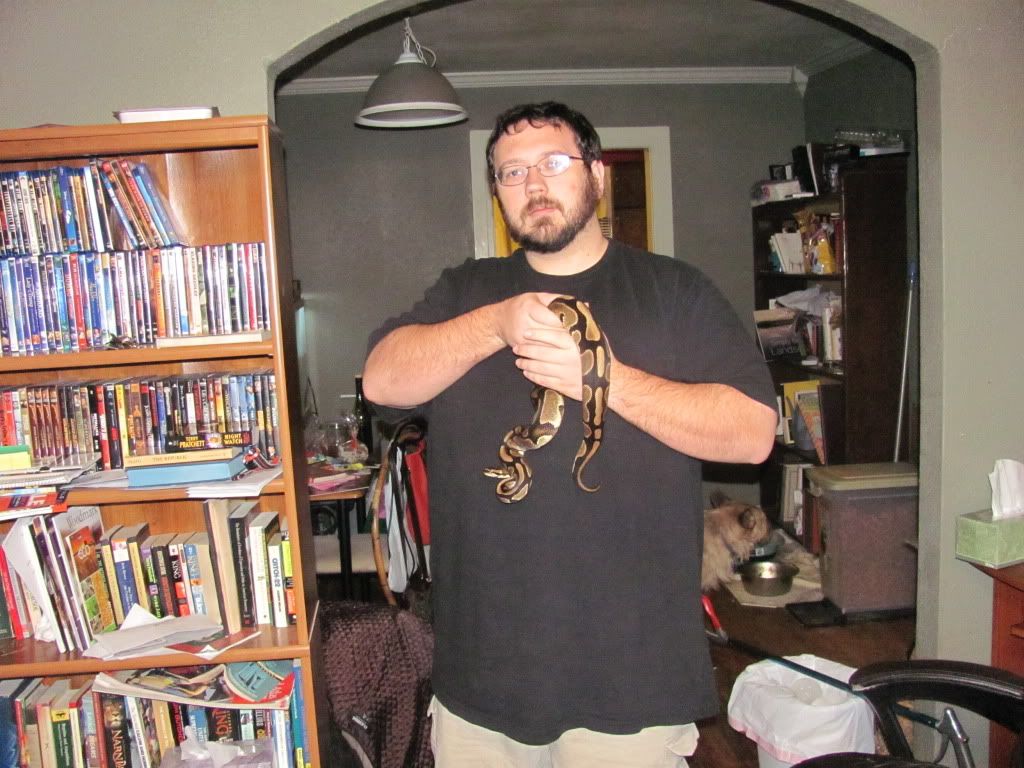
Lots of herpers get pictures of giant rattlesnakes (or other species) that have been killed and are being posed. These are frequently debunked, with people stating that they use forced perspective to make the snake look larger. That is 100% true. But I thought I could post an example, using my 30-36" ball python. This will help people to understand how much forced perspective can do. The pictures aren't that great, but they don't need to be artistic. And yes the house is a mess. I had my wife take pictures of me holding the ball python from several distances and angles, two shots with me actually holding trouble and several with me using 3' tongs to hold him out from my body.

Here's a picture of me holding Trouble normally. Now, like I said, Trouble is somewhere between 30 and 36" in length. He's a sweetheart despite his name (I got in trouble with the wife for bringing him home, hence the name).

Read full article

What do you want to see in the herp industry?

December 12, 2010

I've been keeping for a bit over a decade now. I started in the mid 90s. There's no denying that the herp industry has come a long way since then (thank god), but there's still some stuff to improve on, particularly regarding husbandry tools. I'll throw this question to the winds (and to kingsnake's vast leadership): What products do you want to see in the herp industry?
I've got a pretty lengthy list ;)

A decent hibernaculum. Some people are lucky enough to be able to chill a whole building, or a room, to induce hibernation. Most of us are not, particularly for colubrids that need chilly temps. My wife would kill me if the house was 50 degrees in the morning. I'm using a wine cooler but it's not perfect; the footprint is too small for anything bigger than shoe boxes, it doesn't easily get down below about 55, and there's wasted space due to the half shelf in back that they all seem to have. I could do a fridge but all the ones I find don't go above about 38 which is too cold.

Read full article

Learning about herps

December 3, 2010

I think that one thing many passionate herpers realize, at some point, is how *much* they don't know and how much there really is to know about herps.
There's 2 species of tuatara, 23 species of crocodilians, 300ish of chelonians, 3,000ish of snakes, 3800ish of lizards, and Amphisbaenia. In amphibians, there's 5,000+ species in Anura (frogs and toads), 500+ species of Caudates, and something like 150 caecilians.

All told, that's north of 12,000 species of extant herps. There's no human way to know everything about every species. Factor in life histories, evolutionary histories, taxonomy and cladistics, physiology...there's more data to be learned than any one person ever could.

Read full article

Hibernation

November 25, 2010

Most people that try to breed temperate colubrids hibernate (cycle) their animals. I have some kingsnakes I want to breed next year, so I decided to give it a go.

Here's the steps:
Decide you'll hibernate them over the holidays to make vacation easier. Good a time as any.
Stop feeding the snakes early october.
In late October, figure out what can keep temps in the low to mid 50s, and hold lots of plastic bins. I went with a wine cooler.
Blanche at the cost of the wine cooler, but buy it anyway.
Realize the wine cooler doesn't fit in your car, call a friend with a van from the phone at Home Depot.
Get the wine cooler home, drop it on your foot while moving it into your bedroom while wondering how you're going to explain this to your wife.
Plug it in, set it at a medium coolness setting, let it run overnight. Realize setting 4 holds it in the mid 50s which seems perfect.
Come home from work, get a "look" from wife regarding the new thing taking up space in the bedroom, and the presence of snakes in the bedroom.
Clean out some extra tubs you have laying around, and some small water bowls.
After tubs are dry, fill with 2-3" of aspen, place water bowl in, an get the snakes in the tubs. I'm chilling them in pairs or trios based on desired breedings.
Week 1-3:
open door daily to let in fresh air, check on water bowls and animals. Be grateful for drastically reduced cage work.
Weeks 4+:
Be bored out of your skull with all your babies in hibernation and nothing to do. Think about painting the house, building an outbuilding, or just watching paint dry.
Week 12 (still to come:
Warm up temps in wine cooler over 3-4 days to the mid sixties. Unplug heat tape on the rack I use, and place them in the tubs at room temp for a day or three, then plug in heat tape on a lower setting.
Week 40:
Look forward to a short break again ;)


Click here for Dragon Serpents
Click to visit Sierra Fish and Pets
Click to visit Spitfire Reptiles
Site Tools