
New species of lizard created in a lab
By Cindy Steinle · June 9, 2011 8:17 am
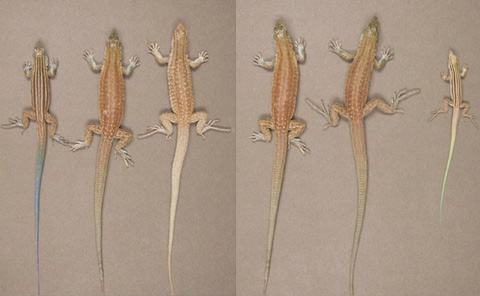 Geneticists have been trying to create any new species of anything for many years, and have finally succeeded with the Whiptail Lizard.
From Physorg.com:
Geneticists have been trying to create any new species of anything for many years, and have finally succeeded with the Whiptail Lizard.
From Physorg.com:
Scientists have known for years that some species exist due to interspecies mating, the whiptail lizards have provided proof of that; they’ve been creating new species themselves for at least several hundred thousand years. What’s new is the process being manipulated by another species, us, Homo sapiens. Geneticists have been trying for years to create a new breed of pretty much anything by urging lab “volunteers” of differing species to mate with one another, not exactly earth shaking science when you consider a dog that tries to mate with a human leg. Efforts such as these are, not surprisingly, more often successful than not; the problem is, the offspring are usually infertile, such as mules, or too weak to survive. The trick has been to create a new species that is able to both survive and reproduce, because otherwise, it can’t really be called a new species if it only exists for the duration of one generation. In a paper published in PNAS, lead researcher Peter Baumann of the Stowers Institute for Medical Research, describes how he and his team paired an A.inornata male with an A.exsanguis female resulting in six eggs; all of which hatched, resulting in young lizards that were more similar to the female than the male, save a bit of blue tint on the tails. Each also had four copies of their parental genes (normally there’s just two), three from their mother, the other from their father. They were also all female and all able to reproduce by cloning themselves. Not only have the initial lizards survived and reproduced, so too have their offspring; the lizards are currently in their fourth generation, leading to the inevitable question of whether they should be given a name. Baumann is hesitant to do so as it’s likely to court controversy from the biology/genetics community as the new species hasn’t yet been given the opportunity to show that it can exist outside of a lab, though the team members certainly believe it’s capable of doing so.I have mixed feelings about this, both the cloning and the full elevation of species. To read the full article and decide for yourself, click here.