


Painted Turtles, East, Central, West and South
By Richard Bartlett · January 22, 2018 10:17 am
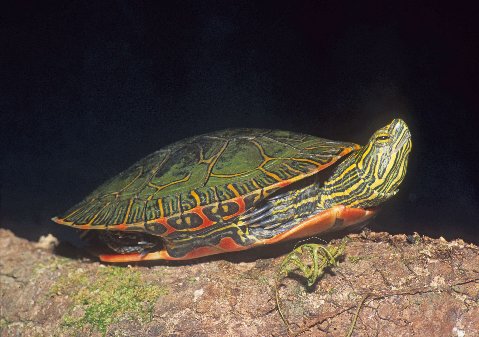
The western painted turtle has carapacial reticulations and a red plastron that bears a complex dark figure. So pretty are painted turtles, collectively, that were they rare they would command formidably high pet trade prices. However not only are all 4 of the subspecies common, but they breed easily in captivity as well. In many areas of their extensive ranges the characteristics (carapacial scute sutures and plastral figure) that differentiate the eastern from the midland subspecies (Chrysemys picta picta and C. p. marginata, respectively) are muddled. But the western form, C. p. bellii, is usually very easily identified and the southern painted turtle, C. p. dorsalis, is so different that it is thought by some to be a full species, designated as C. dorsalis. Although strongly aquatic, painted turtles inhabit semipermanent and permanent ponds, lakes, marshlands, and slow moving riverine sites where they bask on fallen trees and other such haul-out areas. They may also be seen basking well up on shorelines, crossing roadways, and elsewhere as they seek to change their aquatic homes.
The orange vertebral stripe of the southern painted turtle is definitive.
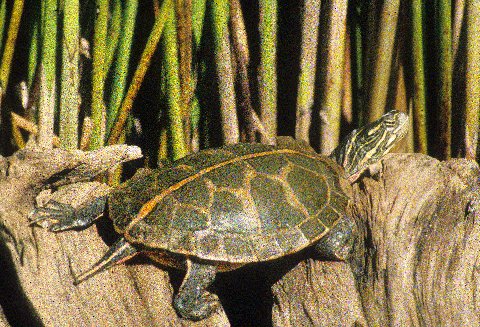
The carapacial sutures of the eastern painted turtle go straight across the shell and there is no plastral figure.
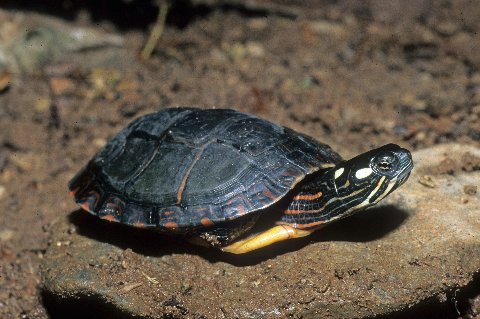
The carapacial sutures of the midland painted turtle do not go straight across the shell and this subspecies bears a dark central plastral figure.