


Amphibians worldwide may be at risk from fungus that killed salamanders in the Netherlands
By kingsnake.com · September 4, 2013 6:14 am
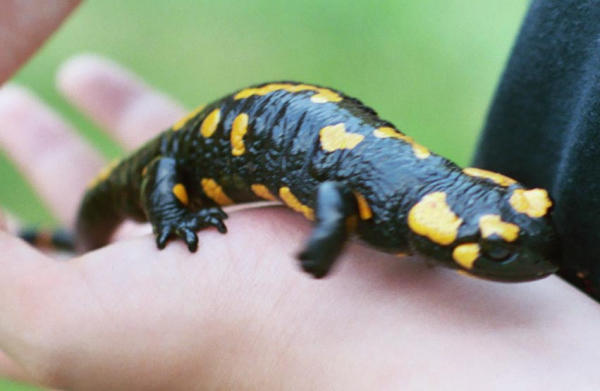 A mysterious disease wiped out nearly all fire salamanders in the Netherlands, even those taken into captivity to protect them. Now scientists have identified the fungus responsible, and warned it could spread to amphibians around the world.
From Scientific American:
A mysterious disease wiped out nearly all fire salamanders in the Netherlands, even those taken into captivity to protect them. Now scientists have identified the fungus responsible, and warned it could spread to amphibians around the world.
From Scientific American:
But now the cause of the fire salamanders’ rapid decline has been revealed. According to a paper published today in the Proceedings of the National Academy of Sciences, the fire salamanders in the Netherlands contracted a previously unknown fungus related to Bd, the fungus that causes chytridiomycosis. The paper dubs the new fungus Batrachochytrium salamandrivorans spec. nov. It causes superficial erosions on the salamanders’ skin, followed by deep ulcerations and microscopic skin necrosis. Captive-bred amphibians which the scientists exposed to the fungus died in as little as seven days. "At this moment we don’t know the origin of the fungus," says the paper’s lead author, An Martel of the Department of Pathology, Bacteriology and Avian Diseases at Ghent University. "It can be an endemic species that became virulent or it can be an invasive species that was introduced in the Netherlands. Worldwide monitoring can give us an answer to this question. But still, if the fungus would spread a lot of amphibian populations are at risk."Read more here. Photo: kingsnake.com user caecilianman02