
Bimini ghosts and goblins and anoles, too
By Richard Bartlett · June 18, 2013 6:54 am
Of the four anole species on Bimini, the twig or ghost anole is the most diverse and the most difficult to find.
This attenuate brownish gray, sharp-nosed, anole is very arboreal and prefers to move slowly and stealthily. The male’s dewlap is a pale yellowish peach and does not seem to be distended as readily as the dewlaps of most species. If approached, the twig anole will quietly and slowly sidle around the branch on which it is resting, adroitly keeping the branch between itself and the observer. The grayish coloration and lineate pattern blend so well with the bark of the trees on which this anole lives that the lizard is very easily overlooked.

In 1948, based on cranial scalation and lamellae count, Jim Oliver thought the Bimini twig anoles sufficiently distinct from those on Cuba and elsewhere in the Bahamas to assign them their own subspecies. He named them Anolis angusticeps chickcharnyi, the subspecific name being based on a mythical being -- a ghost, if you will, or perhaps a goblin -- that supposedly appeared on Andros Island.

Visitors carry flowers or bright cloth that supposedly charms the three fingered, three toed, red-eyed, hook-tailed, creatures called Chickcharnies. If the cloth or flowers are offered with respect Chickcharnie will provide lifelong good luck to the bearer. If proper respect is not shown Chickcharnie will forcibly rotate your head, either 180 degrees or 360 degrees.Whether rotated half way or in a full circle this procedure sounds painful. By the way, Chickcharnie supposedly nested (bred?) at the summit of two pine trees that had been joined together by the beast. They suspended themselves from the pine trees by means of the hooked tail.
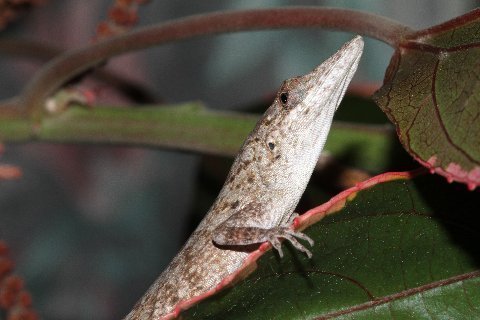 Hope you enjoyed this bit of island lore and will peruse the photos of this seldom seen, almost ghostly, anole. It has now been determined that the differences as outlined by Dr. Oliver were within the normal range of variable for Anolis angusticeps oligaspis, and it was to this that the twig anole of Bimini was returned and yet remains.
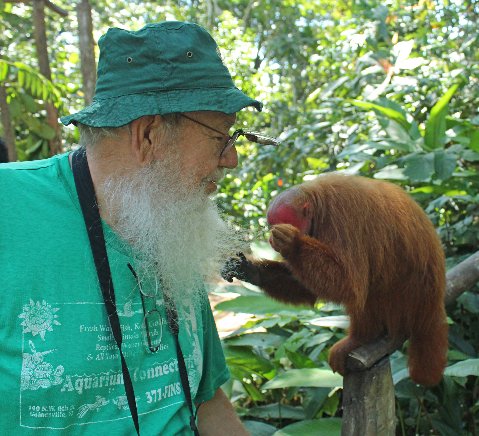 Author, photographer, and columnist Richard Bartlett is one of the most prolific writers on herpetological subjects in the 20th century. With hundreds of books and articles to their credit, Richard and his wife Pat have spent over four decades documenting reptiles both in the field and in captivity. For a list of their current titles, please visit their page in our bookstore. Author, photographer, and columnist Richard Bartlett is one of the most prolific writers on herpetological subjects in the 20th century. With hundreds of books and articles to their credit, Richard and his wife Pat have spent over four decades documenting reptiles both in the field and in captivity. For a list of their current titles, please visit their page in our bookstore. |