- Huachuca Mountain Kingsnake
- Lampropeltis pyromelana woodini
- Size:
- Hatchling: 7 - 8 in.
- Adult: 36 - 42 in.
- Scalation:
- Dorsal: 23
- Ventral: 221 - 233
- Sub caudal: 63 - 78
- Infra labial:10
- Supra labial: 7-8
- Anal Plate: Single
|
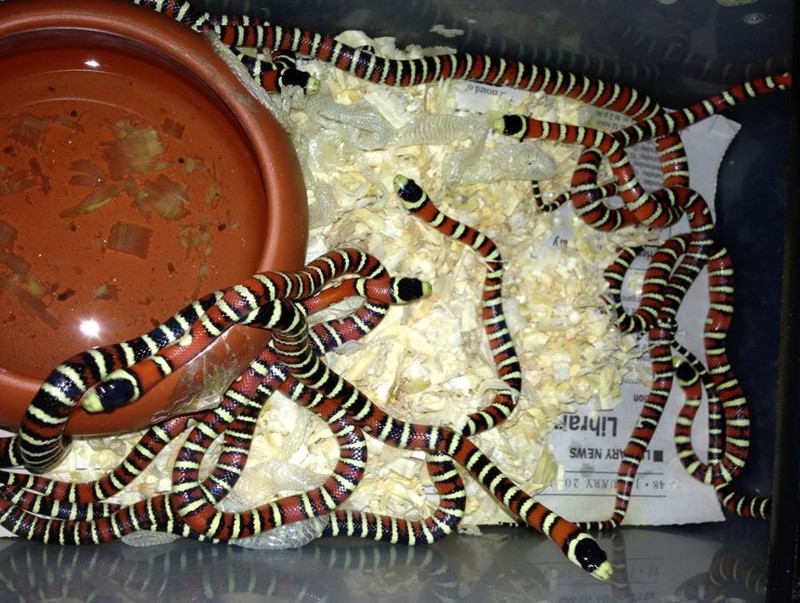
Photo by Mike Russo |
Written by John Cherry
Coloration
Head:
Head is black with a white snout. First white ring is narrow above and wider below.
Dorsal:
This is a tri-colored animal that has fewer white rings ( usually 37 - 40 ) than the adjacent Arizona Mountain King ( 42 - 61 ). Red is a bright lipstick red with little flecking in the scales. Black rings may crossover on spine, but do not reach to ventrals.
Ventral:
White with paler red rings encircling body. Black does not cross onto ventrals
Range:
Restricted to the Huachuca Mts. of Arizona and Mexico.
Habitat:
This subspecies in it's true form is restricted only to the mountainous areas of the sonoran desert.
Prey:
In captivity these animals fair very well on a diet of lab. raised mice. Juveniles require new born
pink mice, because of their small size. They are generally good to average feeders when young.
In the wild they primarily feed on lizards and rodents, although they may be considered opportunistic and feed on nestling birds, other snakes, and various amphibians.
Behavior:
This is a very non-aggressive species that does well in captivity. It is somewhat secretive and requires a hiding box at all times. They become favorites in most collections, because of beautiful colors and gentleness.
Breeding:
Breeding in captivity is achieved in the same manner as with most colubrids using the following as a guideline. Towards the middle of October cease feeding totally, allowing at least 2 -3 weeks at normal temperature for clearing of the gut. Then gradually reduce the ambient tempeture inside the cage to the middle 50's/low 60's and maintain for a period of 3 months. Be sure and provide clean water and systematically check animals for general condition and welfare during this period. middle of the brumation cycle with good success. After brumation and the animals are brought back up to optimum temperature of 76 - 82 degrees, feeding should resume for approx. three weeks and the pair should be placed together under supervision for short periods of time until copulation can be confirmed. An egg laying chamber/box partially filled with damp vermiculite or sphagnum moss is helpful. Eggs should be removed immediately after laying and placed in damp vermiculite for the incubation period of 58 - 66 days at temperatures of 80 - 83 degrees.
Literature Cited:
Stebbins,Robert C. 1985 second editition revised. A field guide to Western
Reptiles and Amphibians. Houghton Mifflin Company
Cherry, John & Cindy Field & Breeding Notes
|
|
Sponsored Link
New & Updated Business Listings
Looking for a reptile or amphibian related business? A reptile store, breeder, importer,
maunfacturer or supplier? Our business directory lists some of the most popluar herp businesses in the world.
| Locate a reptile or amphibian business by name:
|
|
Recent Mountain Kingsnakes Forum Posts
• Desert king, posted by kcaj
• Desert king, posted by kcaj
• Desert king, posted by kcaj
• Arizona mnt king, posted by kcaj
• Zonata ownership in Ca?, posted by steeve111
• Zonata, posted by mountain-kings
• photos, posted by mountain-kings
• no new posts, posted by mountain-kings
• Ring counts for pyros, posted by emoryi
• Breeding size for Arizona Mountain Kings, posted by 4dnospolk
• incubation time approx., posted by kcaj
• Santa Barbara habitat shots, posted by markg
• 2014 pyro, posted by markg
• 2014 CB zonata, posted by Ryan_Sikola
• hi, posted by batgirl25
Recent Mountain Kingsnake Classifieds:
Banner Pool
KINGSNAKE.COM
Enjoy all our content free of charge with a user account that gives you full access to every feature.
For added visibility, paid options are available - post in our Classifieds, showcase your business with
Banner Ads or a Directory listing, promote reptile events, and more.
|
Quick Links
|
Community
|
Legal & Safety
|
Support
|
|
|
Kingsnake.com ® is a registered trademark © 1997-
|
|
|