- South Florida Mole Kingsnake
- Lampropeltis calligaster occipitolineata
- Size:
- Hatchling: unknown, presumably same as L. c. rhombomaculata
- Adult: presumably 24-36 inches
- Scalation:
- Dorsal: 21 at mid body
- Ventral: 211 - 219
- Sub caudal: 41 - 44
- Infra labial: 10
- Supra labial: 8
- Anal Plate: single
|
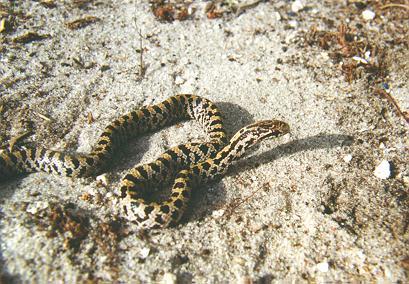
Photo by Douglas H. Mong - click to enlarge |
|
Written by Deron Hartman
Coloration:
- Head:
A post-ocular stripe the same color as the dorsal blotches running from the eye to the angle of
the jaw is present. Two, long blotches on the back of the head and neck help to form the
V-shape on the top of the head, similar to that of L. c. calligaster.
- Dorsal:
The ground color is grayish to tanish orange with 60-79 round, oval, or odd shaped red to
red-orange blotches edged with black.
- Ventral:
The belly is cream colored with brownish-black blotches.
Behavior:
The south Florida mole king is an extremely secretive snake generally considered to be
fossorial in habit. It is the most recently described member of the genus Lampropeltis, being
described in 1987. Mole kings in general have been collected both during the day and at night.
Breeding:
Nothing is known of breeding habits or clutch size. Presumably the same as L. c.
rhombomaculata. As with other Florida snakes it does not hibernate due to the temperatures
in south and central Florida. A cooling down period of 2-3 months with temps. between
55-65 F should be required in order for successful breeding to take place.
Range:
Specimens are known from Okeechobee county, one from northern Brevard county and one
from Desoto county. Of the original 4 specimens, 3 were from Okeechobee county and a
photo of the 4th from northern Brevard county. Their range probably also includes parts of
Highlands, Glades, St. Lucie, Indian River and Osceola counties within suitable habitat.
Habitat:
In northern Florida mole kings L. c. rhombomaculata have been found in pinelands and they
seem to like open fields such as pastureland. Of the original three specimens from
Okeechobee county, two were found on paved roads near grassy areas and one was found in
the parking lot of a convenience store.
Prey:
Presumably the same as the other subspecies. Most likely lizards, small nestling rodents,
snakes and possibly frogs and toads.
Note:
There is very little data available on this subspecies both in the wild and in captivity. Further
study is greatly needed in order to help determine the exact range, habitat preferences,
genetics and to gather breeding information of this extremely secretive snake. The scale counts
given above are based on two DOR specimens from Okeechobee county that are in my
collection.
|
All images on this site are used with the permission of the photographers and are protected
by copyright. Unauthorized use is prohibited without written consent of the photographer.

|
Sponsored Link
New & Updated Business Listings
Looking for a reptile or amphibian related business? A reptile store, breeder, importer,
maunfacturer or supplier? Our business directory lists some of the most popluar herp businesses in the world.
| Locate a reptile or amphibian business by name:
|
|
Recent Mole & Prairie Kingsnakes Forum Posts
• Is there anybody out there?, posted by crotalus
• Prairie King Project (updated), posted by ssshane
• Mole Clutch, posted by Rust
• 2012 hypo prairie kingsnakes, posted by zonatahunt
• Two for next season (MD MOLES), posted by joecop
• MD moles and offspring, posted by joecop
• Missouri Calligasters, posted by BrandonD
• MD girl---to give life to the forum, posted by joecop
• California King Snake lies upside down, posted by gizi72
• FL panhandle , posted by CrimsonKing
• SFMK, posted by GerardS
• Check --check--this thing on?, posted by joecop
• my mole king, posted by jhawkman
• K....7.1 oh boy...., posted by chris jones
• Mark, any updates?, posted by antelope
Recent Kingsnake Classifieds:
- Now Buying Kingsnakesall...
- Mexican Black Kingsnake ...
- Mexican Black Kingsnake ...
Banner Pool
KINGSNAKE.COM
Enjoy all our content free of charge with a user account that gives you full access to every feature.
For added visibility, paid options are available - post in our Classifieds, showcase your business with
Banner Ads or a Directory listing, promote reptile events, and more.
|
Quick Links
|
Community
|
Legal & Safety
|
Support
|
|
|
Kingsnake.com ® is a registered trademark © 1997-
|
|
|