
mobile - desktop


  |
| mobile - desktop |
|
 |
 Contact Sales! |
News & Events:
|
|
Reptile & Amphibian
News Blog Keep up with news and features of interest to the reptile and amphibian community on the kingsnake.com blog. We cover breaking stories from the mainstream and scientific media, user-submitted photos and videos, and feature articles and photos by Jeff Barringer, Richard Bartlett, and other herpetologists and herpetoculturists.


Wednesday, September 15 2010Welcome to the 'new' kingsnake.com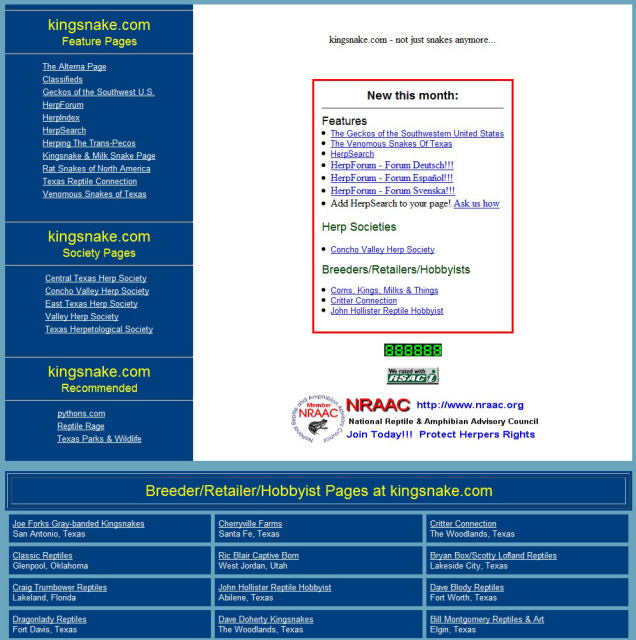 Welcome to the "new" kingsnake.com! Welcome to the "new" kingsnake.com! In 1997 when I started kingsnake.com (pictured right) , I never imagined that 13 years later we would still be here and that the site would have grown so huge. And technologies that were just dreams then, like web video, web-connected cell phones and iPads, are not only reality but commonplace today. In 1997 we were happy to have pictures and colors, having just stepped up from HTML 1.0 which didn't allow for either. Forums, classifieds, photo galleries, chat, video; we have added a lot to site over the years, so much in fact that the site was getting tough to navigate. Today we have relaunched kingsnake.com with an easier-to-navigate user interface. But this is more than just a facelift, because we're also launching two huge new features. Community Blog - You are reading this on kingsnake.com's brand new community blog. It allows any of our registered site users to start their own reptile or amphibian-oriented blog. Share your experiences, your pets, your politics and more! Connect - kingsnake.com's Connect is a beta project being developed to let the herp community stay in touch with their friends and fellow hobbyists, keep each other up to date on legislative issues as they develop, and to build and strengthen the herp community network. Registered users of kingsnake.com can use it to share photos, links, information, alerts, updates and more. Please bear in mind that Connect is a beta project and may need to be taken offline for updates from time to time. We have created a Connect forum to post questions, get answers, report bugs, and request features. Our staff has worked hard over the last few months to bring these projects forward and we hope you enjoy the fruit of their efforts. Check out some more pages from kingsnake.com's history after the jump.
Continue reading "Welcome to the 'new' kingsnake.com" Monday, September 13 2010NARBC: Sunday photo-palooza
I was flying back to Milwaukee Sunday, but kingsnake.com BFF Desiree Wong went to the show again and took another load of photos! Although she left before the Leo sighting (Leonardo Di Caprio attending the show just before close), she got some cool shots. And as always, many more photos to be found after the bump.
Saucy baby Red Foot Tortoise from Tortoise Supply:  Continue reading "NARBC: Sunday photo-palooza" Sunday, September 12 2010NARBC: The auction
Saturday night at the shows is auction night, and NARBC 2010 is no exception.
This year's auction proceeds went to two organizations working on legislative issues, PIJAC and USARK. Brian Potter was the ringmaster as always, and made it a fun evening. If you ever attend NARBC, please be prepared: this is NOT a family auction. Brian and Bob, NARBC masterminds, are first up:  As always more photos after the bump!
Continue reading "NARBC: The auction" NARBC: Helping with photos on opening day
While we had some issues uploading, there was no shortage of pics at the show. I had a good time taking a few photos yesterday as I walked around and I will also be taking pics at the show today as well.
 Don Schultz and Cindy Steinle More photos after the bump... Continue reading "NARBC: Helping with photos on opening day" NARBC: The women of the reptile community
I had such a lovely time chatting with some of the most amazing women this weekend. I am still amazed that so few people realize that 49 percent of kingsnake.com users are female. I had some very involved conversations with these women this weekend and I have decided that, if given the chance, we could make world peace. We all are on the same page.
 Tracy Barker of VPI and me More photos after the bump. Continue reading "NARBC: The women of the reptile community" Saturday, September 11 2010NARBC: Friends and family The best thing about reptile shows is the chance to hang with friends and family. We enjoyed a quiet little family lunch with a small group of folks. I also got to see the Venom Doc reduced to purchasing a corn snake. The photo in the corner is our lunch group including Bryan Fry, Chip Cochran, and Desiree Wong, among others. The best thing about reptile shows is the chance to hang with friends and family. We enjoyed a quiet little family lunch with a small group of folks. I also got to see the Venom Doc reduced to purchasing a corn snake. The photo in the corner is our lunch group including Bryan Fry, Chip Cochran, and Desiree Wong, among others. Photo after the jump is the snake Dr. Bryan Grieg Fry purchased, albeit for his girlfriend. Off to the auction and more photos will follow soon.
Continue reading "NARBC: Friends and family" NARBC: Day one photos
We've been having some upload problems from the NARBC show here in Anaheim, but here are a few photos to hold you over until we get back to our real computers!
Desiree Wong and Thushara from Zoomed:  More under the bump... Continue reading "NARBC: Day one photos" Friday, September 10 2010NARBC: San Diego Zoo conservation and Safari Park At the top of my "must-see" list during this trip to California: Visiting Jeff Lemm and seeing his conservation work with the San Diego Zoo and the Beckman Center for Conservation Research. At the top of my "must-see" list during this trip to California: Visiting Jeff Lemm and seeing his conservation work with the San Diego Zoo and the Beckman Center for Conservation Research. Conservation programs run by the Chicago Herpetological Society are what got me involved with the reptile community back in the day, and conservation efforts continue to be where my passions lie. Uber-herper Jeff Lemm is one of the research coordinators in the Applied Animal Ecology department, and he's long been one of my heroes for his work with Rock Iguanas. He met me, along with my husband, Brian, and my sister-in-law, Cheri, at the Beckman Center for Conservation Research and proudly showed off his Mountain Yellow Legged frogs project, including their goals for re-introduction and on-site breeding project. The current status of these frogs is quite dismal, but it's amazing to watch a species grasp the chance to return to the wild. Jeff then took us to his newly designed iguana facility. The attention to detail, from the heating and cooling to the humidity sources, was amazing. Juvie Blue Iguanas greeted us in the grow-up cages, and Jeff shared where they would eventually be heading to live out their lives. We also discussed the processes he went through to learn exactly what was needed to breed the more rarer , how they started with the Cuban Rocks, which are stable in captivity.
Continue reading "NARBC: San Diego Zoo conservation and Safari Park" North American Reptile Breeders Conference in Anaheim We're on the road again! I'm heading out to represent Kingsnake.com at the North American Reptiles Breeder's Conference in Anaheim, CA. We're on the road again! I'm heading out to represent Kingsnake.com at the North American Reptiles Breeder's Conference in Anaheim, CA. kingsnake.com will be covering NARBC live, just like we did Daytona last month. I'll be meeting up with Jeff Lemm from the San Diego Zoo as well as a pet author Liz Palika, who is very well known in dog land but also runs a reptile rescue from her home in California. If you're there, look for me at set-up on Friday as well as at the show and auction over the rest of the weekend. Stop me and say hi! Desiree Wong of the International Reptile Conservation Foundation and her sidekick, Xan, will also be helping with the online coverage. You can follow us on the Kingsnake.com blog here. We have a photo gallery made specifically for this show! Upload shots from the show while you're down there to share with everyone! You can find the NARBC Anaheim gallery here. Be sure to "like" us on Facebook here -- we'll be updating there, too, as well as on Twitter, here. Are you a regular Twitter user? We have started a hashtag for the event! Post from the show with #narbc to join in on the fun! Not familiar with how hashtags work? No problem! Check out this helpful link for more information. Safe travels to all on their way to and from the show. If you see me, please stop and say hi! And don't be shocked if I ask for a photo with you!
Continue reading "North American Reptile Breeders Conference in Anaheim" Wednesday, September 8 2010FWS proposes the hellbender for CITES listing The Fish and Wildlife Service today issued a proposal to add the native hellbender and its subspecies to Appendix III of CITES in an effort to monitor the trade in the species. Found in the heartland of the Eastern United States, these giant salamanders are the third largest salamander species in the world. We, the U.S. Fish and Wildlife Service (Service), propose to include the hellbender (Cryptobranchus alleganiensis), a large aquatic salamander, including its two subspecies, the eastern hellbender (Cryptobranchus alleganiensis alleganiensis) and the Ozark hellbender (Cryptobranchus alleganiensis bishopi), in Appendix III of the Convention on International Trade in Endangered Species of Wild Fauna and Flora (CITES or Convention), including live and dead whole specimens, and all readily recognizable parts, products, and derivatives. Listing hellbenders in Appendix III of CITES is necessary to allow us to adequately monitor international trade in the taxon; to determine whether exports are occurring legally, with respect to State law; and to determine whether further measures under CITES or other laws are required to conserve this species... Hellbenders have been classified an endangered species in Illinois, Indiana, Maryland, Missouri and Ohio, and "rare" or "of special concern" in Georgia, Kentucky, New York, North Carolina, Virginia, West Virginia and Tennessee. The species has been in decline due to a number of factors, including an increase in the number of dams, reduced water quality, collection for the pet trade, and persecution by fishermen who view them as a threat. Hellbenders like, many of the worlds amphibians, are also susceptible to Chytridiomycosis The proposal was published in today's Federal Register (Federal Register / Vol. 75, No. 173 / Wednesday, September 8, 2010), and those who wish to submit comments need to do so by or before November 8, 2010. Comments may be submitted to www.regulations.gov. Follow the instructions for submitting comments on Docket No. FWS–R9–IA–2009–0033.
Tuesday, September 7 2010American Crocodile Education Sanctuary burned to ground In what can only be described as a horrendous tragedy, the American Crocodile Education Sanctuary in Belize was burned to the ground this weekend. Today, croc fans worldwide wait to see the future not only for ACES but also for Cherie and Vince Rose, who dedicated their lives to helping rehabilitate the American Crocodile. In what can only be described as a horrendous tragedy, the American Crocodile Education Sanctuary in Belize was burned to the ground this weekend. Today, croc fans worldwide wait to see the future not only for ACES but also for Cherie and Vince Rose, who dedicated their lives to helping rehabilitate the American Crocodile.From CNN.com: Bit by bit, their hope turned into reality. They built a two-story octagonal-shaped house that rested on stilts and reached 30 feet into the air. They constructed two smaller cottages for researchers and students to stay in. They dug out two acres of canals for the crocodiles. They acquired two boats. I first learned of ACES when Wildlife Discovery Center in Lake Forest, IL, began fundraising to bring one of their American Crocs to the facility. Cherie and Vince are in our thoughts today, and we hope for their safety as the rebuild. We will keep you posted on this as it unfolds. Sea Turtle gets CT scan Modern medicine isn't just for humans anymore. A Loggerhead Sea Turtle named J. George received a CT scan for free at Bon Secours Health Center to help learn why he couldnt dive. Modern medicine isn't just for humans anymore. A Loggerhead Sea Turtle named J. George received a CT scan for free at Bon Secours Health Center to help learn why he couldnt dive.From Pilot-Online: "His caudal end is buoyant," said the stranding team's Christina Trapani, and Dr. George translated: "He floats with his rear end up like a crab pot marker." After 13 months of rehab, they are currently working to see if J.George will be able to be fixed and released. If he is unable to dive, he will need to remain in captivity. Monday, September 6 2010Congrats to St. Augustine on their hatchings The birth of rare crocodilians is a pretty exciting event, and St. Augustine Alligator Farm is having some nice rare events. TEarlier this week they had a Slender Snout Crocodile hatching, and then today they hatched the first of their Siamese Crocs. Great to see conservation in action at one of my favorite places to visit. The birth of rare crocodilians is a pretty exciting event, and St. Augustine Alligator Farm is having some nice rare events. TEarlier this week they had a Slender Snout Crocodile hatching, and then today they hatched the first of their Siamese Crocs. Great to see conservation in action at one of my favorite places to visit. Now for TEH CUTES. The photo to the right is the baby hatchling Siamese Croc -- thanks to Kevin Torregrosa. The photo below is the baby Slender Snouted Croc. So very cute that they made Zooborns.
Saturday, September 4 2010Michigan's oiled turtles have a hero on their side The folks in Eaton, Mich., love animals and they are taking steps to show even normal people can become extraordinary heroes. The folks in Eaton, Mich., love animals and they are taking steps to show even normal people can become extraordinary heroes. Going above and beyond their normal daily lives, they are taking steps to ensure the wildlife affected by the oil spill gets cleaned up and a second chance. From the Lansing State Journal: Then there's the woman known as the "Turtle Rehabber," Kay Frasher. Frasher, who works as a vet tech at the Holt Veterinarian Clinic, is licensed as an animal rehabilitator and specializes in turtles native to Michigan. To read the tales of all the rescuers, click here. Friday, September 3 2010Herp Report: Second chance for Eastern Indigo Snake Several efforts are being launched to create refuges for the Eastern Indigo, one of the largest snakes in the United States. Several efforts are being launched to create refuges for the Eastern Indigo, one of the largest snakes in the United States. First up, a congressman who gets it. For those keeping track for voting purposes, this is Congressman Jack Kingston of Savannah, GA. From the Island Packet: The bespectacled Republican couldn't help but crack a joke about his search for the harmless indigo, one of the largest snakes in North America. What he was promoting and researching was Project Orianne, which is named after a little girl who loves Indigos; seriously how cool is that! From the Orlando Sentinal: Antonio said the Lake site provides an ideal arena for study and breeding the reptiles, allowing researchers to construct individual open-air enclosures that mirror the eastern indigo snake's natural habitat. He said the enclosures will keep the snakes in and black bear, foxes and other animals out. Continue reading "Herp Report: Second chance for Eastern Indigo Snake" Wednesday, September 1 2010Tuesday, August 31 2010Herp Report: Loose crocodilians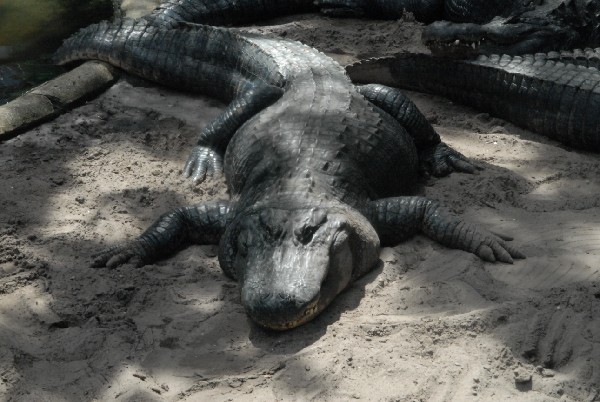 Are you really sure what you saw in that river? Some keen-eyed spotter was not quite as keen as he thought. The Crocodile of the English Channel? Nope, it was wood. From the BBC: Are you really sure what you saw in that river? Some keen-eyed spotter was not quite as keen as he thought. The Crocodile of the English Channel? Nope, it was wood. From the BBC:Coastguards in Dover and France say a large crocodile sighted in the English Channel was actually a piece of wood. However, on that note, numerous alligators have been sighted and reclaimed by rescuers. As a board member of the Chicago Herpetological Society, I can only tell you that the number of phone calls to me while flying home from the NRBE in Daytona last week was insane. The second alligator in the Chicago River in a one month time period was being hunted and was eventually captured. Seriously, this is not the image we want people to have of us. Continue reading "Herp Report: Loose crocodilians" Update on Michigan oil spill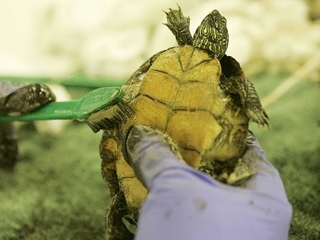 Clean-up from the oil spill continues in Michigan, and even though news coverage has faded away, Fort Worth Zoo is still bringing in daily loads of animals which need care. Clean-up from the oil spill continues in Michigan, and even though news coverage has faded away, Fort Worth Zoo is still bringing in daily loads of animals which need care.We have an upcoming interview with one of the rehabbers on the scene, but in the meantime, here's a quick follow up from FWDailynews.com: The turtles need a lot of help. “Many of the turtles are covered in black, gooey oil residue,” says Smith. “It can take hours to clean a single turtle.” To read the full article, click here. Herp Report: Flesh healing frogs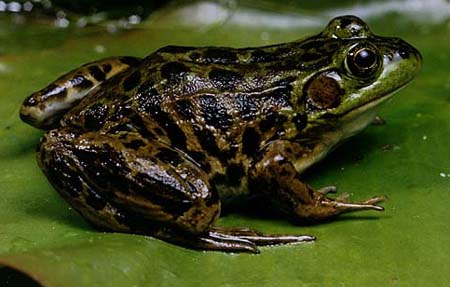 Would you kiss a frog to heal Methicillin-resistant Staphylococcus aureus (MRSA)? Turns out that amphibian skin, primarily that of frogs, is leading the way in creating antibiotics that combat resistant germs. Would you kiss a frog to heal Methicillin-resistant Staphylococcus aureus (MRSA)? Turns out that amphibian skin, primarily that of frogs, is leading the way in creating antibiotics that combat resistant germs.From Science Daily: In a report at the 240th National Meeting of the American Chemical Society on August 26, the team of stalwart frog-fanciers described enlisting colleagues worldwide to ship secretions from hundreds of promising frog skins to their laboratory in the United Arab Emirates. Using that amphibious treasure trove, they identified more than 100 antibiotic substances in the skins of different frog species from around the world. One even fights "Iraqibacter," the bacterium responsible for drug-resistant infections in wounded soldiers returning from Iraq. All hail the Frog Prince. Monday, August 30 2010Saturday, August 28 2010Cage Security Problem Even For Experts Once you have kept reptiles long enough you will usually have at least one funny escape story and one sad escape story, but as reptile keepers cage security is an every day issue not to be taken lightly. Once you have kept reptiles long enough you will usually have at least one funny escape story and one sad escape story, but as reptile keepers cage security is an every day issue not to be taken lightly. No matter how good a keeper you are, pet owner, hobbyist or professional, everyone can have a bad day. According to an article in the Atlanta Journal Constitution the Atlanta Zoo is having one of those days. Zoo spokeswoman Keisha N. Hines said workers are "aggressively looking" for an adult female tiger rattlesnake that escaped quarantine Friday. Zoo officials have been working around the clock to capture the venomous creature, she said. No one wants to make the news for an escape, whether it's a burmese python, an alligator, or a tiger rattlesnake. Do yourself a favor and check your collection before the news crews do it for you. If your in the Grant Park area and spot the snake, do not attempt to capture it, but please call Zoo Atlanta at 404-624-5670. Herp Report: Frog, small and rare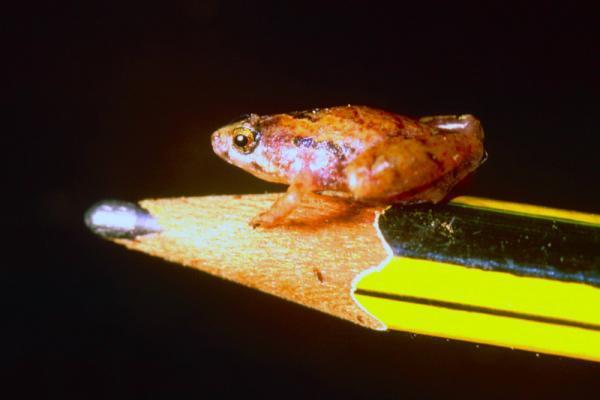 From the island of Borneo, the world's smallest frog is discovered. The size of a pea, these frogs were previously thought to be juveniles of other species. Not so: From the island of Borneo, the world's smallest frog is discovered. The size of a pea, these frogs were previously thought to be juveniles of other species. Not so:The mini frogs (Microhyla nepenthicola) were found on the edge of a road leading to the summit of the Gunung Serapi mountain, which lies within Kubah National Park. The new species was named after the plant on which it depends to live, the Nepenthes ampullaria, one of many species of pitcher plants in Borneo, which has a globular pitcher and grows in damp, shady forests. The frogs deposit their eggs on the sides of the pitcher, and tadpoles grow in the liquid accumulated inside the plant. For the full report from Science Daily, click here. Scientists in 14 countries are now searching out the top ten most wanted lost amphibians. In trying to track down the lost species, they are also trying to learn what has allowed some of them to survive. With amphibian populations around the world declining quickly and a third at risk of extinction, the unprecedented search could help scientists better understand the crisis. For the full report on Wired, click here. Friday, August 27 2010Slayer's Kerry King to be at NARBC Anaheim After a successful year with the band with a new CD, a tour of Europe with thrash's big four (that's Metallica, Megadeth, Slayer and Anthrax), Slayer's Kerry King also had a great year with his snake breeding and is going to take time out of his tour break to sell some of his snakes at the upcoming North American Reptile Breeders Conference in Anaheim. Along with his usual carpet pythons, Kerry says he will be signing autographs and selling some of his personal stash of merch so anyone wanting a chance to meet him, maybe buy a snake or a TShirt, he will be at the Anaheim Convention Center Sept 11 and 12th. After a successful year with the band with a new CD, a tour of Europe with thrash's big four (that's Metallica, Megadeth, Slayer and Anthrax), Slayer's Kerry King also had a great year with his snake breeding and is going to take time out of his tour break to sell some of his snakes at the upcoming North American Reptile Breeders Conference in Anaheim. Along with his usual carpet pythons, Kerry says he will be signing autographs and selling some of his personal stash of merch so anyone wanting a chance to meet him, maybe buy a snake or a TShirt, he will be at the Anaheim Convention Center Sept 11 and 12th.I won't see Kerry again until Dallas where the second leg of the American Carnage tour picks up again and hope to post a whole bunch of stuff from the road. If you take a picture with Kerry in Anaheim make sure to upload it to our herp events photo gallery! Thursday, August 26 2010Herp Report: Baby Komodos born Komodo Dragons are a rare and very hard-to-breed monitor species, but on August 8 at the L.A. Zoo, 22 babies took their first breath out of the egg. Komodo Dragons are a rare and very hard-to-breed monitor species, but on August 8 at the L.A. Zoo, 22 babies took their first breath out of the egg.The first of the new batch was born on Aug. 8. The remaining dragons hatched over the following 11 days. Less than ten zoos nationwide have been able to breed these stunning animals. Of course, I couldn't resist reporting on this bundle of teh cute! To read the full article and see the amazing slideshow, click here.
Wednesday, August 25 2010NRBE: Florida Herping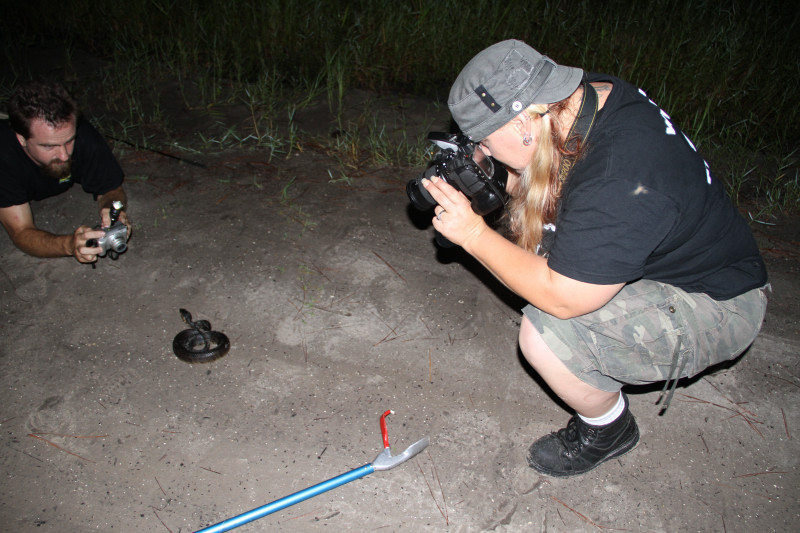 Field herping isn't for the impatient, and it's definitely not for someone who's addicted to the cheap and easy thrill. Field herping isn't for the impatient, and it's definitely not for someone who's addicted to the cheap and easy thrill.Not that I'd know anything about that. Ahem. Don't get me wrong -- I enjoy the camaraderie of a group of folks going out and tromping through the woods in hopes of finding some cool animals. It's just that I want a guaranteed score. I'd road-cruised in Florida before during Daytona, and the best thing we found was an obscene sign. But this year when a commenter on my blog set me a challenge, I gave it another shot and went out with my friends Jeff from Arizona and Eric from Ohio. There was one rule: If my friends did not supply a venomous snake or an alligator, there would be hell to pay. Either that or I would channel my inner girl and turn into a very whiny, crabby woman. I suspect they thought that second option was the worst. So we went out road-cruising on a dirt road. After around 15 minutes, we found our first toad. Ten minutes later we saw just what I wanted to see: Lying flat in the road, illuminated by the headlights, was a nice-sized Cottonmouth. We found a variety of frogs, a green anole, a really cool owl and a coyote. Our last find was another Cottonmouth that Eric went all commando on to track down in the brush at the side of the road. The guys were spared my wrath, and I learned field herping might be just my thing after all. Maybe next year we'll take a spring trip to Snake Road in Illinois... Pictures under the bump, as usual! Continue reading "NRBE: Florida Herping" Herp Report: Healing venom One bite or sting can easily kill you, but scientists are working on learning the medical benefits of venom -- adding to the amazement we reptile keepers have for the beautiful venomous animals. One bite or sting can easily kill you, but scientists are working on learning the medical benefits of venom -- adding to the amazement we reptile keepers have for the beautiful venomous animals.From Foxnews.com: The University of Washington recently announced the latest breakthrough in this field, explaining how scorpion venom can be useful in treating brain cancer. Researchers found that chlorotoxin,an amino acid found in deathstalker scorpions, can slow the cancer's spread by blocking narrow channels in the brain through which malignant, shape-shifting cells can migrate. One side note: despite being described as "Gila Monster spit," it's the venom that is helping diabetics in the form of the drug Byetta.
Sunday, August 22 2010NRBE: The show is ova! In the word's of Wayne Hill, "The 2010 National Reptile Breeders Expo is over." Many of the vendors told me it was a wonderful turnout for them. While today seemed much slower than yesterday, the traffic was constant and it was impossible to get with folks for interviews. In the word's of Wayne Hill, "The 2010 National Reptile Breeders Expo is over." Many of the vendors told me it was a wonderful turnout for them. While today seemed much slower than yesterday, the traffic was constant and it was impossible to get with folks for interviews. Usually one species dominates a show, but the selection was quite vast this weekend. Everything from Bearded Dragons and Ball Pythons to this amazing Albino Jag. (Did I mention I would bribe easily for this snake?) The best part of the show was meeting our members and advertisers, and I want to thank everyone for the kind words about the blog this weekend. I also will take all your suggestions and advice for the site to heart. My bed behind me and the bar on the first floor are both looking pretty inviting now, but I am off for an evening of field herping with some of my good friends. They have promised I will see things. Besides, Paul challenged me on the St. Augustine post, and I'm a girl who doesn't back down from challenges. Safe travels to all!
|
Our Sponsors CategoriesSubscribe |

|
|

|
|


