
mobile - desktop


  |
| mobile - desktop |
|
 |
 Contact Sales! |
News & Events:
|
|
Reptile & Amphibian
News Blog Keep up with news and features of interest to the reptile and amphibian community on the kingsnake.com blog. We cover breaking stories from the mainstream and scientific media, user-submitted photos and videos, and feature articles and photos by Jeff Barringer, Richard Bartlett, and other herpetologists and herpetoculturists.


Wednesday, February 29 2012Chula Vista drops reptiles from proposed regulations After a late night session, the City Council of Chula Vista, California has removed proposed restrictions regarding reptiles from its upcoming overhaul of pet laws after receiving input from local pet owners and businesses. More than 35 local reptile owners were able to attend the meeting, after receiving word of the proposal only yesterday. Though some had to leave early, most stayed and were able to work with the Mayor and Council to modify the proposal and table the reptile restrictions. After a late night session, the City Council of Chula Vista, California has removed proposed restrictions regarding reptiles from its upcoming overhaul of pet laws after receiving input from local pet owners and businesses. More than 35 local reptile owners were able to attend the meeting, after receiving word of the proposal only yesterday. Though some had to leave early, most stayed and were able to work with the Mayor and Council to modify the proposal and table the reptile restrictions. Loren Leigh of LLL Reptile was one of those business and reptile owners that was able to drop everything and help rally reptile owners to the council chambers. I was able to speak with Loren briefly today about what was on the table and whet they got accomplished. To listen to the interview click here. Tuesday, February 28 2012House Judiciary Committee passes H.R. 511 Despite the input of thousands of reptile owners and businesses, today the Florida Independent is reporting that the U.S. House Judiciary Committee passed H.R. 511, a bill that would add nine species of constrictor snakes to the the list of injurious species under the Lacey Act, clearing the way for a vote by the full House of Representatives later in the year. Despite the input of thousands of reptile owners and businesses, today the Florida Independent is reporting that the U.S. House Judiciary Committee passed H.R. 511, a bill that would add nine species of constrictor snakes to the the list of injurious species under the Lacey Act, clearing the way for a vote by the full House of Representatives later in the year. Quick to release a statement, the HSUS is already pushing to take the next step. “The House Judiciary Committee recognized that the trade in large, constricting snakes is reckless and irresponsible, putting people, ecosystems and the animals that live in them, and the snakes themselves at risk,” said Wayne Pacelle, president and CEO of The Humane Society of the United States. “We hope that the bill is scheduled for a vote on the House floor soon, and that the Senate takes up the matter expeditiously.” The read the full text of the article at the Florida Independent click here The next step for H.R. 511 is the full House of Representatives, where it will have to be voted on and pass, and from there to the U.S. Senate, and then to the President, a process that can take days, or months depending on the impetus of the bill. If you are a pet owner concerned or impacted by the implications of this proposed legislation, please make sure to let your House of Representatives member know how it impacts you and your family. Update from Illinois Senate hearing on 'Dangerous Animals Act of 2012' The proposed "Illinois Dangerous Animals Act of 2012, Senate Bill SB3264", a bill which would have eliminated and restricted the ownership of many pet reptiles in Illinois, was the agenda of a Senate hearing today at the state capital in Springfield. A group of concerned Illinois pet and business owners, led by the always fearless and outspoken Brian Potter, went to Springfield today to speak their minds on the proposal. The proposed "Illinois Dangerous Animals Act of 2012, Senate Bill SB3264", a bill which would have eliminated and restricted the ownership of many pet reptiles in Illinois, was the agenda of a Senate hearing today at the state capital in Springfield. A group of concerned Illinois pet and business owners, led by the always fearless and outspoken Brian Potter, went to Springfield today to speak their minds on the proposal.I had a chance to speak with Brian for a few minutes right after the hearing. He was kind enough to give us an update on the current situation in Illinois. Click here to hear the interview with Brian Potter. Monday, February 27 2012Chula Vista proposes boa and python ban, meeting tomorrow The Chula Vista, California City Council will discuss an overhaul of the city’s current animal laws tomorrow at its Tuesday, February 28th meeting. Among the amendments presented in this wide-ranging, proposed ordinance is a ban on certain “wild animals” and other provisions that impact reptile owners and businesses. The Chula Vista, California City Council will discuss an overhaul of the city’s current animal laws tomorrow at its Tuesday, February 28th meeting. Among the amendments presented in this wide-ranging, proposed ordinance is a ban on certain “wild animals” and other provisions that impact reptile owners and businesses. This proposal bans the sale, possession for sale, importation or breeding of a wild animal, and declares that “no person may possess or maintain the following:”
For a complete list of the animals impacted by the ordinance refer to the full text of the proposal located here. The proposal states that this ordinance will take effect, and be in full force, on the 13th day after its adoption. The proposal is set to be discussed at the February 28, 2012 City Council meeting (Council Chambers, City Hall – 276 Fourth Avenue, 4:00 p.m.). All pet owners, pet business operators and anyone else affected by this proposal should attend the meeting and contact the council. Thanks again to PIJAC for bringing this to our attention. Senate bill HR511 adds the 'Big 9' to the Lacey Act It was the other shoe dropping for our community. Four species of pythons have been added to the Lacey Act of the United States. On Tuesday, February 28, the Judiciary Committee will see another bill looking to include the remaining original species of snakes. From the House of Representatives webpage: It was the other shoe dropping for our community. Four species of pythons have been added to the Lacey Act of the United States. On Tuesday, February 28, the Judiciary Committee will see another bill looking to include the remaining original species of snakes. From the House of Representatives webpage:A BILL This would be a good time to reach out to your representatives. Remember: always be polite. Explain that the recent Lacey Act Rule including the Burmese, the Yellow Anaconda and the Northern and Southern Rock Pythons has not taken effect nor has it proven to be a failed addition. Also point out that this bill will criminalize many responsible owners on such basic tasks as crossing the state lines for vet care or in the event the family moves. You can also touch on the job loss and the impact this will have on the economy. Make it personal, and do not refer to your animals as a "collection" but as pets. Not sure who your representative is? Click here to find out. After the bump there is a list of those targeted as key members of the judiciary committee, however to reach out to the full list of committee members, click here. Lamar Smith (R-TX)- 202-225-4236 Jim Sensenbrenner (R-WI)- 202-225-5101 Howard Coble (R-NC)- 202-225-3065 Darrell Issa (R-CA)- 202-225-3906 Louie Gohmert (R-TX)- 202-225-3035 Jason Chaffetz (R-UT)- 202-225-7751 Trey Gowdy (R-SC)- 202-225-6030 Ted Poe (R-TX)- 202-225-6565 Bob Goodlatte (R-VA)- 202-225-5431 Saturday, February 25 2012Blue Tongue Skinks becoming resistant to Cane Toad toxin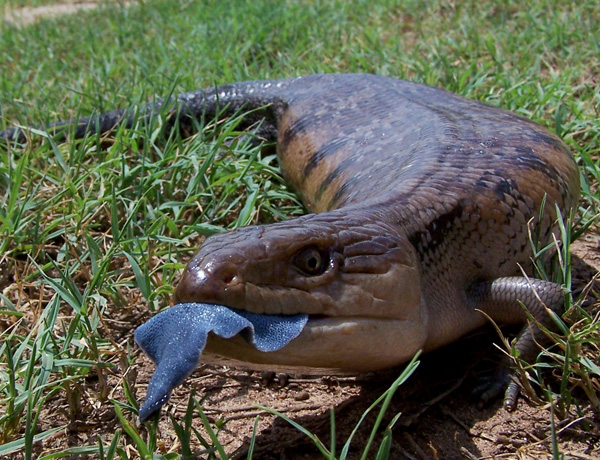 Blue Tongue Skins in Australia are develping resistance to the poisonous Cane Toad. From NewScientist.com: Blue Tongue Skins in Australia are develping resistance to the poisonous Cane Toad. From NewScientist.com:Some blue-tongue lizards in eastern Australia can dine on the cane toads and live, though. Oddly enough, they might owe their immunity to another invasive species. To read the full article, click here. Thursday, February 23 2012What's new in the animal world? Plenty. A beautiful lizard in the Andes, geckos in India, a family of Caecilians in North-east Asia and Sea Snakes in Australia. A beautiful lizard in the Andes, geckos in India, a family of Caecilians in North-east Asia and Sea Snakes in Australia. First up, the Rough Scaled Sea Snakes in Weipa: The snake has been given the scientific name Hydrophis donaldii to honour Associate Professor Fry's long-time boat captain David Donald. Next the Caecilians: These amphibians live below the soil and their discovery was after extensive research of five years. “The new family of amphibians from northeast India has ancient links to Africa,” said a study done by SD Biju of University of Delhi with co-researchers from the Natural History Museum, London and Vrije University, Brussels. And then there is the new Geckos of Asia: A new species of gecko, first found on a wall at Junagadh’s Vagheshwari Mata Temple, in the Girnar Hills, has earned Gujarat the distinction of having a lizard named after it. Lastly the newest lizard from the Andes: Germán Chávez and Diego Vásquez from the Centro de Ornitología y Biodiversidad (CORBIDI) in Peru have discovered a new colorful lizard which they named Potamites montanicola, or “mountain dweller”. The new species was found in Cordillera de Vilcabamba and Apurimac river valley, the Cusco Region of Peru at altitude ranging from 1,600 to 2,100 meters. Their study was published in the open access journal ZooKeys. Tuesday, February 21 2012Pennsylvania moves to protect the Massasauga Rattlesnake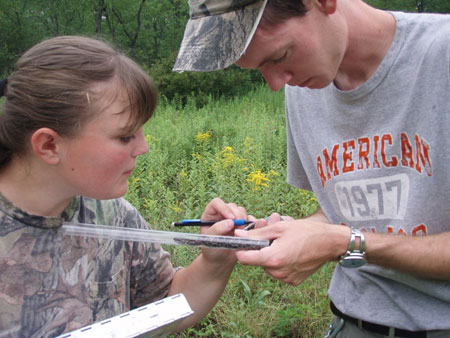 When it comes to conservation efforts, rattlesnakes can be a tough sell. The Western Pennsylvania Conservancy just took steps to protect the environment of a an endangered rattlesnake and preserve part of their ecosystem. When it comes to conservation efforts, rattlesnakes can be a tough sell. The Western Pennsylvania Conservancy just took steps to protect the environment of a an endangered rattlesnake and preserve part of their ecosystem."They bring balance to the ecosystem, and they are part of our history in Pennsylvania and worth preserving," Ryan Miller, a zoologist with the conservancy, said about the snakes. To read the full article, click here. Wednesday, February 15 2012NARBC brings out reptiles and crowds and kids in Arlington The floor was busy at the North American Reptile Breeders Conference on Saturday and Sunday as thousands of people from the D/FW Metroplex converged on the Arlington Expo Center to learn about, look at, and take home reptiles, amphibians, invertebrates and all sorts of cool stuff. Though not Texas oldest (the East Texas Herp Society event takes that honor), the NARBC expo is currently the largest regular reptile and amphibian event in Texas, drawing vendors and visitors from both coasts. The floor was busy at the North American Reptile Breeders Conference on Saturday and Sunday as thousands of people from the D/FW Metroplex converged on the Arlington Expo Center to learn about, look at, and take home reptiles, amphibians, invertebrates and all sorts of cool stuff. Though not Texas oldest (the East Texas Herp Society event takes that honor), the NARBC expo is currently the largest regular reptile and amphibian event in Texas, drawing vendors and visitors from both coasts.kingsnake.com was there displaying our "field observation vehicle" that we are preparing for this years field work, as well as handing out thousands of kingsnake.com window stickers. Both PIJAC and USARK had booths and spent a good deal of time talking with pet owners and breeders about the current regulatory issues our community faces. An auction of reptile and amphibian related items with proceeds benefiting both organizations was held Saturday and raised over $18,000.00. PIJAC sent their new president to Arlington, Mike Canning, and it was good to finally meet with him and talk about the issues. Look for a web radio interview here on kingsnake.com with Mike to talk about what PIJAC thinks about the reptile regulatory scene in the near future. The next NARBC show is the upcoming Reptile Law Summit in Chicago (Tinley Park), Illinois on March 17-18 and I would encourage anyone with questions, concerns, problems, issues and suggestions regarding state and federal reptile and amphibian laws and regulations, or the organizations (PIJAC, USARK) representing our community to attend. For more information on the Reptile Law Summit and who will be attending please visit the NARBC web site at http://narbc.com. To see pictures from last weekends NARBC Arlington expo, or to upload your own, please visit kingsnake.coms photo gallery. Tuesday, February 14 2012Want to protect your right to own reptiles? Get off the computer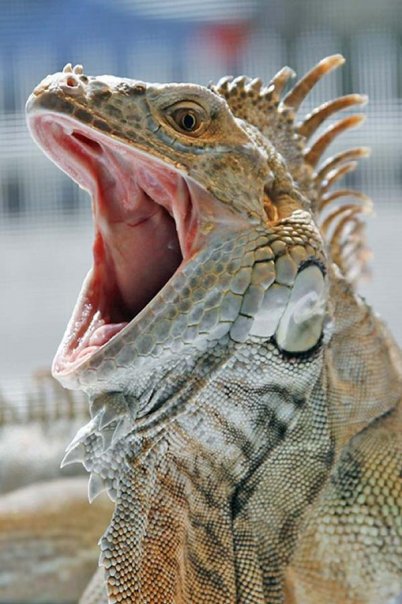 Proposed and actual bans on keeping various types of reptiles are spreading across the country, from the federal to local level. What can we do? Turn off our computers. Proposed and actual bans on keeping various types of reptiles are spreading across the country, from the federal to local level. What can we do? Turn off our computers.I see a million and one petitions circulating with people complaining that not enough people have signed them. But nobody cares about online petitions. It costs you nothing to sign them, and lawmakers and the media know it. Ditto a bunch of us getting together to rant and rave about animal rights groups, politicians, and the media changes not one mind. It doesn't stop one law. It doesn't get a single article in a newspaper that presents our point of view. Instead, get out in the public eye and talk with people who don't understand the appeal of keeping reptiles, and those who don't know about us, our hobby, or our animals. Go to your local pet stores, vet clinics, and dog parks. Network. Educate. Reach out to other pet owners, who you'll find are more sympathetic than you might imagine, once you talk to them as one pet-lover to another. Carry pre-written letters with you if your state is under fire. Print out 20 copies of letters to our representatives. People are more likely to sign a letter and give it to you if you're willing to mail it for them! Remember, this was a major impact tactic that worked fighting HR669. Keep them on hand and mail them in. Remember, you should have the signer print their name and address on the form so that it shows residency. Don't waste your breath trying to make people believe in the vast AR conspiracy. You aren't going to get anywhere with that approach, and run the risk of having them think you're a conspiracy theorist and just tune you out. Instead, focus on educational outreach about herpetology and herp-keeping. I can’t stress this enough. People will not give a damn about these laws if they aren't given a reason to. Let your passion for our hobby and your love of your pets be that reason. Remind the people you talk to that every classroom in America has lizards, frogs, and turtles in it. Talk to them about the wonders of the natural world, and of herpetological study. Even if they don't personally want to start keeping reptiles, that may be all it takes for the tide of public opinion to start turning our way, even just a little. Monday, February 13 2012South Carolina proposes "Exotic Animal and Reptile Control and Regulation Act" On Friday South Carolina announced proposed new legislation that impacts reptile owners, as well as owners of exotic mammals. South Carolina's Senate Bill S 1204 Exotic Animal and Reptile Control and Regulation Act places new restrictions, regulations and penalties on owners of the following reptile species; Reticulated Python, Python reticulatus; Burmese Python, Python molurus; African Rock Python, Python sebae; Amethystine Python, Morelia amethistina and Green Anaconda, Eunectes murinus or any of their subspecies or hybrids, as well as Crocodilians and Venomous species. Has there ever a reptile regulatory proposal that could be considered good for the reptile community? If so this might be one of them, or at the least considerably less onerous than most of the other proposed state regulations. Unlike many of the other proposals currently being considered by other states this legislation does not appear to ban the possession, sale or ownership of these animals, but appears to add caging requirements, safety restrictions and legal penalties for non-compliance, as well as legal penalties for intentional release. These are all things that responsible reptile owners should already be doing, it just makes them legally mandatory and raises the bar of professionalism in our community and industry. As a community, and an industry we should expect to be regulated, few industries go without regulation. We can either work with these agencies, state and federal, to develop workable legislation or we can work against them. I would venture that working against them thus far has met with limited success. To see the reptile portion of the proposed bill, click below Continue reading "South Carolina proposes "Exotic Animal and Reptile Control and Regulation Act"" Friday, February 10 2012What's your problem with calling them 'pets'?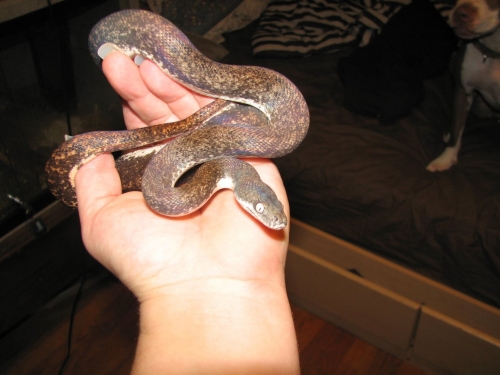 Webster defines a pet as "a domesticated animal kept for pleasure rather than utility." So why does the reptile community have such an issue with the word "pet"? Webster defines a pet as "a domesticated animal kept for pleasure rather than utility." So why does the reptile community have such an issue with the word "pet"?Me, I have an issue with using the word "collections" to describe our animals. I collect comic books, but my reptiles are my pets. I provide their daily needs -- food, water and a clean enclosure. I give them enrichment items and interact with them daily. I keep them because they give me pleasure. That doesn't change because breeding them and making money doing it; you are still gaining pleasure from those animals that you are raising in your home. You gain personal joy from doing it, you network with others keeping reptiles, and you build our community. Before you complain our animals are not domesticated, check again. According to Webster, our reptiles are in fact domesticated. Domesticate: "To adapt (an animal or plant) to life in intimate association with and to the advantage of humans." So tell me, why is saying you have a "pet snake" so wrong? Thursday, February 9 2012One man working to reverse amphibian decline in India Amphibians are nature's barometer. When their populations are stable and healthy, their environment is, too: Amphibians are nature's barometer. When their populations are stable and healthy, their environment is, too:"Amphibians were the first land animals and have a 350-million-year history. They are an environmental barometer and we can analyse the quality of our environment by studying them. We cannot imagine life without frogs. If there are no frogs, it would not be possible to grow anything in our fields," (researcher Dr. Sathyabhama Das) Biju says. To read the full article, click here. Wednesday, February 8 2012kingsnake.com turns 15 years old!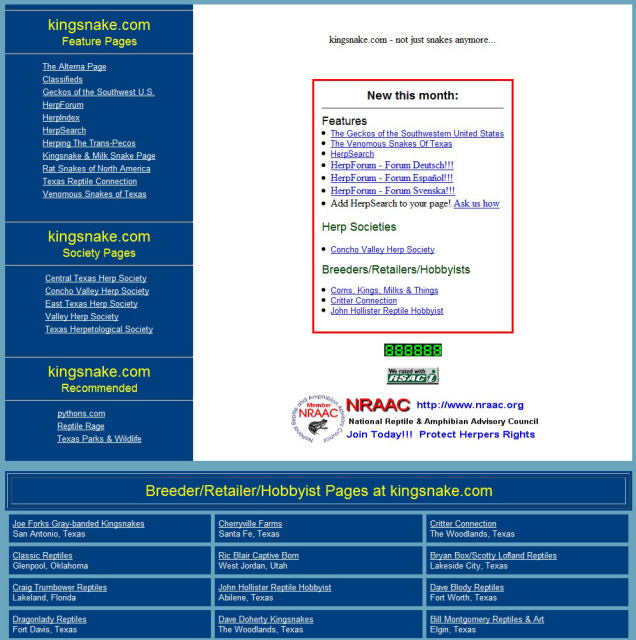 Fifteen years is a looong time. On February 8, 1997 kingsnake.com first appeared on the internet; It has been 5,478 days, or 137,952 hours, or 8,277,120 minutes from when our servers first went active. Since then our reptile and amphibian community has been visited by millions of people from around the world who have posted millions of photos and messages about their pets. Yahoo and Amazon.com may be older, but Google, YouTube, and of course Facebook are still our junior. When I first started this web site few reptile people had even seen the internet, now the internet is so ingrained in our daily lives, in our community, and in our industry, we wonder how we were able to function without it. Along the way kingsnake.com has documented much of it, good and bad, and stored in it's archives is essentially a history of the reptile communities last decade and a half. Wading through it brings back a lot of memories of great animals, events, experiences, and friends that have long past. It will be interesting to see what changes the next 15 years bring. kingsnake.com will be celebrating it's 15th anniversary all year at a variety of Reptile and Amphibian events, including this weekends NARBC expo in Arlington Texas. Please stop by our booth, pick up a free kingsnake.com window sticker and let us know how long you have been reading kingsnake.com! If you can't make it to this weekends show then tune in here for updates from the expo floor. I want to thank the many users, advertisers, sponsors, volunteers, and staffers who have made kingsnake.com what it is today: the largest, most relevant, and most popular reptile community on the internet. - Jeff Barringer Click below to see images of kingsnake.com throughout the years... Continue reading "kingsnake.com turns 15 years old!" Saturday, February 4 2012Kerry King talks carpet pythons, python laws, and Slayer If there is a cool Carpet Python in North America Kerry King and his Psychotic Exotics probably owns it, or it's one he hatched. California based Carpet Python breeder Kerry King is the first guest of 2012 for kingsnake.com's web radio season and todays interview is now available for download. Kerry and I had a great time talking about what morphs he bred this year, what morphs he plans to breed next year, and what the thinks about the new federal python listing. Kerry and his company Psychotic Exotics are frequent trade show exhibitors at west coast reptile shows when they don't conflict with Slayers tour shedule, so we talked a little about his reptile show plans this year. Will he make it to Arlington or Tinley? And whats the deal with shelf liner? Tune in and you might find out. And we didn't want to leave you Slayer fans out. We talked about Slayer's one of gig in Austin last year, the plans for this years Mayhem Festival, hitting the European festivals. We also talked about the new albums release date and the possibility of a Slayer U.S. tour in the fall/winter. To download or stream the interview click here http://kingsnake.com/radio/kfk2012a.mp3 Illinois proposes Dangerous Animals Act SB3264 Yet another state, Illinois, has proposed a law on "Dangerous Animals" that includes constrictor snakes. The Illinois Dangerous Animals Act of 2012, Senate Bill SB3264, introduced by Sen. Heather A. Steans on Wednesday identifies a class of animals that qualify as dangerous animals, requires that a person must hold a Dangerous Animal Permit or a Limited Entry Permit to possess a dangerous animal in the State and sets forth requirements that must be met before the Department of Natural Resources may issue a Dangerous Animal Permit or a Limited Entry Permit, among other things. Yet another state, Illinois, has proposed a law on "Dangerous Animals" that includes constrictor snakes. The Illinois Dangerous Animals Act of 2012, Senate Bill SB3264, introduced by Sen. Heather A. Steans on Wednesday identifies a class of animals that qualify as dangerous animals, requires that a person must hold a Dangerous Animal Permit or a Limited Entry Permit to possess a dangerous animal in the State and sets forth requirements that must be met before the Department of Natural Resources may issue a Dangerous Animal Permit or a Limited Entry Permit, among other things.According to the bill as proposed reptiles and amphibians impacted by this legislation include: (14) Venomous reptiles, regardless of whether they have been surgically altered, including, but not limited to, venomous species of the following families or genera of the order Squamata: Helodermatidae, such as gila monsters and beaded lizards; Elapidae, such as cobras and coral snakes; Hydrophiidae, such as sea snakes; Viperidae and Crotalinae, such as vipers and pit vipers; Atractaspididae, such as burrowing asps; as well as colubrids such as the: Alsophis, such as the West Indian racers; Boiga, such as boigas and mangrove snakes; Conophis such as road guarders; Dispholidus, such as Boomslang; Hydrodynastes, such as false water cobras; Hemirhagerrhis, such as bark snakes; Macropisthodon, such as varied or hooded keelbacks; Madagascarophis, such as Madagascar common snakes; Malpolon, such as Montpellier snakes; Mimophis, such as Mahafaly sand snakes; Phalotris, such as collared snakes; Philodryas, such as palm snakes or green racers; Psammophis, such as sand snakes or racers; Psammophylax, such as skaapstekers; Rhabdophis, such as keelbacks; Rhamphiophis, such as beaked snakes; Tachymenis, such as slender snakes or false vipers; Thelotornis, such as Twig snakes; Thrasops, such as black tree snakes; Tomodon, such as Pampas snakes; Waglerophis, such as Wagler's snakes; Xenodon, such as false fer-de-lances; Boiga irregularis, including specimens or eggs of the brown tree snake; and any others that the Department designates, by administrative rule, as outlined or deemed medically significant. (15) All members of the Boidae family, such as boas, pythons, and anacondas as provided by the Department by administrative rule. (16) All members of the order Crocodilia, such as crocodiles, alligators, caimans, and gavials; members of the Varanidae family, such as Nile, water, and crocodile monitors as well as Komodo dragons. (17) Medically significant poisonous amphibians capable of causing bodily harm to humans or animals, including, but not limited to, Bufo marinus, such as cane or marine toads, and Bufo alvarius, such as Colorado River toads. Just for good measure they have also included a variety of spiders and scorpions as well. Thanks to Jeff West for bringing this to my attention. To read the full text of the bill as introduced, please continue reading... Continue reading "Illinois proposes Dangerous Animals Act SB3264" Wednesday, February 1 2012When people ask why you keep reptiles, tell them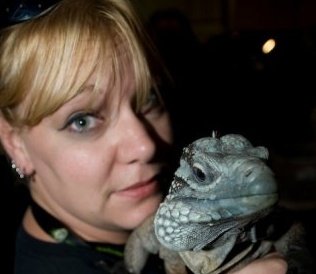 Every reptile keeper is familiar with it: Total incomprehension on the part of non-herpers as to why we keep the pets we do. Every reptile keeper is familiar with it: Total incomprehension on the part of non-herpers as to why we keep the pets we do.While others are off in Washington doing their work fighting this battle on the legislative front, the rest of us have our own battles to fight. I issued a challenge to the members of the reptile community in December to do education in libraries, schools, and public events like pet fairs, but we also need to do one-on-one education about the beauty and wonder of our chosen species. Start by sharing with skeptical members of the public how beautiful you find animals like snakes. Their fluid movements, grace, and beauty enthrall me each and every day I am with them. Their bodies are amazing mechanically; their muscle movements enchant me. We need to help people understand that yes, we have relationships with our snakes. I talk to each one that lives with me, calling then by name even though they never answer back. These are beautiful, low maintenance pets who make me smile each day; what could be wrong with that? My lizards are much more personable. Osama answers to his name and is clearly my favorite. He greets me with a series of headbobs communicating his mood, much like a dog does with his tail. I train my dogs, and I've also trained my lizards. Using treats to reward the behavior I want, I have successfully trained Osama to go where I want him to and remain hands free if I wish. He responds to my voice, not in the same way as my dogs, but in his own way. It's clear he recognizes my voice. He also responds to my touch and often reaches out to be held. No, my reptiles don't follow me around the house like my dogs. They don't share scraps off my plate or cuddle with me on the couch -- but neither does my cat. You may think you shouldn't have to explain to people that your pets are great animals and that you aren't a "freak" for keeping them. You're right; in a perfect world, that would be true. But in case you haven't noticed, this isn't a perfect world, and the more we get average pet-owners to understand that we love, respect and admire our reptile pets, the easier it will be to get them to oppose laws that would take our pets away or irrationally restrict our right to keep them, or to share this wonderful hobby with another generation of herpers. So the next time you tell someone you keep snakes and they say, "Euwww," don't argue with them; educate them. Start today. Photo of me and Osama Binguana, my beloved Grand Cayman Hybrid Iguana. Virginia tables one exotic animal bill til 2013, leaves another active According to a PIJAC Pet Alert released this morning, one of the proposed bills to prohibit ownership of various species of animals in Virginia has been put on hold while the sponsor, Delegate Chris Peace (R), considers a number of changes. HB 1242, as originally written, would have prohibited the possession, sale, transfer, or breeding of certain listed species, subject to some statutory exceptions. Species subject to the proposed ban included: According to a PIJAC Pet Alert released this morning, one of the proposed bills to prohibit ownership of various species of animals in Virginia has been put on hold while the sponsor, Delegate Chris Peace (R), considers a number of changes. HB 1242, as originally written, would have prohibited the possession, sale, transfer, or breeding of certain listed species, subject to some statutory exceptions. Species subject to the proposed ban included:
No further action will occur on HB 1242 this legislative session, but the bill will remain in committee for further consideration during the second year of the session (2013). "PIJAC will continue working with the sponsor concerning objections to this legislation. Please note that Senate Bill 477, which also bans possession of certain species of animals, remains active at this time. The bill is currently in the Senate Committee on Agriculture, Conservation & Natural Resources. PIJAC is working with interested parties on addressing concerns about this legislation as well. PIJAC will publish an updated PetAlert when there is any change in status on either of these bills. For additional information on these bills, or other legislation impacting the keeping, breeding or selling of pets, please feel free to contact PIJAC’s Michael Maddox at 202-452-1525, ext. 106, or via email at michael@pijac.org with questions or concerns. " |
Our Sponsors CategoriesSubscribe |

|

|

|
|

