
Study: Pythons won't survive outside of Florida
By Cindy Steinle · September 25, 2010 9:20 pm
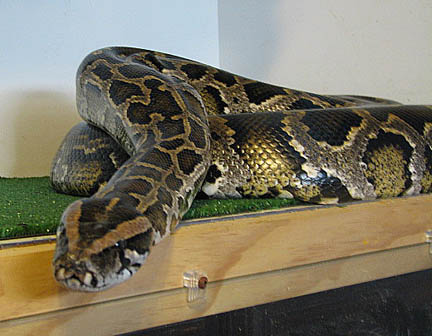 It'll come as a disappointment to the media, no doubt, but it looks like giant Burmese Pythons aren't going to flood out of the Everglades and take over half the United States after all.
The Savannah River Ecology Laboratory (SREL) study is completed, and the findings are clear -- and no surprise at all to those who know anything about Burmese Pythons. From the Aikenstandard.com:
It'll come as a disappointment to the media, no doubt, but it looks like giant Burmese Pythons aren't going to flood out of the Everglades and take over half the United States after all.
The Savannah River Ecology Laboratory (SREL) study is completed, and the findings are clear -- and no surprise at all to those who know anything about Burmese Pythons. From the Aikenstandard.com:
Of the 10 pythons tracked, none survived the winter, all succumbing to one of the most brutal winters on record in South Carolina. "Our results suggest that Burmese pythons from the population currently established in Florida are capable of withstanding conditions substantially cooler that those typically experienced in southern Florida, but may not be able to survive severe winters in regions as temperate as central South Carolina," the researchers reported. [....] Half of the snakes perished on Dec. 11, when temperatures dipped to around 25 degrees. Of those initial deaths, none of the snakes had sought cover or refuge in the artificial dens. Three more snakes died between Dec. 17 and Jan. 4, each having failed to seek cover during subfreezing temperatures. The last two snakes were found in underground cover in mid January during an extreme cold spell.The study initially drew fire from the reptile community because of the provision of artificial dens, food being provided as opposed to the snakes having to fend for themselves, and warmer temperatures caused by run-off from the local power plant. Even with all those factors taken into account, however, the pythons still did not survive the winter. To read the study, click here. Just a warning, the full study will cost $34.00. The abstract, however, is presented in its entirety after the bump.
Understanding potential for range expansion is critical when evaluating the risk posed by invasive species. Burmese pythons (Python molurus bivittatus) are established in southern Florida and pose a significant threat to native ecosystems. Recent studies indicate that climate suitable for the species P. molurus exists throughout much of the southern United States. We examined survivorship, thermal biology, and behavior of Burmese pythons from South Florida in a semi-natural enclosure in South Carolina, where winters are appreciably cooler than in Florida, but within the predicted region of suitable climate. All pythons acclimated to the enclosure, but most died after failing to seek appropriate refugia during sub-freezing weather. The remaining snakes used refugia but died during an unusually cold period in January 2010. Although all snakes died during the study, most survived extended periods at temperatures below those typical of southern Florida and none exhibited obvious signs of disease. Our study represents a first step in evaluating the results of climate matching models and we address factors that may affect range expansion in this invasive species.