mobile - desktop


  |
| mobile - desktop |
|
 |
 Contact Sales! |
News & Events:
|
|
Reptile & Amphibian
News Blog Keep up with news and features of interest to the reptile and amphibian community on the kingsnake.com blog. We cover breaking stories from the mainstream and scientific media, user-submitted photos and videos, and feature articles and photos by Jeff Barringer, Richard Bartlett, and other herpetologists and herpetoculturists.


Monday, August 9 2021The Yellow-blotched Palm Pit Viper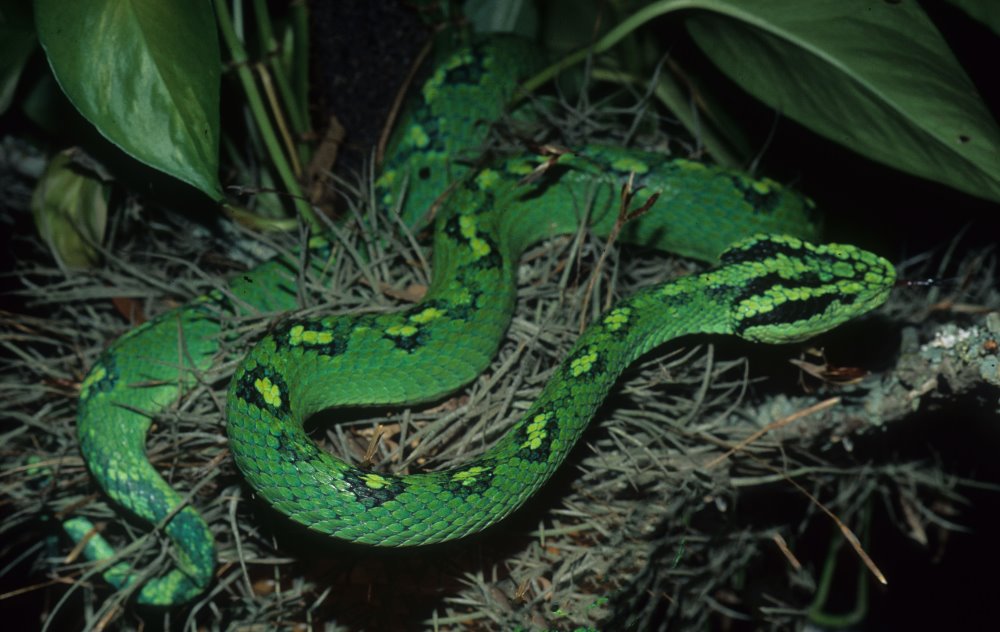 Yellow-blotched Palm Pit Vipers remain comparatively uncommon in collections. This montane, arboreal, venomous beauty, ranges from the state of Chiapas, Mexico to northern Guatemala. Like is congenerics, it is small (to about 30 inches) and slender in build. The tail is strongly prehensile. As with most snakes, both the common and the scientific name may be misleading. Although most examples are leaf-green with prominent black edging around the yellowish dorsal blotches and black facial markings, and some have black-edged green blotches that are nearly the same as the body in color. Others may be uniform green, lacking both dorsal and facial black patterning. Black, variably distinct, irregular vertebral striping may connect the dorsal blotches. If present this marking is often most discernable anteriorly. The belly of adults is usually marginally lighter than the dorsum and neonates are a pale green with the expected dark markings. Captives readily accept mice and it is expected that in the wild the diet may include small rodents, mouse opossums, and, for neonate vipers treefrogs and lizards. The Yellow-blotched Palm Pit Viper, Bothriechis aurifer, considered by biologists to be a “vulnerable species,” is not frequently imported and is currently uncommon in both zoo and private collections. Seemingly little is known, or at least has been published about the venom of this pit viper. I’ll close here by saying that as with any venomous snake, extreme care should be used when handling. Comments
Display comments as
(Linear | Threaded)
The author does not allow comments to this entry
|
Our Sponsors CategoriesSubscribe |

|

|

|
|