mobile - desktop


  |
| mobile - desktop |
|
 |
 Contact Sales! |
News & Events:
|
|
Reptile & Amphibian
News Blog Keep up with news and features of interest to the reptile and amphibian community on the kingsnake.com blog. We cover breaking stories from the mainstream and scientific media, user-submitted photos and videos, and feature articles and photos by Jeff Barringer, Richard Bartlett, and other herpetologists and herpetoculturists.


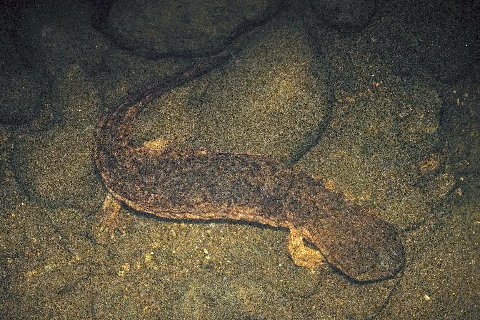
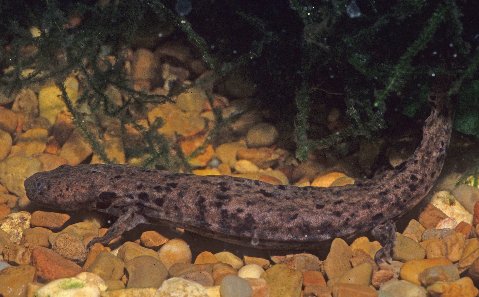
Thursday, April 6 2017Southern Hellbenders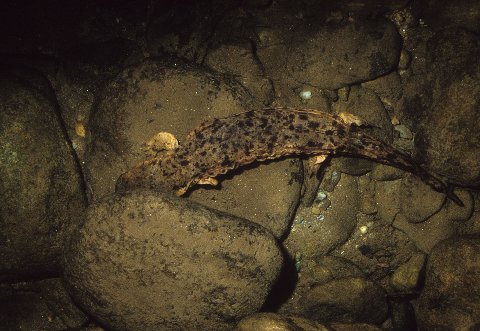 Eastern hellbenders may be strongly patterned or virtually devoid of markings. I was in northeastern Georgia, about a 6 hour drive from home, staring in awe at the natural beauty of my surroundings. Delighted by the solitude and cooled by the knee-deep, clear rushing waters, the beauty of the forest greens, off-whites, and pinks of the stream-edge mountain laurels, and the crispness of the mountain air, all tied to the possibility of seeing North America’s largest salamander, the wonderful hellbender, brought memories of similar scenes far to the north. There were a few partially submerged rocks along streamedge. Beneath some I found southern two-lined salamanders, Eurycea cirrigera. In deeper water, about 6 feet of my starting point—HELLBENDER! Not big, about 15 inches, but a hellbender. The possibility had become a reality. I had checked beneath only a half dozen stream bottom rocks when beneath a flat rock just to the side of a riffle I found the young hellbender, Cryptobranchus a. alleganiensis. Photos were taken. I watched as the little giant slid unhurriedly beneath a riock, and I left, happy. Now on to the rhododendron edged streams of the Carolina Blue Ridges, terrestrial salamander central! Comments
Display comments as
(Linear | Threaded)
The author does not allow comments to this entry
|
Our Sponsors CategoriesSubscribe |

|

|

|
|