mobile - desktop


  |
| mobile - desktop |
|
 |
 Contact Sales! |
News & Events:
|
|
Reptile & Amphibian
News Blog Keep up with news and features of interest to the reptile and amphibian community on the kingsnake.com blog. We cover breaking stories from the mainstream and scientific media, user-submitted photos and videos, and feature articles and photos by Jeff Barringer, Richard Bartlett, and other herpetologists and herpetoculturists.


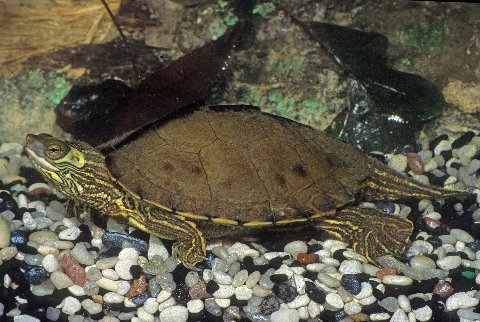
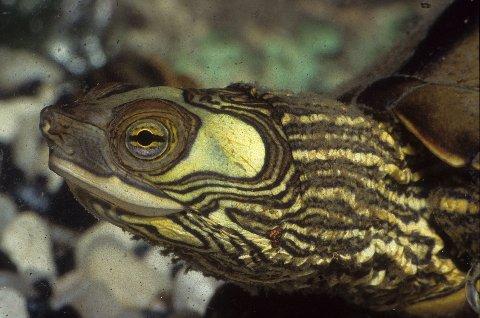
Thursday, February 9 2017Ringed and Pearl River Map Turtles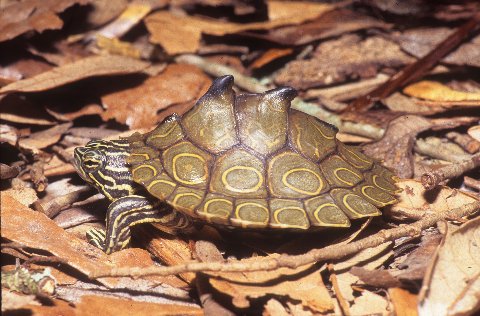 The carapacial markings of the ringed sawback are often obscured by accumulated silt. Typical of many of the jaunts that Jake and I embark on, this trip had morphed from a frog search that would have taken us on a round trip of about 700 miles to a frog AND turtle hunt that now would carry us close to 3500 miles. The Pearl River forms the LA-MS state line in the south and extends far into MS as it meanders northward. It is the home of the beautiful little ringed sawback, Graptemys oculifera, and the marginally larger, broad-headed Pearl River map turtle, Graptemys pearlensis, a species that can be difficult to find. Again, based on temporal blotch shape and genetics, the latter once considered the westernmost population of the Pascagoula map turtle is now a full species. Both taxa range from 3 to 8 1/2” in length; again females are the larger. On our first access to the Pearl (late in the afternoon) we were able to see several ringed sawbacks on a nearby snag and the next day, from a very high and busy bridge, we saw a dozen or so more. It was at this 2nd vantage point that Jake succeeded in finding his “twofer”, finding 2 Pearl River maps among the ringed sawbacks while I, on the opposite end of the bridge, failed. But since I had seen them on an earlier trip, all was not lost. What now? Back eastward and a bit northward to try for 1 species and 1 subspecies that we had missed on our run westward. And off we went. Comments
Display comments as
(Linear | Threaded)
The author does not allow comments to this entry
|
Our Sponsors CategoriesSubscribe |

|

|

|
|