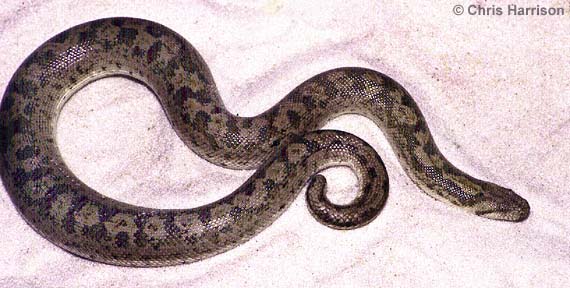
The Desert and Black Sand Boas (Eryx miliaris)
Other images
Other names
Dwarf Sand Boa, Central Asian Sand Boa, Mountain Sand Boa,
Russian Sand Boa (a name also used for E. tataricus),
Turkmen Sand Boa, "Turkish" Sand Boa (sic - these
snakes do not occur in Turkey).
Note that the correct spelling for this specific epiphet is miliaris, not miliarius (as in the Pygmy Rattlesnake Sistrurus miliarius).
Introduction
The Desert Sand Boa (Eryx miliaris) was almost unknown
in captivity in the United States 10 years ago but now is more
common due to recent imports out of Russia and other former
Soviet Republics and are becoming more popular with
herpetoculturalists. Captive reproduction however has been
sporadic, but is on the rise.
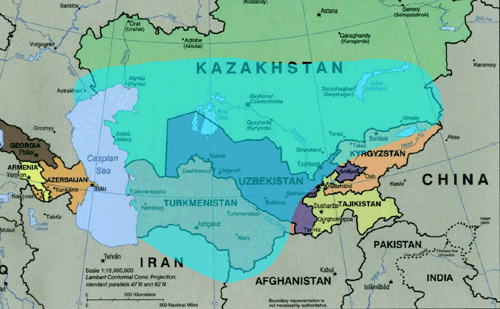
This map shows an approximation of the range of the Desert Sand Boa in blue. This species occurs mainly in the deserts of Central Asia. They occur from the southern part of Russia along the northern shores of the Caspian Sea, east through the Central Asian deserts of Kazakstan and Turkmenistan, south into Iran and east towards the deserts of western China and possibly into Mongolia. Its real range is difficult to delimit because it occurs in countries that have not been heavily traveled by western scientists over the last half century and because it is easily confused with the Tartar Sand Boa (E. tataricus) over a large part of its range.
Desert Sand Boas are one of the smallest boas. Adult females rarely exceed two feet in length and males rarely exceed 18 inches. There are records of miliaris reaching 95 cm. (over 37 inches) but these records are difficult to evaluate considering the frequent confusion with the much larger E. tataricus.
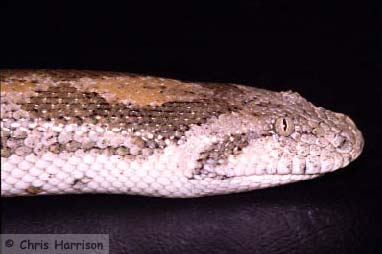
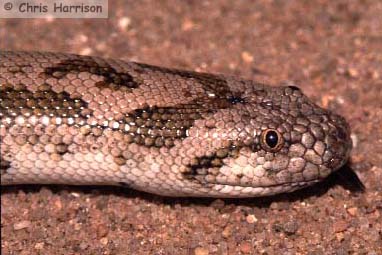
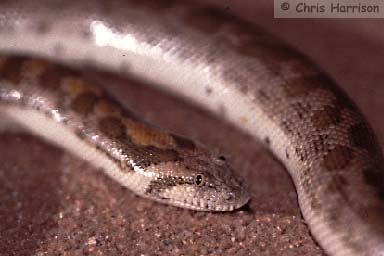
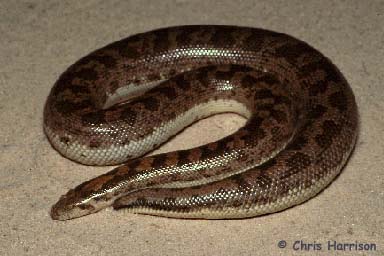
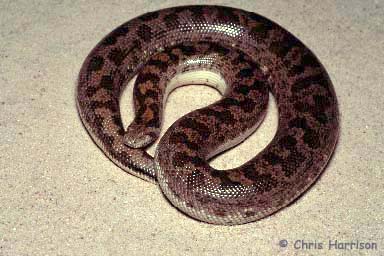
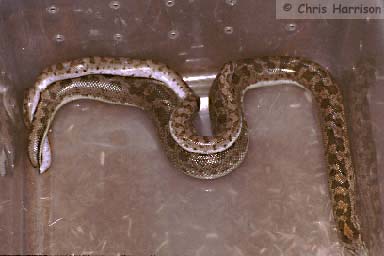
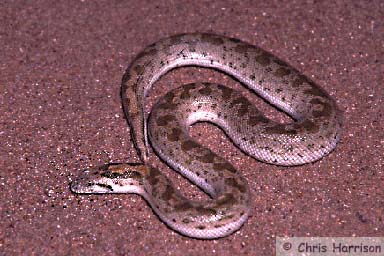
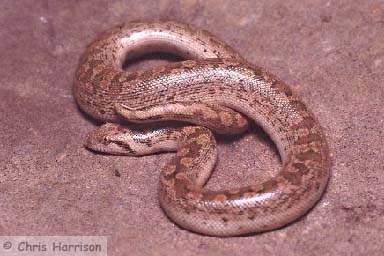
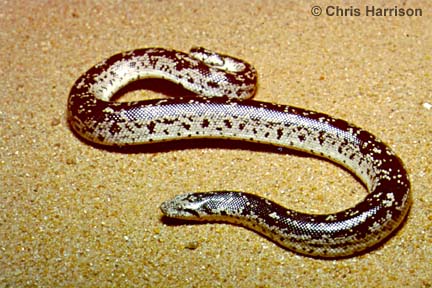
Desert Sand Boas are tremendously variable in color and
pattern. Most are tan with a pattern or darker blotches on the back. These blotches frequently fuse to form stripes down either side of the tail. The blotches can be dark brown, rusty brown, olive green, or even black. There may be some orange blotches along the back between the darker blotches and some animals are quite orange overall.
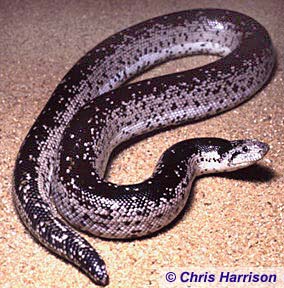
In the northwestern parts of the range (along the northern and
northwestern shores of the Caspian Sea) melanistic individuals
are found that have the pattern partially or completely obscured
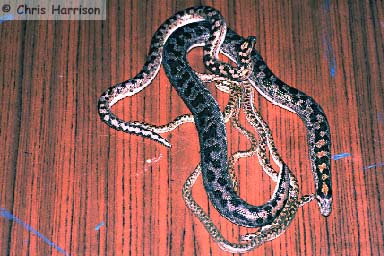
on the back by black pigment. This melanism is only seen in adults. The neonates are normally colored miliaris but as they age they darken. See Bruce Miller's photos of adults and neonates at Bruce Miller's Redding Reptiles Russian Sand Boa Page. These are often referred to as
Black Sand Boas (Eryx nogaiorum) in the pet trade, but are probably just color variants of the Desert Sand Boa. These Black Sand Boas are undoubtedly one of the most attractive members of the genus Eryx. The name nogaiorum refers to the Nogai Steppe of Russia, the area from which they were first collected.
The Black Sand Boa is a problematic taxon. Some people regard it as a valid species while others regard it as a color variant
of E. miliaris. However, the more miliaris you have seen, the more likely you are to draw the latter conclusion. This is in part due to the tremendous variability in pattern seen in E. miliaris. They vary from light tan with darker blotches to
gray with black blotches.
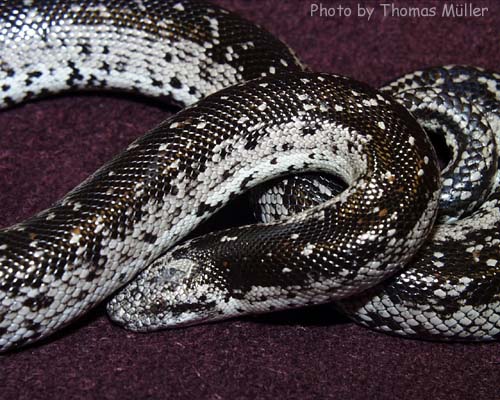
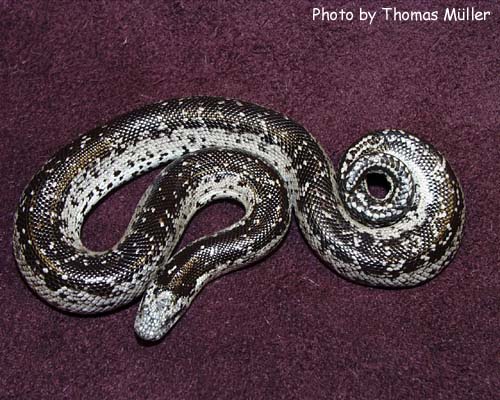
Although most people think of "E. m. nogaiorum"
as a black snake, they are usually gray with a varying amount of
black pigment on their backs. There can also be reddish spots on the back. Even in the earliest descriptions of nogaiorum this variability was noted:
"Dorsal surface sand colored with a median
longitudinal dorsal row of large, quadrangular bright brown spots,
or with two longitudinal dorsal rows of nearly black angular
spots, occasionally joined at angles with the spots on the other
side; some specimens are almost black." (Nikol'skii, 1916)
Thus, although there are some "typical" Black Sand
Boas, many of them are not even black and may be
indistinguishable from the highly variable Desert Sand Boa. Some of the darker intermediates between "typical" miliaris and "typical" nogaiorum are quite unattractive
snakes (such as the snake pictured by Bartlett (1996)), but other
black-backed specimens are among the most startlingly colored
erycines. This variation is yet another of the many problems waiting to be resolved in Sand Boa taxonomy.
For more information and pictures of Black Sand Boas, see Bruce Miller's Redding Reptiles Russian Sand Boa Page.
The Desert Sand Boa in Captivity
Of all the Sand Boas I have kept in captivity, E. miliaris is my favorite. They are small, docile, and consistently easier to feed and house than other species, including species which are much more common in the pet trade! Wild caught adults frequently are imported with significant parasite loads, which must be treated by a qualified veterinarian.
Desert Sand Boas are docile snakes although recent imports may
jerk and strike wildly at first. Sand Boas don't actually strike like a rat snake, rather, they lunge sideways wildly, but with
little accuracy. They rarely do this while being handled. Captive born and raised animals never bite out of fear, but they can be very aggressive feeders and may strike out at anything they think is food (including your hand).
Because of their small size, Desert Sand Boas only require
modest cages. All but the largest adults can be readily housed in
a ten gallon aquarium or plastic sweater box. They should be housed separately outside of the breeding season, because the
larger female may eat all the food that is placed in the cage.
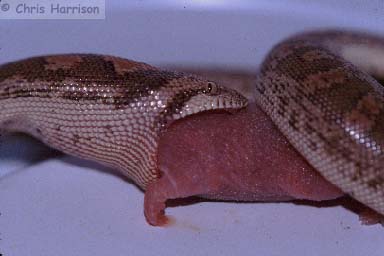
Feeding Desert Sand Boas is rarely a problem. They are very
aggressive feeders even from birth and will usually take appropriately sized prekilled mice without fail. Some wild caught adults may take a while to acclimate to prekilled food, but most miliaris will acclimate to prekilled food. Like other Sand Boas, they prefer food items not much larger than the diameter of their head.
Although newborn babies are very small and fragile looking,
many will eat pinkies right after their first shed. A few are slower to learn that pinkies are edible, but usually catch on
after a couple of weeks. I have had a couple of babies refuse pinkies for several months. One of them I got eating by repeatedly putting a pinkie in her mouth and putting her down.
She spat it out about 10 times, but finally she ate it and never refused a pinkie again. One small male refused food for months, although he actively searched the cage and investigated anything I put in, he didn't recognize mice as edible. I tried several kinds of baby lizards (Anolis, Sceloporus, Eumeces, Scincella, Hemidactylus) but he refused all until I tried a baby Texas Banded Gecko (Coleonyx brevis). He practically snatched that out of my hand. I got him to take pinkies by allowing him to smell a gecko in my hand and then as he chased my hand around the cage I stuck a gecko scented pinkie in front of him and voilà, he never refused a pinkie again. I don't know if this would work with any other Eublepharine gecko (e.g. Leopard Gecko scented pinkies) but it would be worth trying on the reluctant starter.
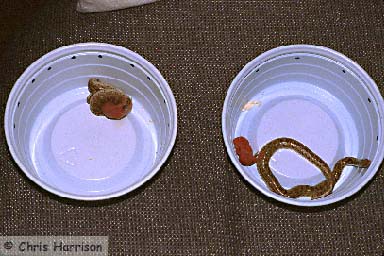
I have also had luck recently by braining pinkies for this species. Most captive born babies I have produced would either take a pinkie right away with no special treatment, or require brained, prekilled pinkies for a couple of weeks. See the feeding page for more information. Once started, Desert Sand Boas are
the most aggressive feeding Eryx I have seen, although adult
males become reluctant to feed in the breeding season.
References
Nikol'skii, A.M. 1916. Fauna of Russia and Adjacent Countries:
Reptiles: Vol II Ophidia. Israel Program for Scientific
Translations, Jerusalem. pp 15-23.
Sorenson, David. Personal communication.
© Chris Harrison
|
Sponsored Link
New & Updated Business Listings
Looking for a reptile or amphibian related business? A reptile store, breeder, importer,
maunfacturer or supplier? Our business directory lists some of the most popluar herp businesses in the world.
| Locate a reptile or amphibian business by name:
|
|
KINGSNAKE.COM
Enjoy all our content free of charge with a user account that gives you full access to every feature.
For added visibility, paid options are available - post in our Classifieds, showcase your business with
Banner Ads or a Directory listing, promote reptile events, and more.
|
Quick Links
|
Community
|
Legal & Safety
|
Support
|
|
|
Kingsnake.com ® is a registered trademark © 1997-
|
|
|